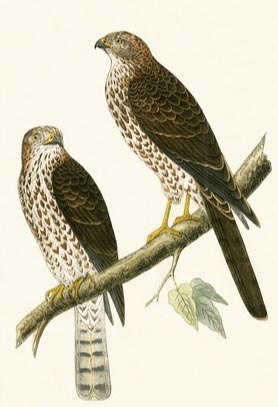
Levantine sparrow hawk
Part 1 of a three-part trilogy by George N. El-Hage
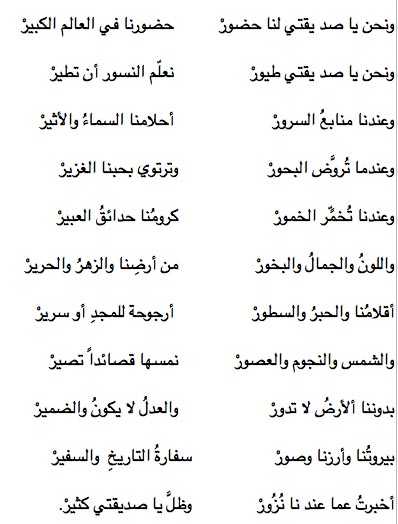
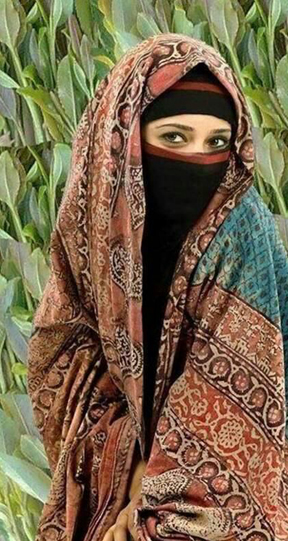
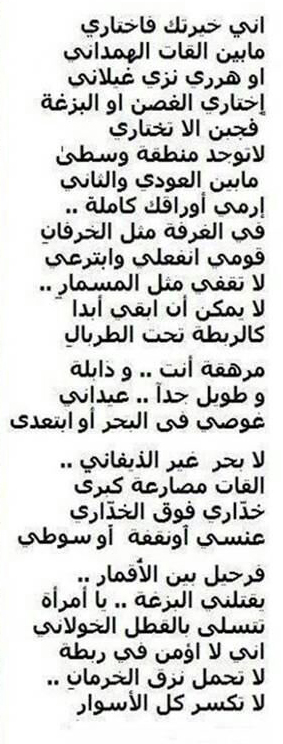
The following Yemeni poem about qat (Catha edulis), accompanied by the photograph above of a Yemeni girl, was provided by a friend.
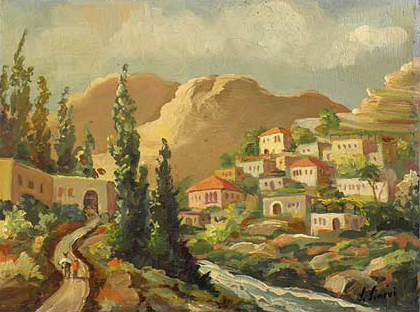
Lebanese village by Saadi Sinevi
by George Nicolas El-Hage, Ph.D.This is part three of a series from my book: The Return of the Hero and the Resurrection of the City, originally written in Arabic and translated by George N. El-Hage and edited by MaryAnn Del Vecchio, Ph.D. For part one, click here. For part two click here.September 1988Monterey, CAThird LetterI plant you in my eyes, a song of virgin longing, and I draw your smile over my sails bound towards the future.I am longing for return, and you are my hope and the eternal truth.Your two hands, my little one, are the cradle of love, and I am but a Sufi drowning in the deluge of meditation.I wear the gown of pain, and my feet are rooted in the glowing clay of creativity.May peace be upon you the day you were born and the day you embraced me and I felt that I held a bouquet of innocence and embraced a flaming sword.Glory be to your miraculous childhood.You are the lamb of peace, the joy of life, the tear of yearning and the hope of resurrection.My letters to you are but the embers of my burning thoughts, for you are the flame of prophecy and the wings of inspiration.You carry me to the world of the unknown and plant me in the fields of lilies and poems.You throw me on the sidewalks of the past and desert me on the shores of faraway islands.There, I metamorphose and transform into tropical plants, exploding with pleasure and burdened with forbidden fruits.I take off the tied gown of civilization and become naught but the flame of truth.I become one with the elements and melt like dew in the eyes of bereaving mothers. Continue reading Letters to My Son, #3
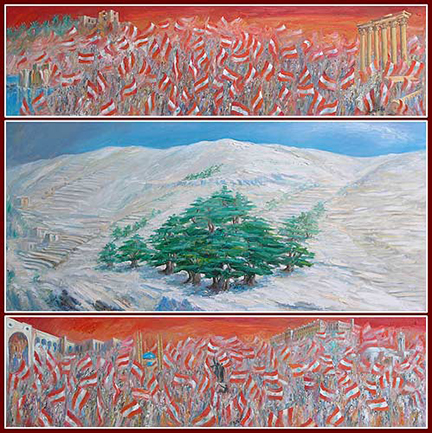
Lebanese triptych by Joseph Matta
by George Nicolas El-Hage, Ph.D.
This is part two of a series from my book: The Return of the Hero and the Resurrection of the City, originally written in Arabic and translated by George N. El-Hage and edited by MaryAnn Del Vecchio, Ph.D. For part one, click here.
July 1988
Monterey, CA
First Letter
In the name of God, I preface my first letter to you, my son. You are the stream of tenderness that flows in my heart and fills my cup. You are my provisions for the coming years and the lantern of my future. You are the most precious possession that I have in this world. You were gifted to me at my most blessed moment of contentment and peace. That day, you were formed in my conscience, a graceful thought, and in your mother’s womb, a clot of blood. That day, I was very conscious of what I was doing. To your mother, I said: “Come, my love, let us create a son, and his name shall be Nicolas.†I knew that the newcomer will be you. An inner feeling and a sense of the mystical awakened inside of me an unmistakable realization of your arrival, my joy, my boy, whose playground is the wide world while you remain ever present with me and within me.
Your wide open eyes are two lakes of emeralds. You are not of flesh and blood. You are the essence of love, the expanse of light, a river of warmth and the glimmer of hope. Let time stand behind us because we existed before time. As for me, you are my whole existence. Your smile permeates the world with joy. Your little hands are the perfumed lilies of the fields and your face the shining sun of light and truth. As you embrace me, time stops, and within me, the glory of the Lord shines bright. I declare to you our eternal relationship: You, me and your mother. Let all others who have populated my books come out. They are naught but a mob of “unnecessary duplicates.†You are not alone. I am with you forever. I give you more soul from mine, more love from my love and more heart from my heart. Your presence overfills my existence and leaves no space for any other. You, alone, are my preoccupation, and at your feet, time stops. You are ever-present in my memory. You are my fruit, my roots and my future. You are my glorious history. Continue reading Letters to My Son, #2
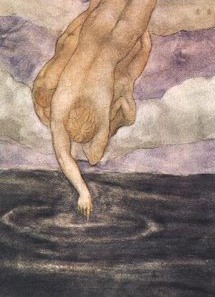
Art by Khalil Gibran
by George Nicolas El-Hage, Ph.D.
From my book: The Return of the Hero and the Resurrection of the City, originally written in Arabic and translated by George N. El-Hage and edited by MaryAnn Del Vecchio, Ph.D.
Forward
These four letters, selected out of ten, are in fact a personal account of my feelings as a father, an immigrant, and a poet, towards my son. They are an emotional register of the dilemma of alienation, exile and loneliness that faces every immigrant, Lebanese or not, who, for various circumstances, leaves his or her country and emigrates abroad. I happen to be a Lebanese man who traveled to America during the Lebanese war to continue my education and make a future for me, my parents and my siblings. Like many cultures, being the eldest son in a Lebanese family carries a huge responsibility that falls on your shoulders and becomes your cause.
America, as it was known, was “the land of endless opportunities, the generous and welcoming land, where money grows on trees,†and “attaining the American Dream was only a measure of your determination, perseverance and hard work.†Indeed, this is the land where endless possibilities abound and the reality of forging a better life has, and still does, lure people from around the world. In fact, may God bless America.
It was not an easy task to write these letters to my son and to put my innermost feelings out there in the open. But as a poet, it is my mission to share because poetry is the art of the unusual encounter with the inevitable and the holy, and the poet’s mission is to always take the road rarely traveled and to return and inform fellow beings. Continue reading Letters to My Son, #1
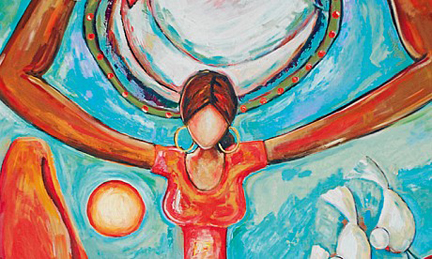
Artwork by Lebanese artist Fady Habib
By George N. El-Hage. Ph.D.
[Originally written in Arabic and Translated by Allen Lederman and George Nicolas El-Hage. For part 1, click here.]
1 – Glory be to Lebanon and the strength and dignity of man in her, now and forever.
2 – Oh my Lebanese friend, if only you could witness the politicians, and by God they are many. Those who deprived politics of its national obligations, you will see them as they are, without their chameleon skins, parrot tongues, and raven cloaks. If only you saw them in the mirror of truth and patriotism, you would curse them and refuse their sedition.
3 – Because Lebanon embodies love, and love embodies God, Lebanon endures. Fear not, oh Lebanese.
4 – No. The sound of the cannons and the explosions of the bombs and bullets no longer frighten our women. For the Woman who reared history’s greatest heroes is able to beget heroism any time.
5 – Those who died in the cause of Lebanon know they live in our hearts and that to die for Lebanon, is to live.
6 – Never have invaders and oppressors been more powerful than a people fighting for its survival. Thus we know we will triumph and endure.
7 – Those who sold their homeland and bartered their cause do not even deserve the curse of history, for he who has neither country nor cause, is non-existent.
8 – Those whom Lebanon harbored and fed, and carried their cause to the world, chased her people out, starved and killed them. We will continue to love them, for what good is it to love only those who love you. Continue reading Lebanese Hymns of Love and War- Part 2
[This is the second in a series of poems translated from the Arabic of George Nicolas El-Hage’s If You Were Mine. For the first installment, and information about the poet, click here.]
Exile
My unbelief and sins and faith
And black cares watch over me
September and March come
And I am in my room, collapsing
A nightmare wears my sorrows …
It comes to me also, comes to me
News, my dark one, threw me
Into your eyes’ hollow it threw me …
Other years I wait
December and January …
The room swells in my breast
I die slowly …
The room swells in my breast
I live through seasons, unaware,
That exile is my country.
Continue reading George Nicolas El-Hage: If you were mine, 2
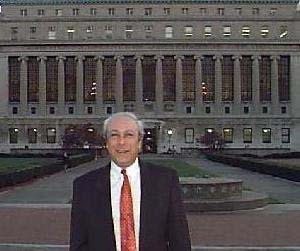
Poems by George Nicolas El-Hage
Translated from the original Arabic by Diana Malouf and George El-Hage
Introduction by Khalil Semaan, Binghamton University.
George Nicolas El-Hage was born in Mansourieh, near Beirut, Lebanon. He was educated at the Lebanese University of Beirut and in the United States where he earned an M.A and a Ph.D. in Arabic and Comparative Literature at Binghamton University in N.Y. His Dissertation (later published into a book by NDU Press, Lebanon) was on William Blake and Kahlil Gibran: Poets of Prophetic Vision. He has taught at Yale University, Binghamton University, The Lebanese University, Columbia University, Monterey Institute of International Studies and the Defense Language Institute. His academic career was equally spent between teaching, authoring, lecturing and administration.
He published five volumes of poetry, numerous research articles, books on language pedagogy and poetry in Lebanese Dialect and Zajal. While in Beirut, El-Hage studied with and was influenced by poets like Buland al-Haidari and Khalil Hawi. His poetry betrays a marked fluctuation between a deep romantic sensitivity and a tragic existential awareness which colors his reading of current universal and regional events. The tragedy of his embattled country constitutes a dominant theme in his writings. El-Hage is a supporter of the free verse movement in Modern Arabic Poetry. Nevertheless, he still appreciates the Qasida ‘Amudiyya, the classical form of traditional Arabic Poetry. He always chooses short meters and his poetry is characterized by its musical effects.
From El-Hage’s book of poetry: If You Were Mine
From the INTRODUCTION
No, I shall not tell you that I became a poet. The day I read joy and sadness in your smile and witnessed the sun rising in your eyes, I abandoned my heart, crucified on the ivory ramparts of your face, and setting sail, I strove to navigate the deep waters of inspiration. That day, I discovered my inner self in the mirror of your pure love, and I vowed to tell you this in words. These are some of them. Continue reading George Nicolas El-Hage: If you were mine, 1