Category Archives: Poetry

Ibn al-Farid’s “Khamriyya” – or “Ode on Wine”


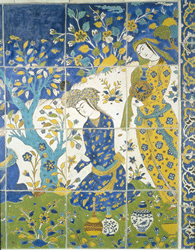
[Illustration: Tile panel with picnic scene (detail), Iran (Safavid), Isfahan, 17th century, fritware with colored glazes, Victoria and Albert Museum, London]

Ibn al-Farid’s “Khamriyya” – or “Ode on Wine”
A critical introduction, translation and analysis.

by George Nicolas El-Hage, P.h.D. Columbia University

Sufism has been defined as both “the apprehension of divine realities and as a universal message of love, brotherhood, and unity of man.” (1) Although R.A. Nicholson writes that Sufism is at once “the religious philosophy and the popular religion of Islam” (2), nevertheless it must not be understood that Sufism is a type of organized or conventional religion. It is not a religion, nor does it claim to create another sect, but it attempts to eliminate hatred and conflicts and to gather people in brotherhood. In his book, Sufism: Message of Brotherhood, Harmony, and Hope, Nasrolla S. Fatemi says that the elements common to Judaism, Buddhism, Christianity, and Islam can best be appreciated in Sufism. To the Sufi, only the moment of ecstasy can cleanse the soul of all its earthly concerns and elevate it to a joyful reunion with its creator. The soul, anxious to partake in divine love, will become ready to behold the truth and embrace the light and the beauty. Continue reading Ibn al-Farid’s “Khamriyya” – or “Ode on Wine”

The Wind and the Whirlwind


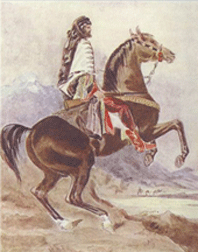
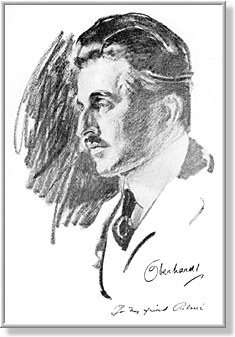
Wilfrid Scawen Blunt on Pharaoh, drawn by Lady Anne Blunt

[Note: The following poem was written by Blunt in response to the British occupation of Egypt in the late 19th century, but its words are apt for the present occupation of Iraq and Afghanistan today.]

by Wilfrid Scawen Blunt

I have a thing to say. But how to say it?
I have a cause to plead. But to what ears?
How shall I move a world by lamentation,
A world which heeded not a Nation’s tears?

How shall I speak of justice to the aggressors,
Of right to Kings whose rights include all wrong,
Of truth to Statecraft, true but in deceiving,
Of peace to Prelates, pity to the Strong?

Where shall I find a hearing? In high places?
The voice of havock drowns the voice of good.
On the throne’s steps? The elders of the nation
Rise in their ranks and call aloud for blood. Continue reading The Wind and the Whirlwind

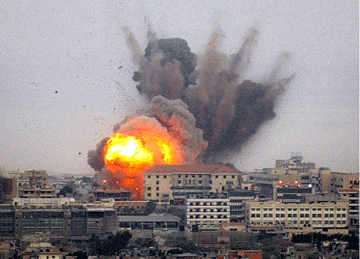
You, Beirut and the Children


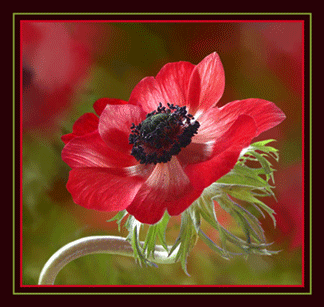
Illustration: “Red Anemone,” by Diana Cornelissen

By George N. El-Hage
Columbia University

As the leaves of October,
I scatter myself over your blazing inferno;
Your divine and succulent body
From its forbidden summits
Down to its ravenous depth and fertile valleys.

As a summer cloud bearing spring,
I shower gentle kisses upon your flushed lips
Whose color gives the rose its crimson
Whose benevolent banks are a bed of red anemones. Continue reading You, Beirut and the Children

The Gates of Gaza


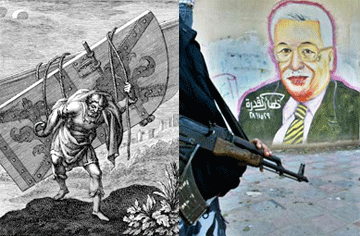
Illustration: left: “Samson carries gates” by Johann Christoph Weigel, 1695; right, Large mural of Palestinian presidential candidate Mahmoud Abbas in Gaza city, December 26, 2004, Reuters

The fragile and it seems futile political engagement of Fatah and Hamas has run into a veritable brick wall in Gaza, not surprising given all the mud slinging that has been going on. Hamas supporters have stormed what they see as the Bastille of President Mahmoud Abbas and in biblical terms carried away the gates. In reading the news reports today and looking at the pictures, especially the Hamas fighters gloating in Abbas’s former presidential office, it is as the baseball sage said “déjà vu all over again.” With fighting still continuing in Palestinian refugee camps in Lebanon, the agony of Palestinian suffering endures. Of course, this is not the first time that havoc has raged in Gaza. Since so little is held sacred in the “Holy Land,’ we might as well raid scripture and summon up an ancient moral tale that ended with a blind man’s suicide in which the temple walls came tumbling down. Today it is obvious there is no Samson in the heroic sense, and recent events confirm that the the blind still lead the blind, while much of the rest of the world simply turns a blind eye. In such times perhaps the only antidote to unstoppable tears is poetry… Continue reading The Gates of Gaza

The Dervish Dishes it Out

Some messages are timeless. This poem of Rumi, though at least seven centuries old, still resonates no matter how sanitized the morality of the day.

Dervish at the Door

A dervish knocked at a house
to ask for a piece of dry bread,
or moist, it didn’t matter.

‘This is not a bakery,’ said the owner.

‘Might you have a bit of gristle then?’

‘Does this like like a butchershop?’

‘A little flour?’

‘Do you hear a grinding stone?’ Continue reading The Dervish Dishes it Out

Lebanese Hymns of Love and War

By George N. El-Hage

1-
Thirty years of prosperity, patriotism, harmony and florescence, ruined in one year, it is true that destroying is easier than building, but it is also true that a year in which the masks fell and the buffoons stepped from their disguises into the shadows, was more real to them and to us than the thirty years they masked themselves in falsehood, hypocrisy and exploitation.

2 –
There were those who sold Lebanon and lost their families, their children and their villages. Then the strangers spit in their faces and cursed them. Their shekels were plundered, the price of treason. Do not ask those of their honor and patriotism. How can they give you what they do not possess?

3 –
The youth of Lebanon who abandoned their books and embraced rifles, know that they will triumph, because those who know how to live life, know how to live death and resurrection. Continue reading Lebanese Hymns of Love and War

Selections from al-Rihaniyyat

by Ameen al-Rihani (1876-1940)

1 – Oh Freedom: When would you direct your face towards the East? When would your light merge with the light of this bright moon so it would rotate with it around the earth and enlighten the darkness of every oppressed people?

2 – When would the religious chasms be obliterated and sectarianism be trampled under the boots of civilization? When would we form the organization of tolerance and build the church of forebearance?. When would we raise and establish the school and journal of tolerance?

3 – I am the flower that bloomed out of the despair of the Prophets. A flower that flourished and then withered and finally its buds were scattered until the seeds of life gushed out of her heart and the winds carried it to the four corners of the earth. Continue reading Selections from al-Rihaniyyat