Category Archives: Poetry

Lebanon is Laid Waste

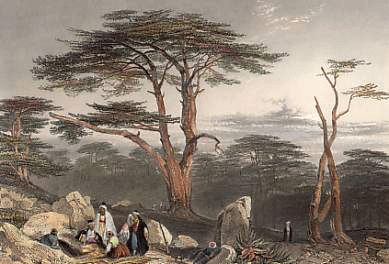
[The Cedars of Lebanon, steel engraving by J. D. Harding after C. Barry, 1835]

Lebanon is laid waste.
I need no bible-toting prophet to remind me
that someone’s long silent God gave the order
to saw through the last cedars.

The litany of woes crosses the Litani
but no bridge is left behind to burn,
just the kindling of ersatz-born leaflets that first say “Flee”
then demand “Stop,”
but really mean “Do not breathe, we own the air.” Continue reading Lebanon is Laid Waste

The Letters of Badr Shakir al-Sayyab: #4

[Note: This is the fourth in a series of translations of selected letters of the noted Iraqi poet Badr Shakir al-Sayyab.]

Letter #4 (3/25/1954)
The Directorate of Imported Funds, Baghdad, Iraq

My Kind and Respected Brother, Dr. (Suheil) Idres,

Sweet greetings to you.

The kind letter that you sent me has had a deep effect on my soul. It bears witness anew to the nobility of your spirit, the vastness of your heart, and the sincerity of the pledge that you have assumed in the service of the Arab community and its literature which is advancing towards the light. I have made an elite group of friends, writers, and lovers of literature aware of your letter so they are informed of the biased uproar that a group of “preachers” have attempted to create.

It appears that Divine Justice has wished numerous, simultaneous events to occur so that the truth could become evident. Your letter to me and to our brother, Kathim (Jawad), arrived at the same time that the magazine, al-Adeeb, came out displaying a photograph of the “Preacher of Modern Poetry.” “The preacher” had dedicated the photograph to “the great poet, Albert Adeeb!!” This appeared along with a discussion on the great international poets such as Nathem Hikmat, Pablo Neruda and Aragone!! Is there more falsehood than this? Continue reading The Letters of Badr Shakir al-Sayyab: #4

The Letters of Badr Shakir al-Sayyab: #3


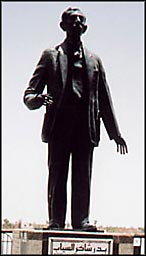
[Statue of Badr Shakir al-Sayyab in Basra, Iraq.]

[Note: This is the third in a series of translations of selected letters of the noted Iraqi poet Badr Shakir al-Sayyab. Click here for #1 and click here for #2.]

Letter #3 (5/7/1947)

My Dear Brother, Saleh, (Jawad al-Tu’mah)

As I write to you, I am suffering from the most difficult and severe physical condition, but I feel that loneliness weighs more heavily on me than illness itself. I have waited a very long time for the arrival of a letter from you. You said that you would begin writing… but I forgive you because I can surmise why you have forgotten or have become oblivious to the fact that there is a lonely person out there whose sorrows would be alleviated by your letter. It is spring, and not only flowers blossom in spring, but hearts and souls as well. Perhaps the decadent spring has stretched its tender fingers to your heart, tickling it and awakening it to love or perhaps the approach of final examinations has distracted you from everything except studying and being diligent. Continue reading The Letters of Badr Shakir al-Sayyab: #3

At a Tomb in Abydos

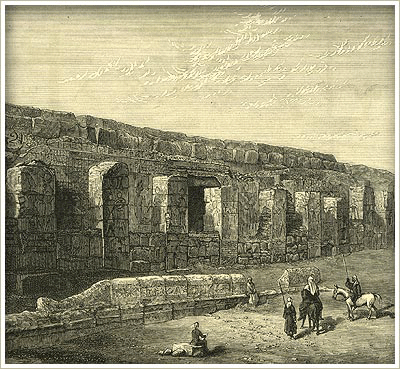
Temple at Abydos

by Augustus Wight Bomberger

How little hath life changed, O ancient King!
This fan so delicate and bracelet rare,
These dainty, jeweled trinkets for the hair,
Were thine own gifts, I know, and thine this ring.
And Bener-Ab, thy daughter, “Sweet of Heart,”
Who wore them once, was precious of a truth
And dear to thee in all her winsome youth,
Unspotted from the world, unspoiled of art:
So dear that thou at times didst reckon less
Thy royal sceptre than her soft caress;
Yet for that cause wert all the more a king,
Five thousand years ago when thou didst reign
In great Abydos — city of the plain.
And now — ah me, how close these symbols bring
Thy soul to mine across the vast of years – Continue reading At a Tomb in Abydos

The Letters of Bakr Shakir al-Sayyab:#2


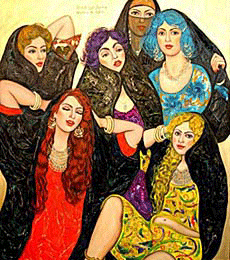
[Art by Wasima al-Agha, Iraq’s Fine Arts Gallery.]

[Note: This is the second in a series of translations of selected letters of the noted Iraqi poet Badr Shakir al-Sayyab.]

Letter #2
Abu al-Khaseeb: 4/ 20/1946

My Beloved Brother, Khalid (al-Shawwaaf),

A grim and suffocating event has made me hate writing letters even to those dearest and closest to me. No doubt, you remember the encounter…my encounter… with my first love; you recall what she said to me…. “Bring me all the poetry you write…by way of Miss …..”

I have completed the poem, “The Song of Encounter,” which reached a hundred and nineteen lines in length. I proceeded to copy it into a small and elegant notebook which I devoted two long days to do in order to also decorate and beautify it, and I sent it to Miss….imploring her to deliver it to my ladylove and to hurry back and inform me of the effect that my poem has left on her soul. Continue reading The Letters of Bakr Shakir al-Sayyab:#2

Letters of Badr Shakir al-Sayyab


The Iraqi Poet Badr Shakir al-Sayyab

Introduction to the Translation of the “Letters of Badr Shakir al-Sayyab”

By George Nicolas El-Hage, Ph.D.

Throughout the better part of his brief life (1926-1964) Badr Shakir al-Sayyab was haunted with the idea of death, the afterlife, mortality and immortality. At the end of his earthly journey, Badr made peace with himself, and thereby reconciled the two seemingly contradictory aspects of “Life” and “Death.” He conquered death by humanizing it, mastering his fear of it, and by surrendering to his fate as the ultimate rest for an ailing and constantly deteriorating body. Although never an existentialist, Sayyab, at one point, entertained the idea of embracing “Existentialism,” surmising that it might have the philosophical answer to his existential problem: how far and how high will he be able to carry the rock of Sisyphus? How long will his battle with destiny last and who will prevail? Sayyab was immensely in love with life, yet his poetry and personal letters ironically convey a different message and are colored with the dark clouds of dejection, frustration, loneliness, exile and poverty.

Sayyab played a prominent role in shaping the course of modern Arabic poetry and literature. The tragic journey of this poetic genius was marked with constant tragedies that punctuated his life with one disaster after another: the death of his grandmother, the tragic loss of his loving mother whose passing left a permanent scar on his soul, the stormy relationship with his father and insensitive stepmother, his intense political struggle against the Iraqi regime, persecution and repeated imprisonment and exile, job uncertainty and insecurity, extreme poverty, unhappy marriage and the burden of family obligations, and ultimately his ailing health and deteriorating physical condition that left him paralyzed from the waist down. All these catastrophic events that inflicted his frail body with severe and constant pain were unable to break his spirit, restrain his will or dampen his inspiration. He continued to write magnificent poetry that portrayed both his physical and psychological suffering. Even when he was on his death bed oscillating between moments of unconsciousness, hallucinations and lapses of memory, his imagination remained ablaze and alert, and his inspiration alive and focused. In the last few years before his tragic death, Sayyab renounced his political activities and turned from “committed” poetry to “personal” poetry that became more permeated with self eulogy and focused on his heroic struggle with destiny and man’s place in the universe. Continue reading Letters of Badr Shakir al-Sayyab

Letter to a Country with No Frontier

by George El-Hage

[Note: This is a translation from the Arabic, which is available in pdf by clicking here.]

Stand up! Get up!

Carry your bed and follow me.

Let’s leave this ungrateful land

This land…

That savors the decaying cadavers of its sons

A land satiated by the blood of its children.

Let’s leave these poor people

Defeated, fragmented

Knowing nothing but selfishness,

Servicing foreigners,

And worshipping the hollow love of prestige. Continue reading Letter to a Country with No Frontier

Eden is Lost

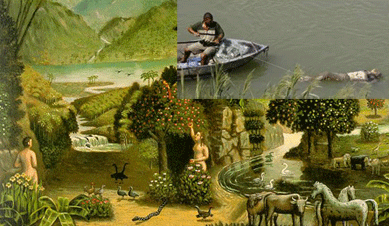
Today’s BBC has a report about the daily toll of mutilated bodies dumped into the Tigris River in Iraq and found in nets down river. Once a symbol of a river of paradise, the Tigris might as well be fed these days by a burning lake of fire. There are times when perhaps the best way to respond is in poetry.

A river rises in Eden to water the garden; beyond there it divides and becomes four branches. The name of the first is the Pishon; it is the one that winds through the whole land of Havilah, where there is gold. The gold of that land is excellent; bdellium and lapis lazuli are also there. The name of the second river is the Gihon; it is the one that winds all through the land of Cush. The name of the third river is the Tigris; it is the one that flows east of Asshur. The fourth river is the Euphrates. The LORD God then took the man and settled him in the garden of Eden, to cultivate and care for it. (Genesis 2:10-15)

Eden is lost
yet again.
The weeds of war have choked the marshes
where the water god once spoke of life.
Nothing rises in Eden today
but the dust of a hate I can not measure.
God’s good well is dry
and the fields lie parched,
savaged by unwanted salt and more lies. Continue reading Eden is Lost