Category Archives: Anthropology/Sociology

“It sure would be nice to have a drone up there”

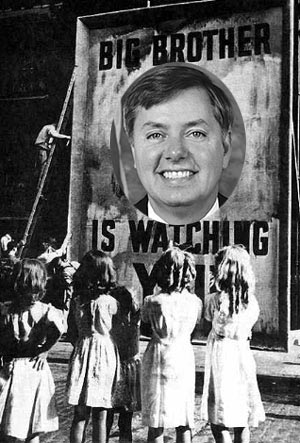
If George Orwell had lived to see how 1984 plays out in 2013, he would no doubt shake his head, marveling at how a novel he wrote in 1949 could come so close to reality. Senator Lindsay Graham, a South Carolina Republican (who may not gulp down Tea Party rhetoric but surely likes to sip some of its poison), was interviewed yesterday in the Washington Post before the second suspect in the Boston Marathon bombing was caught. His intent, as reported in the article, seemed more to downgrade the libertarian Rand Paul than to offer any kind of constructive comment on the unfolding tragedy of the bombing.

In his senate filibuster, Senator Paul had argued that America is not a battlefield, so Graham used his senatorial perch to argue “It’s a battlefield because the terrorists think it is.” Really? When exactly did a terrorist act, not an attack from another country or an armed insurrection from within, define what a “battlefield” is? Yorktown was a battlefield in 1781; Gettysburg in 1863; Normandy in 1944. If the sadistic setting of bombs targeted at civilians proves that America is a battlefield, then what about Waco in 1993 or Oklahoma City in 1995 or even the hijackings that led to the destruction of the Twin Towers in 2001? When a battle is fought in war there are battlefields stained with the blood of combatants and often civilians as well; when a terrorist detonates a bomb it is a criminal act no less than when a disturbed 20-year old walks into an elementary school in Newtown, Connecticut and shoots 20 children and 6 adults, after having killed his own mother. If every act of violence defines a battlefield, there can be no peace anywhere. Continue reading “It sure would be nice to have a drone up there”
What is Terrorism?


by Laura Beth Nielsen, Al Jazeera Opinion, April 17, 2013

The Boston Marathon bombing once again has Americans asking, “Is this terrorism?” And more broadly, “What is terrorism?”

We asked ourselves those questions the moment we heard the news. Our news anchors asked for the next 24 hours (though they were clear to say at first that they did not know if it was terrorism). President Obama – thankfully – was careful not to use the word in his first press conference on the day of the bombings. But later on the following day – on Tuesday – Obama said, “Any time bombs are used to target civilians, it is an act of terrorism.”

What does it mean when we say something is “terrorism” and why does it matter?

As a professor of Sociology and Law, I study how ordinary people understand the law and how the law itself, including law’s categories and terms affect how people understand the world around them.

Using terms like “terrorism” shapes what ordinary people expect of the police, the justice system and our government. It affects what kind of punishment we want and the level of fear we feel about what is going on around us.

But what is terrorism? The most obvious definition is that terrorism is a crime meant to terrorise. We know what these kinds of crimes are: they are the kind that make us afraid to send our children to school, like Columbine; make us afraid to go to work, like 9/11; or make us afraid even just to spend beautiful spring day competing with our friends competing in a footrace. Continue reading What is Terrorism?

Whose body is it anyway?

Last Thursday was dubbed “Topless Jihad Day,” a call by the feminist group FEMEN for women to protest in support of a Tunisian woman who posted photographs of herself topless (with remarks on her body that many would consider tasteless) on her Facebook site and soon received condemnation and calls for punishment. The result was hardly an outpouring of indigenous support like the “Arab Spring” that flooded the main squares of Tunis, Cairo and Sanaa. The FEMEN website has posted images of women baring their breasts in Rio de Janeiro, San Francisco, Montreal, Paris, Milan, Kiev, Brussels, Berlin and a few other major cities. Two things stand out about this day of protest. First, it takes place only in cosmopolitan Western cities, not in Muslim-majority countries. Second, several of the scenes focus on the protesting women being arrested for breaking the law. The patriarchy that is being protested is not, therefore, only an issue about Islam.

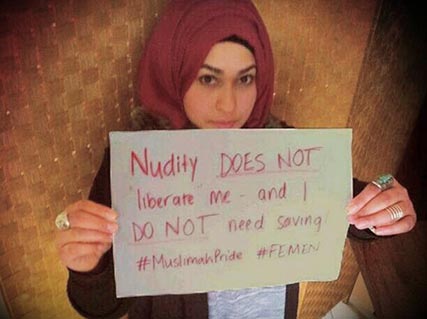
There is a basic principle of physics that every action results in a reaction. The moral code that would cause a Tunisian cleric to condemn a young Tunisian woman for exposing her breast on Facebook causes a protest from an international feminist organization. And, not surprisingly, there is a counter to this from a “Muslimah Pride” network. As the young woman in the image above indicates, she does not feel liberated by exposing her body. But perhaps even more poignant is her comment that she does not need saving. It is not clear if this Muslim woman is condemning the Tunisian woman at the center of the current protest, but she is definitely making a statement about her own body. Whose body is it anyway?

FEMEN has attracted followers for a variety of reasons. I suspect that some testosterone-loaded males in the West cheer wildly whenever a woman shows her bare breasts. These hardly support the stated goal of FEMEN: “sextremism serving to protect women’s rights, democracy watchdogs attacking patriarchy, in all its forms: the dictatorship, the church, the sex industry.” Historically there is no question that women have not had equal rights with men in economic, political or legal contexts; this is true for almost all cultures, ranging from those with despicable patriarchal rules to democracies with permanent glass ceilings. Secularism has challenged many (but not all) of these inequalities, giving women the right to own property, vote, and theoretically have equal opportunities in education and the workplace. Appeals to women’s rights resonate with most people, whether secular or religious, but the devil is in the details.

There is also an elephant in the room, in everyone’s room: who decides what women’s rights are? Continue reading Whose body is it anyway?

Sanaa Book Republished

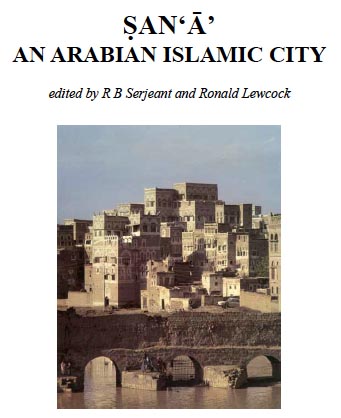
One of the most important volumes for anyone interested in Yemen is San’a’ An Arabian Islamic City, edited by R. B. Serjeant and R. Lewcock for the World of Islam Festival Trust in 1983. Long out-of-print, it is now being brought back into print. And there is a discount, if ordered before April 30, 2013.

The published price is £85.00 but the book is being offered at a pre-publication price of £50.00 until 30th of April 2013, quote SP13 to receive this offer.

For details, contact:

Vicki Coombs
Melisende UK Ltd
G8 Allen House
The Maltings, Station Road
Sawbridgeworth
Herts. CM21 9JX
+44 (0)1279 721398
www.melisende.com

Keeping track of camels


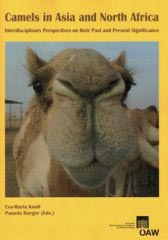
In 2010 I had the privilege of participating in an international conference in Vienna on camels (not on camelback, of course). A book from this conference has now appeared. This is: Eva-Maria KNOLL – Pamela BURGER, editors, Camels in Asia and North Africa. Interdisciplinary Perspectives on their Past and Present Significance. 2012, 290 p., with 26 articles, 33 graphs/maps, 111 pictures, and an index. My article is on what camels eat, for which I have created a website.

Here is how the editors describe the book:

Humanity’s history is closely linked to those of camels. Without these remarkable animals we could not have inhabited the arid zones of Asia and North Africa, nor could we cope with today’s challenges of increasing desertification. Researching interactions between humans and camels therefore has been established at the Austrian Academy of Sciences ever since its foundation more than 160 years ago. The present publication is committed to this research tradition. This book assembles insights upon current and historical interactions between humans and camels. Thereby it is international and interdisciplinary from the outset and aims at intensifying a camel-related knowledge exchange between the natural sciences and the humanities. The here presented discussions of Old World camels (dromedary, Bactrian, wild camel) include such diverse topics as camel origin, domestication, breeding, raising and commerce. Moreover, camels’ significance is also discussed regarding socio-cultural and economic factors, music, folk medicine and veterinary medicine, as well as saving the last remaining wild camels. With an afterword by Richard W. Bulliet (New York), one of the world’s leading authorities on the camels’ history.

The high social price of humanitarian dissimulation


By Estella Carpi

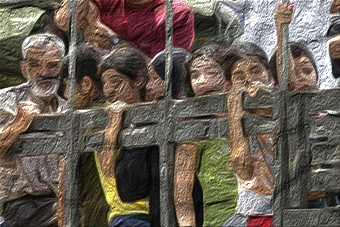
A few months ago, while conducting my PhD fieldwork in North Lebanon, I shared my ideas on the current humanitarian assistance to Syrian refugees with a journalist working in Lebanon. I reported that I was told by some Lebanese from Halba that their neighbors threw stones at humanitarian workers during the food kits’ distribution for Syrian refugees in a little town in ‘Akkar (North Lebanon). Apparently it was just an outburst of tension because of the sudden massive presence of humanitarian organizations in loco. In the past they have always neglected this area in Lebanon due to lack of political interests, since the Israeli occupation and the consequent local impoverishment were primarily vexing the south of the country (1978-2000).

The humanitarian agency that the journalist was working for at that time first decided to omit such information before publishing the article. After that, in order not to be accused of censorship, with a cringe-worthy diplomatic move, they published it by elegantly modifying the content of the stones episode, and contending that local people in North Lebanon would definitely warm up if aid were provided to them too. This is a human dynamic that, unfortunately, I had never got the insight of in the field. The humanitarian agency at issue declared that this “information amendment” was carried out in a bid not to generate further frictions between the Lebanese and the Syrian communities. My “Wikileaks philosophy” pushes me instead to broach out the subject overtly and try to analyze it. Continue reading The high social price of humanitarian dissimulation

Karim Ben Khelifa: “The World is Changing, Change With It”


Karim Ben Khelifa

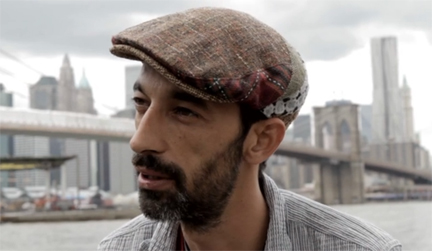
Photojournalist Karim Ben Khelifa is interviewed about his work in war zones with a collage of his photographs on Vimeo. This is a short video; check it out for an excellent insight into the art of photojournalism in the Arab Spring and other conflict contexts. For his website of older galleries, click here. For his Twitter account, click here. Karim has also found a new online photojournalism site called Emphasis.is.


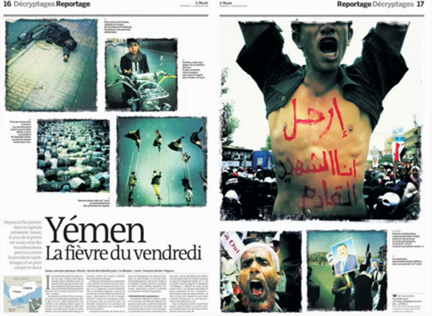
Karim’s work in Le Monde

Continue reading Karim Ben Khelifa: “The World is Changing, Change With It”

USAID in Yemen


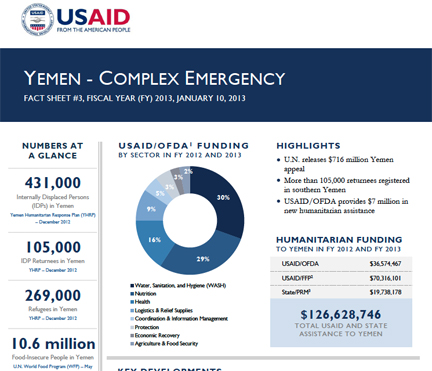
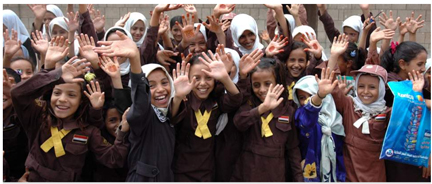
The drones capture the headlines when Yemen makes the news. The development arm of the U.S. State Department, USAID, also works in Yemen, although its activities have been greatly curtailed since the old days when I worked as a consultant on a number of USAID projects, starting in 1982 on the Agricultural Sector Assessment of Yemen of that year. For information on USAID’s current programs in Yemen, check out the relevant website. USAID provides a recent (January) fact sheet on the development situation in Yemen.