Category Archives: Anthropology/Sociology

Is Informationalization Good for the Middle East?

By Jon W. Anderson, Arab Media & Society, Summer, 2013

Nearly all studies and most opinion about new media and information technologies in the Middle East have held that they are a boon in an environment of information-averse regimes, state-controlled media, and limited communications. New media, in this reckoning, open communications to new voices, foster an expanded public sphere,[1] break the molds of old patterns not only of communication but also of thought,[2] or modify media ecologies[3]—all of which erode state monopolies and shift balances from state-cultivated models of citizenship to citizens’ taking charge.[4] Skeptical voices have been few, redundantly focused on multiple means of censorship to offset the benefits of new media, or cautioning against jumping to conclusions about new media impacts.[5] Early pessimistic assessments of the prospects for informational freedom in the digital age have been largely assimilated, such as Kalathil and Boas’ demonstration that the malleability of the Internet is also available to authoritarian states,[6] while more recent, more global, and more famous critiques have yet to influence research priorities in the Middle East.[7] None of these has strayed far from global views of epochal, structural transformation in open networks beyond noting lingering Middle East exceptions, especially lagging numbers of participants by comparison to other regions and to the rest of the world. Regionally as well as globally, open communications, network flows, and other notions of informationalization generally seem to be embraced as an unalloyed good by most analysts, if not by all actors. Continue reading Is Informationalization Good for the Middle East?

Humanitarianism (?) in Lebanon


bread provided by NGOs to Syrian refugees in the aid kit in Wadi Khaled (Akkar); photograph by Estella Carpi


A practitioner and a researcher assess humanitarianism in today’s Lebanon

By Fiorenzo Conte and Estella Carpi

In our combined effort of providing the perspectives of the practitioner and the researcher, we would like to take as a point of departure Italian scholar Roberto Belloni’s theses according to which humanitarianism, on the one hand, ends up being the short-term substitute for development, and, on the other, tends to reproduce the same cleavages it tries to overcome.

Humanitarianism as a short-term substitute for development

While conducting research and grounded humanitarian work in Lebanon, we have noticed how humanitarianism, while providing increasing quantity of aid, avoids addressing the root causes of Lebanese chronic poverty, administrative anarchy and recurring war-like events. Predominantly Western and Gulf countries have focused their attention on managing the symptoms of the malaise without effectively addressing its causes and hence engaging in the long term.

The humanitarian needs in Lebanon are surely huge for both Syrian refugees and long neglected Lebanese host communities. With the massive influx of Syrian refugees since August 2011, the Lebanese community, living in the poorest regions, has felt the pinch. Indeed, many residents are currently trying to tackle increased expenditures and a drop in income caused by a variety of factors: the closure of the border and the consequent inaccessibility to Syrian cheaper goods through the usual border-cross smuggling; fierce competition in the labor market that has been increased by the presence of Syrian workers; a deteriorating security situation; and reduced access to the agricultural lands strewn with landmines (1).

The situation for Syrians is similarly grim: according to a recent report, more than 50% of Syrian refugees and Lebanese returnees live in substandard conditions, as Lebanese host communities are no longer able to absorb new flows of refugees in their houses. Continue reading Humanitarianism (?) in Lebanon

Agricultural policy in Yemen’s highlands and lowlands


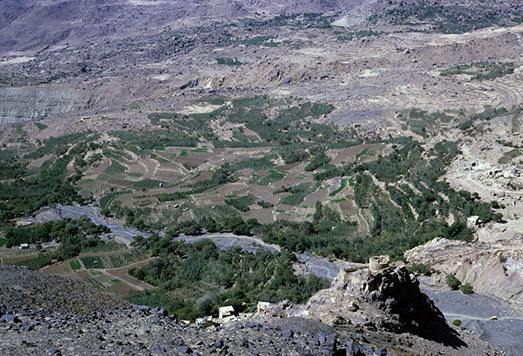
Terraced fields below al-Saraha in valley of al-Ahjur; photograph by Daniel Martin Varisco

by Zaid Ali Alwazir, La Voix du Yemen, June 9, 2013

Agricultural policy describes a set of laws related to the local farming and imported agricultural products from abroad. These laws are supposed to be implemented to get certain results such as utilizing the land, operating it or stabilizing prices of imported and local products.

Since the start of the “youth revolution” in Yemen, talks about the political and economic reforms got increased without focusing on “the agricultural economy” as if it was not part of the general “economy”. Therefore, no attention was paid by reformers to this issue since their talks had been focusing on “the material economy” such as “taxes”, “Zakat” and others.

“Agricultural economy” is not given the required attention despite the fact that agricultural development would feed the budget with more income, boost up farmers’ capacity to give more and optimize their living standards to ensure their welfare. Continue reading Agricultural policy in Yemen’s highlands and lowlands

Journaling On, but why?


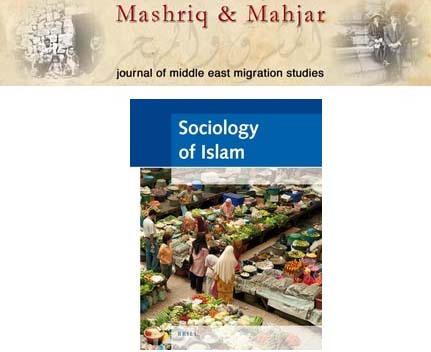
Recently I received news of three new journals with laudable goals: one is Mashriq & Mahjar: Journal of Middle East Migration Studies, an online, open access, peer-reviewed journal; the second is The Sociology of Islam Journal, which will be published by Brill on a subscription basis. The third is Anthropology of the Contemporary Middle East and Central Eurasia (ACME). When I started my graduate career in the early 1970s there were only a few journals dedicated specifically to the study of Islam and none to the anthropology of the Middle East or Central Asia. Der Islam, Studia Islamica, the Muslim World were solely for Islam, although they rarely had sociological or anthropological articles. Most scholars published in journals of their discipline or broader Middle Eastern Studies, such as the Middle East Journal, the International Journal of Middle East Studies, Arabica, Quaderni di Studi Arabi, and the like. The first journal devoted solely to contemporary Islam, with an anthropological focus, is Contemporary Islam, founded by Gabriele Marranci. The first journal created for the anthropology of the Middle East is, appropriately enough, Anthropology of the Middle East.

As the co-editor of a major Springer journal, Contemporary Islam, and the editor-in-chief of an online, peer-reviewed open access journal, CyberOrient, I am probably the last person who should be complaining about more new journals. It is not really a complaint as much as it is a contemplation: why are there more and more subscription-based academic journals when library budgets are being skimmed and few scholars can afford the exorbitant individual subscription prices of major presses? Is it the case that there are too few journals out there? Given the quality of the articles I sometimes see in professional journals, it seems as though quality or cogency is not always significant for getting into print. An argument could be made that there are so many more academic scholars these days, that new journals are needed to accommodate them. I can see this point, but then why not create open-source journals, like Mashriq & Mahjar, which can as easily be peer-reviewed as those distributed by major publishing houses?

There are several disadvantages I see with the expanding number of subscription-based academic journals. Continue reading Journaling On, but why?

Drone Policy in Yemen

For anyone in the NYC region, I will be giving a talk at the COLUMBIA UNIVERSITY SEMINAR on KNOWLEDGE, TECHNOLOGY, and SOCIAL SYSTEMS on Wednesday, May 15, 7 pm (at Columbia University’s Faculty House). The title of the talk is: “Drone Strikes in the War on Terror: The Case of Post-Arab-Spring Yemen.” Unmanned drones have been used by the US military against terrorism in many areas of the world. In particular, these drones have become the US military’s weapon of choice in targeting terrorists in Yemen, where strikes quadrupled in 2012 from the previous year. This talk addresses the impact of these strikes on the political context within Yemen and the effectiveness of the strategy in combating Al Qaeda recruitment. The talk builds on a commentary published in the Middle East Muddle blog of the Anthropology News website.

For information on the talk, please contact me directly by email at daniel.m.varisco@hofstra.edu.

Qat, Cosmopolitanism, and Modernity in Sanaa, Yemen

Webshaykh’s Note: An article entitled “Qat, Cosmopolitanism, and Modernity in Sana’a, Yemen” has been written by Irene van Oorschot, and published inArabian Humanities, Vol. 1, 2013. Her ethnographic study focuses on urban women in Sanaa. I attach here the beginning paragraphs, but urge readers to read the full article on Arabian Humanities, a new journal dealing with Yemen and the Arabian Peninsula.

The prevalence of qat consumption in Yemen strikes even the most casual of observers. Adolescent and adult men can be seen chewing in shops, taxis, and on the streets, while the many qat vendors in the streets and squares of Sana’a contribute —in the eyes of many tourists— to its quaint charm. While women do not usually chew qat in public places, married women chew qat in the privacy of their own or their female relatives’ houses. Chewing qat is however held to be shameful for unmarried women, a notion which is sometimes explained with reference to the alleged effects qat has on people’s libido. As a (sexual) stimulant, qat has no place in unmarried women’s lives. After all, they are not supposed to have premarital relationships, and as such are “not supposed to chew”. However, among unmarried women of the educated and urban elites, qat chewing is an popular way to spend one’s spare time:

“It is just a way to relax, to unwind, to be away from work, and to be with my friends,” Wafā’, an unmarried woman, told me. “My married sister chews qat, too, and she is even younger [than I am]! So why should I not get to chew qat and relax?” Continue reading Qat, Cosmopolitanism, and Modernity in Sanaa, Yemen