Category Archives: Anthropology/Sociology

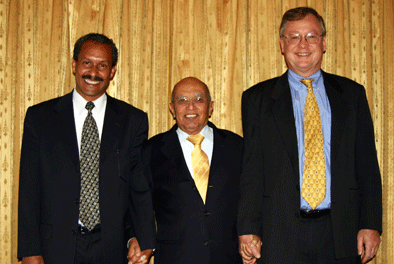
Yemen College of Middle Eastern Studies


left to right, Sabri Saleem, founder; Dr. ‘Abd al-Karim al-Iryani; Dr. Steven Caton, Dean

by Bradley Heinz, Yemen Observer, January 5, 2008

Sana’a may well be on its way to hosting the leading center for scholarship of the contemporary Middle East, so say members of the Board of Governors of the newly organized Yemen College of Middle Eastern Studies (YCMES). In preparation for the inaugural year, prominent scholars, businessmen, and diplomats from Yemen and beyond met Thursday to discuss the logistics and direction for Yemen’s newest teaching and learning center. The meetings are set to last through Saturday and are being held at the Taj Shiba Hotel.

“These meetings are extremely important. They’re the beginning of the realization of an educational vision in the making for years,” said Steve Caton, Dean of the new college and an anthropologist who studied the role of poetry in Yemeni society. Continue reading Yemen College of Middle Eastern Studies

Mass-Mediated Violence in Morocco and the US: Suicide Bombing and Shooting Sprees


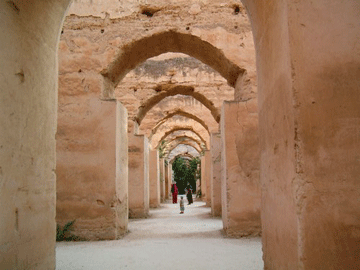
Scene in Meknes, Morocco

by Emilio Spadola
Colgate University
Dept of Sociology and Anthropology

Recently, my efforts to think on Moroccans’ quality of modern (i.e., mass-mediated) life have turned on violence both there and in the US, and, especially, to two forms of youth violence: suicide bombings and suicide shootings. In 2007 Moroccans witnessed separate bombings in Casablanca and Meknes; in separate cases Moroccan state intelligence traced other accused suicide bombers to one neighborhood in Tetouan. In the US in December an Omaha teenager with an automatic weapon shot and killed eight mall goers, then himself; four deaths shortly after in Colorado added to the long year of suicide sprees by young men: six deaths in a Utah mall in February, 33 deaths on the Virginia Tech campus in April.

Emphasizing putative differences, cultural pundits habitually link suicide bombings to the Middle East, and, specifically, to an Islamic culture of violence. And shooting sprees seem typically, if pathologically, American. They are nonetheless strikingly redolent. Yet to compare them, that is, to abstract them from their separate contexts, takes special care. In so doing one faces what Benedict Anderson calls the “specter of comparisons,” that is, the distinctly modern moment in which persons appear, like commodities and print, as serial copies. Yet it is precisely this imagined quality of commensurability—when “anyone” rather than a specific someone can be a target (of mass-mediated messages)—that marks as contemporary suicide bombing and suicide shooting. Continue reading Mass-Mediated Violence in Morocco and the US: Suicide Bombing and Shooting Sprees

Tenure Affirmed, not Bulldozed

[Note: The recent tenure case of Dr. Nadia Abu el-Haj generated a great deal of heat in the blogosphere, but I am pleased to report that she was granted tenure based on the internal reviews and despite the external attempts to bulldoze her voice out of the academy. I had reported on this case in a post here on September 13. The details are provided in a blog item by Richard Silverstein, which I include here to bring closure to this case.]

by Richard Silverstein, Tikkun Olam, November 2, 2007

The long, arduous journey of Nadia Abu El-Haj, Barnard professor of anthropology, to tenure is finally over. The Columbia administration has approved Barnard’s recommendation and she will become tenured faculty on approval of both institutions’ boards of trustees. Thanks to Sol Salbe for noting the JTA report on this from earlier today. However, a Jewish journalist friend of mine has pointed out a typical JTA error in the copy for the story:

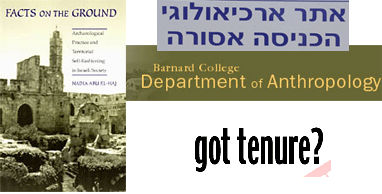
El-Haj is the author of “Facts on the Ground,” a book that attacks the Israeli archaeological establishment for fabricating material used to legitimize Israeli policies.

My friend called this sentence:

a complete and utter distortion of the book, which, of course, the journalist, whoever he/she might be, has not read. What he/she has read is Paula Stern’s petition or Gabrielle Berkner’s New York Sun story. On deadline, people [just] WRITE STUFF. It’s a pity The Sun gets to set the template.

Continue reading Tenure Affirmed, not Bulldozed

Iran’s Nuclear Weapons Program Never Existed

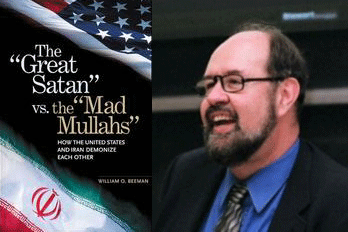
by William O. Beeman,
New America Media, News Analysis, Dec 05, 2007

Iran has never had a proven nuclear weapons program. Ever. This inconvenient fact stands as an indictment of the Bush administration’s stance on Iran.

The recently released 2007 National Intelligence Estimate that Iran “suspended its nuclear weapons program in 2003” caught the Bush administration flat-footed. In his panic, Bush grasped desperately at the idea that the weapons program may have once existed. However, the report does not offer a scintilla of evidence that the weapons program was ever an established fact. Continue reading Iran’s Nuclear Weapons Program Never Existed

The professions: from Woodstock to a novel life, in so many words


Professor Robert Leonard, right.

by Patricia Kitchen
Newsday, November 29, 2007

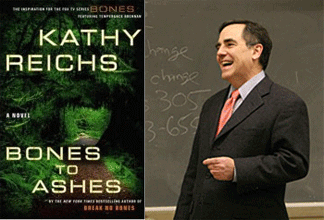
Fans of mystery novelist and forensic anthropologist Kathy Reichs may have noticed a new character in her most recent novel, Bones to Ashes. That would be forensic linguist Rob Potter, a Woodstock rock star-turned-linguist and onetime graduate school mentor to Reichs’ main character, Temperance Brennan.

The newcomer is based on one of Reichs’ friends, Robert Leonard, 59, a real-life former rock star-turned-forensic linguistics professor. Leonard, in fact, heads the Forensic Linguistics Project at Hofstra University. Professionals in that field analyze written and spoken language – including grammar, word choice, dialect and structure – in contracts, confessions, ransom notes, spoken threats, undercover recordings, transcripts of interrogations and other correspondence linked to crimes.

Think professor Henry Higgins meets Sherlock Holmes. Continue reading The professions: from Woodstock to a novel life, in so many words

Secrecy and Anthropology

by Elizabeth Redden, Inside Higher Ed, December 3

With debate over the role of anthropologists in aiding the military machine a theme threading through their annual meeting, scholars voted Friday to demand that the American Anthropological Association reinstate strict language from its 1971 code of ethics prohibiting secret research. Members at the meeting – who, for the second time in about 30 years and the second year in a row constituted a quorum in excess of the required 250 — also voted overwhelmingly to oppose “any covert or overt U.S. military action against Iran.”

The language anthropologists want reinstated on secrecy – which, the resolution’s sponsor affirmed would apply to anthropologists doing work for corporations too – stipulates that “no reports should be provided to sponsors that are not also available to the general public and, where practicable, to the population studied.” Like every item of business discussed Friday other than the resolution on Iran, the resolution on secrecy was not filed for consideration 30 days in advance, as is required under association rules, and so will be submitted to the association’s executive board on an advisory basis only.

But Friday’s vote only strengthens a recommendation contained in a new report from the AAA Commission on the Engagement of Anthropology with the U.S. Security and Intelligence Communities, which suggests that the membership or ethics committee “should consider” reinstating those same sections (1.g, 2.a, 3.a, and 6) of the 1971 code. The report centers on whether the association’s ethical standards bar ties to the military or intelligence agencies. The commission’s short answer: Not necessarily, although more scrutiny is needed. Stressing the diversity of roles anthropologists can play in military and intelligence apparatuses, the panel determined that while certain interactions would violate the ethical code, members also “see circumstances in which engagement can be preferable to detachment or opposition.” On issues of secrecy, for instance, the commission offered one particularly complex dilemma as illustration: “Some situations might be counterintuitive for most of us: consider a situation in which a research project is kept secret from the scholarly community, but not from the local population or community under study – as when an anthropologist employed by a government agency helps a special operation to get medical supplies to a remote town in northern Afghanistan.” Continue reading Secrecy and Anthropology

A True Culture War


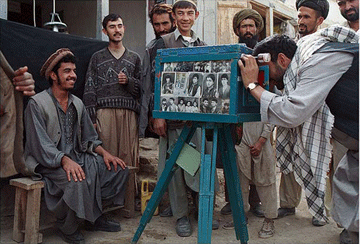
[Photograph taken in Afghanistan by Sergey Maximishin, 2001.]

[Webshaykh’s Note: It is a rare day when an anthropologist’s commentary is published in the New York Times. Here is yesterday’s op-ed by Richard Shweder of the University of Chicago, reproduced below. I invite readers to post their views here. I gave my own view of Anthropo covertus in an earlier post.]

by Richard Shweder, New York Times, October 28, 2007

IS the Pentagon truly going to deploy an army of cultural relativists to Muslim nations in an effort to make the world a safer place?

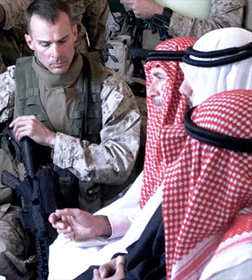
A few weeks ago this newspaper reported on an experimental Pentagon “human terrain” program to embed anthropologists in combat units in Iraq and Afghanistan. It featured two military anthropologists: Tracy (last name withheld), a cultural translator viewed by American paratroopers as “a crucial new weapon” in counterinsurgency; and Montgomery McFate, who has taken her Yale doctorate into active duty in a media blitz to convince skeptical colleagues that the occupying forces should know more about the local cultural scene.

How have members of the anthropological profession reacted to the Pentagon’s new inclusion agenda? Continue reading A True Culture War

Anthropo covertus: A Disputed Species

Get ready for a shock. Anthropology (the best kept discipline secret in American academics) made the front page of today’s New York Times. And, believe it or not in the Ripley tradition, it was not about finding the “missing link” or “Noah’s ark”. In a report filed by David Rohde and entitled “Army Enlists Anthropologists in War Zones,” the focus is on the Pentagon’s newly instituted “Human Terrain Teams,” a kind of social science intellectual swat team approach, in which the military uses experts on the local culture. In a video on the website, an American officer explains that his soldiers no longer routinely break down doors of houses and violate the cultural space of Afghan homes, but let their Afghan counterparts knock first while they wait respectfully outside. While I am not sure it takes an anthropologist to point out what should be obvious through simple experimentation, the basic argument of the article is that the military is being coached to listen and work with the local population rather than play knee-jerk mercenary search and destroy games.

It is hard to argue with the sentiment that talking and negotiating are better ways to accomplish a proposed peace-building mission than assuming everybody in sight is a terrorist or is hiding one. So anthropologists, especially recent graduates who have a hard time finding jobs, should be pleased that supply actually might be influenced by a newfound demand for their services. Take Marcus B. Griffin, for example, an embedded anthropologist in Iraq who has a blog discussing his work. Continue reading Anthropo covertus: A Disputed Species