Category Archives: Anthropology/Sociology

Marranci on the Anthropology of Islam

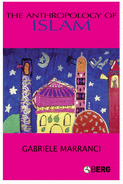
Note: The following is an excerpt from Gabriele Marranci’s latest book, The Anthropology of Islam (Oxford: Berg, 2008), which is well worth reading for insights on previous ethnographic study of Islam and guidelines for current research.

Books and ‘how-to’ guides about anthropological fieldwork are increasing in number within publishers’ catalogues. Among this large production, it is unusual to find even even chapters addressing the experience of conducting fieldwork among Muslim societies and communities. In the few cases in which some examples have been provided, they describe and discuss what I call ‘exotic’ fieldwork. Even less available is material containing reflections on the impact and issues that an anthropologist may face in conducting fieldwork within Muslim communities, in the west and in Islamic countries, during this endless ‘war on terror’. In this chapter, I have tried to start a reflection and discussion on what it means to conduct fieldwork among Muslims today. In doing so, I have provided examples from the experience of some anthropologists as well as my own. I have suggested that at the centre of a contemporary anthropology of Islam should be the human being even before the Muslim. This is vital if we wish to overcome a certain Orientalism and suppression of self-represented identities, as we can observe in classic works, from Geertz to Rabinow and Gellner. Continue reading Marranci on the Anthropology of Islam
Anthropology in Arabic

As is true of many fields of academic study, there are Arabic introductions to the subjects. Many of these are little more than perfunctory translations of English-language textbooks. For a refreshing Arabic text introducing the whole field of Anthropology to Arabic readers, there is now an online work in progress by Saad Sowayan at http://www.saadsowayan.com/articles/anthropology.html.

Here is The Table of Contents

Introduction
02 بداية الحياة على الأرض Begining of Life
03 أحافير الرئيسيات Primate Fossils
04 الرئيسيات المعاصرة Modern Primates
05 البشريات Hominids
06 الأسس البيولوجية للثقافة Biological Bases
07 الإيكولوجيا الطبيعية Natural Ecology
08 الإيكولوجيا الثقافية Cultural Ecology
09 النسق الاقتصادي Economic System
10 النسق الديني Religion

Dr. Sowayan, who has conducted ethnographic and linguistic research in Saudi Arabia and is the editor of a massive volume on Arabian folklore, has made available much of his academic work online at his main website, with sections in Arabic and English.

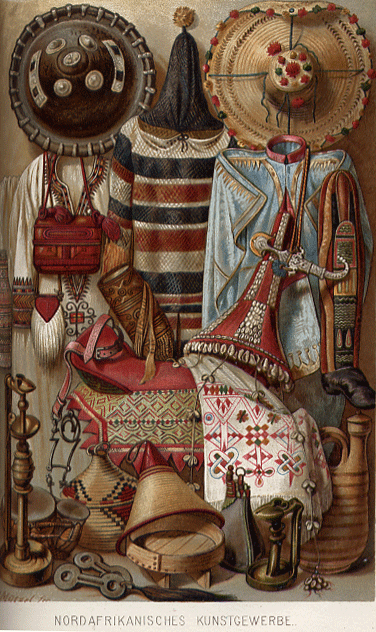
With Ratzel in North Africa

One of the most important German geographers of the late 19th century was Friedrich Ratzel (1844-1904), whose three-volume Völkerkunde (Leipzig and Vienna, Bibliographisches Institut, 1890) is one of those encyclopedia cultural accounts that circulated just as the discipline of anthropology was getting off (in this case literally “on”) the ground. While now a text for curiosity rather than critical scholarship on peoples and cultures, Ratzel’s work is still a fascinating portrayal of cultures being colonized for both revealing the biases of the day and the then-contemporary illustrations of people and material culture. My university library recently divested itself of uncirculated books in storage and one of these was an 1890 edition of the third volume on “Die Kulturvölker der Alten und Neuen Welt.” Whether it was the eye-watering althochdeutsch script of the volume or the mere fact it was written in German, no student or professor at Hofstra ever checked this volume out.

In salvaging a third of Ratzel’s opus for a mere dollar, I could not help but be drawn to the illustrations, mostly lithographs but with a few beautiful color plates. Continue reading With Ratzel in North Africa

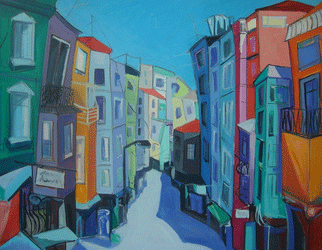
Strolling Through Tarlabasi


Tarlabasi, 2004, by Gamze Olgun, Oil Painting.

by Jenny White
Kamil Pasha Blog
Posted on January 24th, 2008

Tarlabasi is a district on the backside of the Beyoglu hill falling from the crest at Pera – where all the foreign embassies were in Ottoman times, now demoted to consulates – down in the direction of the Golden Horn. In The Abyssinian Proof, Kamil chases a wily criminal to his lair in Tarlabasi. The district is picturesque in the way of crumbling majesty on its last legs (a large part of Tarlabasi will be razed in 6 months, probably replaced by hotels). The steep, narrow lanes are strung with laundry, bustling with locals shopping at an outdoor market crammed into one of the lower streets. At the top of the hill near Istiklal Bouelvard are some lovely stone houses, now ruined or so shabby as to be nearly uninhabitable. A large stone house cracked down the side like an egg is posted for sale. As you walk down the hill, the houses become smaller, shabbier, sometimes outright ruins, less stone and more wood. In Ottoman times, Catholics and Greek Christians (Rum) lived near the top — shop owners, employees of the embassies — and poorer families near the bottom. Taylor Pepo’s apprentice lived in Tarlabasi with his family (The Abyssinian Proof). Today Tarlabasi is inhabited by Roma (gypsy), Kurds, the very poor, and social outcasts of various kinds. Continue reading Strolling Through Tarlabasi

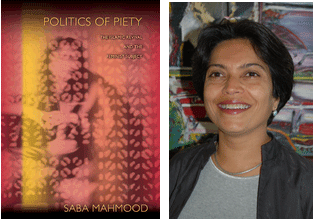
Politics of Piety: A Case Study in Cairo


[In 2005 anthropologist Saba Mahmood published “Politics of Piety: The Islamic Revival and the Feminist Subject” (Princeton University Press). This important ethnography of the women’s mosque movement in Cairo not only presents an informative case study but challenges notions of how Muslim women’s involvement in pious movements should be analyzed in a feminist framework. The following excerpt is from the beginning of Mahmood’s book.]

Over the last two decades, a key question has occupied many feminist theorists: how should issues of historical and cultural specificity inform both the analytics and the politics of any feminist project? While this question has led to serious attempts at integrating issues of sexual, racial, class, and national difference within feminist theory, questions regarding religious difference have remained relatively unexplored. The vexing relationship between feminism and religion is perhaps most manifest in discussions of Islam. This is due in part to the historically contentious relationship that Islamic societies have had with what has come to be called “the West,” but also due to the challenges that contemporary Islamist movements pose to secular-liberal politics of which feminism has been an integral (if critical) part. The suspicion with which many feminists tended to view Islamist movements only intensified in the aftermath of the September 11, 2001, attacks launched against the United States and the immense groundswell of anti-Islamic sentiment that has followed since. If supporters of the Islamist movement were disliked before for their social conservatism and their rejection of liberal values (key among them ‘women’s freedom’), their now almost taken-for-granted association with terrorism has served to further reaffirm their status as agents of a dangerous irrationality. Continue reading Politics of Piety: A Case Study in Cairo

Art, Religion and History: The Case of Bahrain


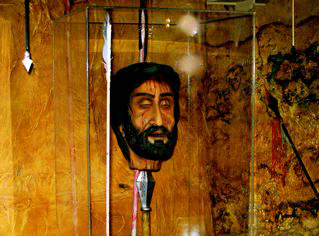
Figure 1. A Replica of the head of Imam Husayn

by El-Sayed el-Aswad
University of Bahrain

Art, in its broad meaning encompassing performance and non-performance forms of expression, plays a significant part in Bahraini imagination and folk culture. The focus here, however, will be on the innovative aspects of Shi‘a vernacular art. Among the Shi‘ti people of Bahrain there has been a shift from traditional or old-fashioned styles of mourning and commemorating the tragic events of ‘Ashura, or the tenth of Muharram (the first month of Islamic calendar in which Imam Husayn, grandson of the prophet Muhammad, was martyred) to a modern way of expression reflected mostly in the art.


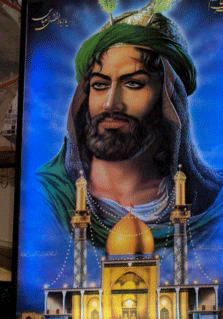
Figure 2. Imaginary of al-‘Abbas, the sibling of Imam Husain

During the first ten days of Muharram, colorful forms of calligraphy, iconography, replicas (tashihat), ritual and visual representations are presented and meticulously enacted in exhibitions and in the streets of Manama, the capital city of Bahrain, as well as in most of the villages with Shi‘a majorities. Continue reading Art, Religion and History: The Case of Bahrain

Suharto’s Legacy

By Timothy Daniels

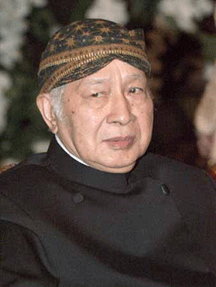
Former President Suharto, long-time dictator of Indonesia, has passed away on January 27, 2008. He came to power during a shadowy “coup” in 1965 which resulted in the charismatic first president, Bung Sukarno, being unseated and imprisoned and in the massacre of thousands of people in what came to be known as the “year of living dangerously.” Bung Sukarno was a leader of the non-aligned movement during the Cold War era and architect of an unifying ideology (nasakom) which sought to include nationalists, religious organizations, and communists—the three main streams of the anti-colonial movement—within national governing units. US political officials viewed Bung Sukarno as a threat to the “free” and “democratic” First World and Suharto, an opportunistic lower-ranked colonel, as the military strongman to keep Indonesia under western influence. Continue reading Suharto’s Legacy

Out-of-Print CCAS Occasional Papers now Available Online

By L. King-Irani, Georgetown Center for Contemporary Arab Studies, October 22, 2007

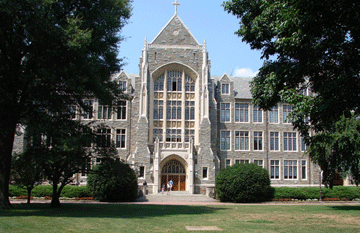
Dissemination of information and analyses within and beyond the scholarly community is a key priority for the Center for Contemporary Arab Studies. The Center’s Multimedia, Research and Publications office publishes a prestigious Occasional Paper series featuring works by scholars, journalists, policy makers and field experts three to four times each year. This series now includes nearly 100 works covering a wide variety of subjects and perspectives on the Arab world. In addition, the series also includes transcripts of discussions among key players in the U.S. and the Arab world, such as Uncovered: Arab Journalists Scrutinize Their Profession, which features prominent Arab journalists’ analyses of press freedom and responsibility across the region. Forty of the Center’s Occasional Papers are now online.

The following six Occasional Papers have just been added to the group available in PDF format, two of them, Talal Asad’s The Idea of an Anthropology of Islam, and the late Hanna Batatu’s The Egyptian, Syrian and Iraqi Revolutions: Some Observations on Their Underlying Causes and Social Character, have been among the most popular and requested Occasional Papers over the last two decades. Continue reading Out-of-Print CCAS Occasional Papers now Available Online