Category Archives: Anthropology/Sociology

Transhumance in Tarkumia

Transhumance in Tarkumia: An Exploration of Aspects of Palestinian Summer Identity This Week in Palestine

“Exploration is not so much a covering of surface distance as a study in depth: a fleeting episode, a fragment of landscape or a remark overheard may provide the only means of understanding and interpreting areas which would otherwise remain barren of meaning.” Claude Levi-Strauss, Tristes Tropiques (1955)

The three-month summer vacation from schools liberates Palestinian families from the constraint of the temporal rhythm of school and from the constriction of space. The students are free, but the parents are equally liberated. This temporal space provides ample opportunities for exploration of self, of other, of place, and of time by means of travel. Travel is usually thought of as a displacement in space. This is an inadequate conception. A journey occurs simultaneously in space, in time, and in the social hierarchy. Each impression can be defined only by being jointly related to these three axes, and since space is itself three-dimensional, five axes are necessary if we are to have an adequate representation of any journey.

Travel is a form of exploration, a spark to the imagination, a quest, commerce, escape, and a means of self-discovery. Continue reading Transhumance in Tarkumia
Tracing the History of Qat


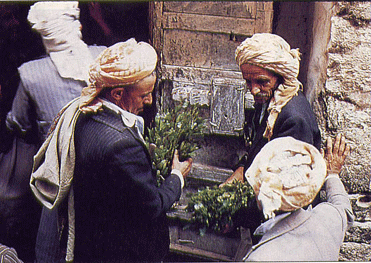
Selling qât in Yemen. Photo by Pascal Maréchaux

Much has been written, pro and con, about the chewing of qât leaves in Yemen. In addition to the economic and social problems over qat, there is a historical puzzle. When and how did the plant Catha edulis come from Ethiopia, its botanical origin, to Yemen? Yemeni legend and folkore suggest that the stimulant qualities of qat leaves were first discovered by a goatherd who noticed the effect on goats who browsed on the plant. A variant of this goat legend, told to me in 1979 by a poet from Husn al-‘Arus, suggests that an Ethiopian came along to explain to the goatherd what was happening. The goat is one of the few animals that can be seen occasionally eating qât leaves, but the story is surely apocryphal. Sometimes it is told for the origin of coffee, another stimulant brought from East Africa. Continue reading Tracing the History of Qat

Hip Hopping the Ummah

Muslim Americans in the post-9/11 era are deepening ties between hip-hop and Islam

by Suad Abdul Khabeer, The Root, June 23

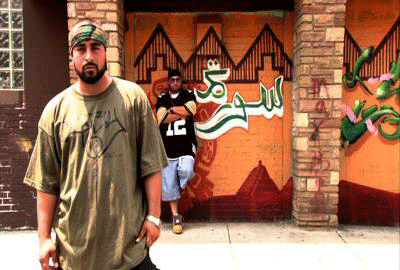
Real hip-hop heads know that Islam and hip-hop have been longtime friends, feeding off each other’s energy. Muslim ideals of self-respect and social change have inspired some of the greatest emcees, and hip-hop is giving voice to the dreams and daily struggles of a generation of Muslims. This cross-pollination between Islam and hip-hop is vividly illustrated in a new documentary, New Muslim Cool, which premieres tonight on PBS.

Directed by veteran filmmaker Jennifer Maytorena Taylor, New Muslim Cool chronicles three years in the life of Hamza “Jason” Perez, a Puerto Rican Muslim, family man, emcee, interfaith prison chaplain and social activist. Continue reading Hip Hopping the Ummah

Emirati Youth in a Rapidly Changing Society

by el-Sayed el-Aswad, United Arab Emirates University

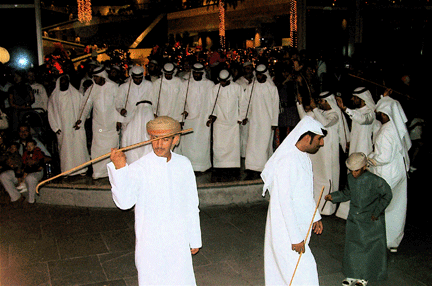
The UAE has developed amenable ways of synchronizing localism with globalism. It is hard to erase specificities that create a misleading portrait of a single global culture. However, Emirati local culture transforms and appropriates aspects of the global into a unique system of local social meaning. The young generations of the Emirates, for instance, have succeeded in assimilating outside influences without deserting their heritage. They have expressed their pride generated by their ability to combine both local culture and modern, global ways of life. They speak Arabic with Emirati dialects, eat indigenous food, use incense and wear traditional costumes (including veils for women) so as to symbolically identify themselves with their traditional society, but, at the same time, they speak English and employ symbols signifying western ‘global’ modernity, such as using computers, eating Western fast food, consuming expensive perfumes, and driving extravagant four wheel-drive cars. However, it can be argued that symbols of modernity do not fundamentally alter people’s beliefs, values, or culture. Continue reading Emirati Youth in a Rapidly Changing Society

Portrait of a Bahraini Anthropologist


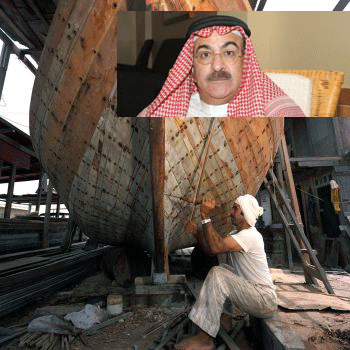
Bahraini dhow builder, photo by Abdulla Al Khan; insert shows Dr. Abdullah Yateem

A modern culture specialist
By Paul Balles, Bahrain This Month

What makes Dr. Abdullah Yateem a modern culture specialist? He’s an anthropologist who has taken a modern approach to studying cultures.

Many people don’t know what anthropology is or what anthropologists do unless they happen to have attended university and learned that they could take courses in the subject.

If they listened to British television critic Nancy Banks-Smith, they might have heard her say, “Anthropology is the science which tells us that people are the same the whole world over — except when they are different.”

Cultural anthropologist Ruth Benedict, with tongue in cheek, put it another way, “The purpose of anthropology is to make the world safe for human differences.”

From these comments, one might safely assume that anthropologists study almost anything related to the similarities and differences between cultures.

Anthropologists like Dr. Abdullah Yateem address questions such as: how can people who look different, talk differently and come from different cultures get along together in today’s world? (paraphrasing Clyde Kluckhohn). Dr. Yateem is not only an anthropologist who studies cultures. Currently, he’s Assistant Undersecretary for Press and Publications in the Ministry of Information. Continue reading Portrait of a Bahraini Anthropologist

Hajj on Second Life


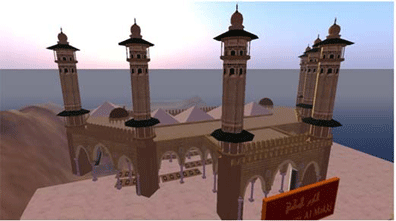
Aerial View of the Masjid Al-Haram, Second Life

Hajj on Second Life

by Krystina Derrickson, excerpt from Second Life and The Sacred: Islamic Space in a Virtual World, Digital Islam, 2008. For the full article, click here.

Mecca is the holiest site in the Muslim world, the literal nexus of the Islamic universe, the direction towards which Muslims worldwide pray and are buried facing, and the figurative, spiritual, and philosophical nexus, flattening history, faith, practice, and praxis[41]. It is the home of the Ka’baa, a large cubical structure believed to have been built by Ibrahim and Isma’il. The Hajj is the pilgrimage, one of the five pillars of the Islamic faith, required at least once by all able-bodied Muslims undertaken during the month long Hajj period.

The Hajj sim is sponsored by IslamOnline.net (IOL), a popular and comprehensive Islamic website run by Egyptian Islamic scholar Yusuf Al-Qaradawi which offers a multitude of services, from e-fatwas, halal business directories, news, and multimedia to matrimonial services and a “cyber-counselor”.[42] Continue reading Hajj on Second Life

Heritage in a Global Era

Heritage in a Global Era: The Integration of Modernity and Tradition in the UAE

by el-Sayed el-Aswad, United Arab Emirates University

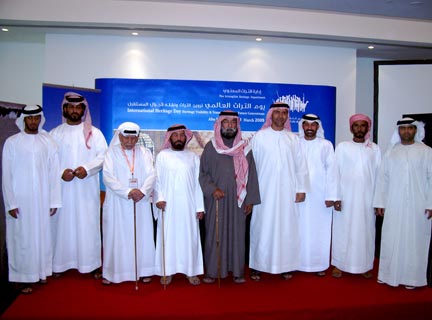
As part of the United Arab Emirate’s celebration of International Heritage Day, the Abu Dhabi Authority for Culture and Heritage (ADACH) organized a conference held on March 18-19, 2009, entitled “Heritage: From Preservation and Documentation to Promotion and Transmission to Future Generations.” The conference provided a fresh perspective by rethinking the oppositions of modernity/tradition and globalism/localism. A number of leading figures in the field of anthropology, folklore and comparative studies participated in the workshop by presenting papers and engaging in discussions and debates concerning various topics including folk tales, child folklore, falconry, symbolism, worldviews, the preservation of oral literature, and heritage promotion. Intangible heritage, more specifically oral literature, is an important component in understanding not only cultural specificities of societies but also enhancing intercultural relations. The following are some basic questions addressed in the workshop: Does the global culture depict the future as relying primarily on economic, technological, and multi-corporate forces that demand systemization, integration and uniformity? Does the traditional culture conceive the future as contingent essentially on the continuation of heritage, value-systems, religion, rituals, and social-kinship relationships? Continue reading Heritage in a Global Era

Muslim in America: a ‘voyage of discovery’


Hailey Woldt, in a traditional Muslim head scarf, studied how people react to her garb in Arab, Alabama.

Muslim in America: a ‘voyage of discovery’

ATLANTA, Georgia (CNN) February 9, 2009 — Hailey Woldt put on the traditional black abaya, expecting the worst. Hailey Woldt, in a traditional Muslim head scarf, studied how people react to her garb in Arab, Alabama.

The last time she’d worn the Muslim dress that, with a head scarf, covered everything but her face, hands and feet, she was in Miami International Airport, where the stares were many and the security check thorough.

This time, she was in a small town called Arab. Arab, Alabama, no less. Continue reading Muslim in America: a ‘voyage of discovery’