Category Archives: Anthropology/Sociology

Going (after) Muslim


A picture making the news rounds of Major Hasan on the day of the shootings.

[Note: I have just published a commentary on a commentary in Forbes Magazine in which Major Nidal Hasan is said to have “gone postal” in his frenzy. This is published on Religion Dispatches. I excerpt the first couple of paragraphs here, but please go to the Religion Dispatches site, where you can post comments as well.]

If the media frenzy over the Fort Hood killings is any gauge, the ugly specter of 9/11 has again taken its psychological toll. This time, instead of the “bad Muslim” being a bearded terrorist called bin Laden, there is a US Army psychologist who was trained to be a healer of military personnel. He happens to have an Arabic ancestry and is Muslim.

Prominent American Muslim organizations issued statements right away condemning the murders. Debate in the media is now focused on his motivation. Was he a fifth-columnist wolf in military dress? Did his sympathies for innocent victims in our ongoing wars in Iraq and Afghanistan overwhelm his common sense of decency? Should the FBI and security arms of the US military have pounced on him when they uncovered his initial links to a radical imam?

One result that I have noticed among those who study Islam, especially my Muslim colleagues, is a growing fault line over the dubious “good Muslim/bad Muslim” binary. As Mahmood Mamdani has eloquently argued, the choice is not between good and bad individuals or citizens, but about being Muslim. Major Hasan is a man who looked very much like a “good Muslim”: a military officer providing therapy to returning veterans. But, now, it seems that at some tipping point he became the “bad Muslim,” the kind who places mosque above state.

For the rest of this commentary, click here.

Daniel Martin Varisco
Contesting Islamism

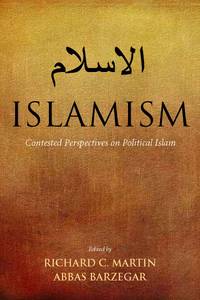
Stanford University Press has just published Islamism: Contested Perspectives on Political Islam, edited by Richard C. Martin and Abbas Barzegar. In this book Political Scientist Donald Emmerson argues for an inclusive use of the term “Islamism” in order to rescue the term from its misappropriation in the media. This is followed by my essay, in which I argue that the term “Islamism” is as tainted as “Mohammedanism” and should be avoided as a replacement for fundamentalist and political Islam. Our two essays are followed by twelve short responses from a variety of perspectives, Muslim and non-Muslim. The contributors include Feisal Abdul Rauf, Syed Farid Alatas, Hillel Fradkin, Graham Fuller, Hasan Hanafi, Amir Hussain, Ziba Mir-Hosseini and Richard Tapper, M. Zuhdi Jasser, Bruce Lawrence, Anouar Majid, Angel Rebasa and Nadia Yassine. Given the range of perspectives on one of the hot topics of the day, this volume will be a great addition to courses on Islam or the Middle East.

The publisher’s description is presented below: Continue reading Contesting Islamism

Talal Asad and the Anthropology of Islam


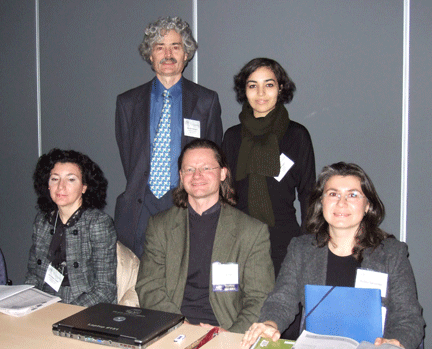
Left to right, Jocelyne Cesari, Dan Varisco, Jens Kreinath, Nadia Fadil, Refika Sarionder at AAR in Montreal

Last Saturday at the annual meeting of the American Academy of Religion I had the privilege of serving in a “responding” role on one of the first panels on the program. This was a session entitled “Talal Asad and the Anthropology of Islam,” organized by Jens Kreinath (Wichita State University), presided over by Refika Sarionder (University of Bielefeld) and with presentations by Jocelyne Cesari (Harvard University), Nadia Fadil (Katholieke Universiteit, Leuven), Jens Kreinath and Bruce B. Lawrence (Duke University). [Abstracts of the panel and papers are posted at the bottom of my comments.]

Following a typically powerful presentation by Bruce Lawrence and placed in the difficult role of representing Talal Asad (who was not present), I began my remarks by noting that I felt myself between a rock (a solid one at that) and a hard place. Drawing on my anthropological roots, I offered myself in the metaphorical role of Thomas Henry Huxley to Darwin, dubbing my wrapping-up task as akin to Asad’s Bulldog. This is not to say that the papers were overtly critical of Dr. Asad’s work; on the contrary, all expressed appreciation of his work as formative in their own ideas. Yet, in reading over the individual papers I detected several criticisms that stem more from dealing with isolated comments than considering the impressive and expanding corpus of Asad. I decided the best approach was to sum up what I see as some of the reasons the continuing intellectual trajectory of Dr. Asad is useful for those of us interested in something that might be called an “anthropology” of Islam.


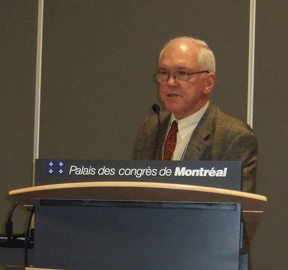
Bruce Lawrence at AAR in Montreal

Continue reading Talal Asad and the Anthropology of Islam

Ignorance is no Excuse


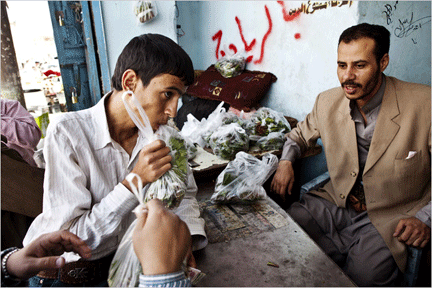
Selling qât in Sanaa, Yemen’s capital. Photo: Bryan Denton

These days if you run across an article on Yemen, it will no doubt feature a scenario of gun-toting tribesmen swearing allegiance to Al-Qaeda, the latest German tourist hijackings or feigned shock at the terrible, terrible addictive drug called qât. At least this was the case in Sunday’s New York Times in another piece of mixed journalistic pablum by roving reporter Robert Worth. Entitling the article “Thirsty Plant Dries Out Yemen,”, the author seems unaware that the site of his posting (Jahiliya) is in fact the Arabic term for the time of “Ignorance” before the rise of Islam. I doubt this reporter stepped out of a Queen-of-Sheba-era time machine and interviewed Abraha about his recent defeat at the “Battle of the Elephant” before Mecca. So where exactly is the fabled posting site of Jahiliya? Ironically, it is part of a World Bank irrigation project. I will leave the irony about IMF money being poured into Jahiliya in the strict sense to the imagination of the reader. And I strongly suspect the posting was made from a fancy hotel in the capital Sanaa and not from a rural internet cafe, while sipping qishr. But for a front page article on a major newspaper, ignorance is no excuse. Continue reading Ignorance is no Excuse

Beeman on Iran in Obama Era

AWAC Presents: Dr. William Beeman

Posted in AWAC Presents

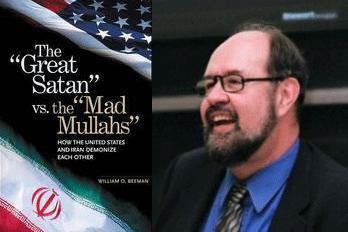
Listen to Dr. William Beeman on U.S. – Iranian Relations During the Obama Era this week on KSKA’s Addressing Alaskans, Thursday (Oct 29) at 2:00 pm, repeating Wednesday (Nov 4) at 9:00 pm on FM 91.1. Recorded at the Alaska World Affairs Council luncheon on Friday October, 23 Dr. William Beeman is the President of the Middle East Section of the American Anthropological Association and Professor & Chair of the Department of Anthropology, University of Minnesota.

Audio will be available under Addressing Alaskans following the radio broadcast Thursday at 2:00 pm.

Mapping the Global Muslim Population


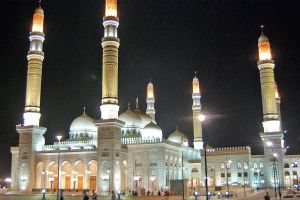
The “President’s Mosque” in Sanaa, Yemen

Mapping the Global Muslim Population
A Report on the Size and Distribution of the World’s Muslim Population

The Pew Forum on Religion and Public Life, October 2009

Executive Summary

A comprehensive demographic study of more than 200 countries finds that there are 1.57 billion Muslims of all ages living in the world today, representing 23% of an estimated 2009 world population of 6.8 billion.

While Muslims are found on all five inhabited continents, more than 60% of the global Muslim population is in Asia and about 20% is in the Middle East and North Africa. However, the Middle East-North Africa region has the highest percentage of Muslim-majority countries. Indeed, more than half of the 20 countries and territories1 in that region have populations that are approximately 95% Muslim or greater.

More than 300 million Muslims, or one-fifth of the world’s Muslim population, live in countries where Islam is not the majority religion. These minority Muslim populations are often quite large. India, for example, has the third-largest population of Muslims worldwide. China has more Muslims than Syria, while Russia is home to more Muslims than Jordan and Libya combined. Continue reading Mapping the Global Muslim Population

Ardi, We hardly knew yah

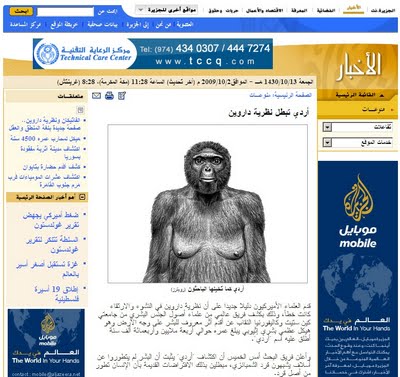
Making sense of Al Jazeera’s strange coverage of “Ardi”

by Salman Hameed, Irtiqa, A Science & Religion Blog, October 13, 2009

About two weeks ago, Science included a series of papers about our 4.4 million year old ancestor Ardipithicus or “Ardi”. It is a fascinating find that has justifiably garnered attention worldwide. You can read the details in Science (there is also a nice short video there) and an excellent description on The Loom.

However, Al Jazeera gave an interesting spin to the same story. Lina Malkawi translates the story on her blog and points out the bizarre coverage by the Arabic version of Al Jazeera, where the headline reads: Ardi refutes Darwin’s theory (the screen shots on the right are from Lina’s blog). And one goes, huh?! Did Al Jazeera any thing about Ardi? Hey – if not the original Science article, at least read the summary of the findings (they could have at least watched the short video that explains the findings). Continue reading Ardi, We hardly knew yah

Healing Herbs in Yemen


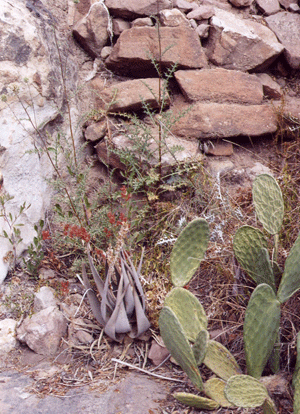
Aloe and Opuntia (balas Turkî) in al-Ahjur, central highlands of Yemen

Today I am flying on Lufthansa to Leipzig, and then on to Halle Wittenberg for a conference called “The use of herbs in Yemeni healing practices. An interdisciplinary workshop on traditional knowledge and cultural concepts in scientific perspective.“ The conference takes place September 25-26, 2009 at the Orientwissenschaftliches Zentrum , Martin-Luther-Universität Halle-Wittenberg, Germany. It has been funded by the Royal Ontario Museum Foundation, Ryerson University (both Toronto/Canada), and Martin-Luther-Universität Halle-Wittenberg, Germany. Click here for the order of the program.

The organizers are Dr Hanne Schönig (Orientwissenschaftliches Zentrum
Martin-Luther-Universität Halle-Wittenberg, homepage: http://www.owz.uni-halle.de/owz.php?pid=2) and Dr Ingrid Hehmeyer (Department of History, Ryerson University, Toronto, homepage: http://www.ryerson.ca/history/faculty/Hehmeyeri.html) and Dr Anne Regourd, Collaborateur Scientifique, Dept of Islamic arts, Musée du Louvre, Paris – France, homepage: http://www.anne.regourd.org.

The conference participants and papers are noted below: Continue reading Healing Herbs in Yemen