Category Archives: Anthropology/Sociology

Toronto Talks

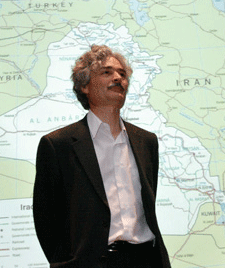
If you are reading this post today, Wednesday, I may very well be in the air on my way to Toronto, where I will be giving two lectures. Anyone who is interested is invited to attend.

Thursday, January 14th, 2010

Interdisciplinary Perspectives on Science
presents:

Daniel Martin Varisco (Hofstra University)

Star Gazing through Religious Phrasing: The Origins of a Lunar Zodiac in Early Islamic Astronomy

At Ryerson University in ENG LG14, George Vari Engineering and Computing Centre, 245 Church St. from 6:00pm to 8:00pm.

One of the most important astronomical time-keeping calendars from the Arabian Peninsula is the so-called anwâ’, which early Muslim astronomers equated with the tradition of 28 lunar stations (manâzil al-qamar). Through a study of this calendar in pre-Islamic Arabic poetry and Arabic lexical texts and by comparison to ethnographic accounts of existing Arabian star calendars, I argue that the system described in the evolving Islamic science of astronomy is one that did not arise in the Arabian Peninsula but was the result of cleansing the magical elements out of the earlier star lore and modeling this on the lunar zodiac of Sassanid Iran and India.


Refreshments will be served after the discussion.

The second talk will take place at the University of Toronto on Friday, January 15:

Anthropology Colloquium Series

Daniel Martin Varisco (Hofstra University)

The Culture Concept without a Textual Attitude: Reading against Orientalism and between the lines of Culture and Imperialism

Friday, January 15th, 2010. 2-4pm. Room 246.

Department of Anthropology, University of Toronto, AP 246, 19 Russell St.

My paper for the University of Toronto is available online as a pdf.
Teaching at the margins

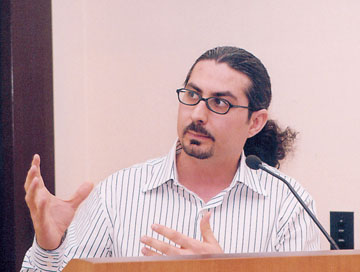
[Webshaykh’s note: Dr. Omar Dewachi, a recent graduate in anthropology from Harvard University, writes about his experiences teaching medical anthropology in Beirut. Here is the first paragraph of his essay, which can be uploaded in full as a pdf at http://www.alterites.ca/dernier.html.]

Teaching at the Margins: Experiences of Anthropology and Medicine in a Middle Eastern Setting

by Omar Dewachi, Altérités 6(2):129-135, 2009

For the last four years I have been teaching the Social Preventive Medicine (SPM) course to first year medical students at the American University of Beirut (AUB) in Lebanon. Around eighty students attend this core course, which is part of the teachin of public health within the medical curriculum. During the course of these years I have attempted to use the SPM as a platform to introduce theories and methods in medical anthropology to medical students. As both a medical doctor trained in Iraq – and an anthropologist – trained in the United States – this task has presented me with many challenges, as well as, offered me insights into tensions between the two fields. These experiences are the subject of this essay, which attempts to explore teaching at the margins of anthropology and medicine in a Middle Eastern setting. While situated at different margins, I reflect on how this course became an interesting site for exploring the complex task of teaching medical anthropology in a non-western context, while, at the same time, raising a set of paradoxes that are particular to teaching medical anthropology in a post-colonial setting. My attempt here is not to generalize my experiences or to reify the dichotomy of East and West; rather it is to situate them within their social-political, economic and historical realities.

To read the entire article in pdf, click here.

Grinding a Greater Axis of Evil


“Yemeni protesters staged a demonstration in the southern part of the country on Thursday after a raid against Qaeda militants”: Photograph from Agence France-Presse for The New York Times

In the midst of two unfinished major wars, the United States has quietly opened a third, largely covert front against Al Qaeda in Yemen. Eric Schmitt and Robert Worth, The New York Times, December 27, 2009

Terrorism takes a toll far beyond the lives lost everyday, even when a plot is thwarted. On Christmas day a 23-year-old Nigerian named Umar Farouk Abdul Mutallab attempted to set himself off as a human bomb on a Northwest Airlines flight from Amsterdam to Detroit. On the surface he hardly fit the profile of a crazed militant fresh out of a training camp in the hills of Pakistan. His father was a recently retired chairman of First Bank of Nigeria and he is an engineering student at University College London. But it now seems that his father was so concerned about his son’s politics that he warned the U.S. embassy about him just a month ago. Initial reports indicate that the explosives were said by Mutallab to be provided by al-Qaeda in Yemen. Based on this claim certain U.S. politicians, most notably Senator Joseph Lieberman of Connecticut, have called for Yemen to be added to the growing terrorist axis of evil. “So I leave you with this thought that somebody in our government said to me in the Sana’a, the capital of Yemen. Iraq was yesterday’s war. Afghanistan is today’s war. If we don’t act preemptively, Yemen will be tomorrow’s war. That’s the danger we face.” Lieberman told Fox News.

Lieberman is actually calling for Yemen to become today’s war, but the key to his thinking is best summed in another line from the same interview: “We’ve got to constantly be thinking like the terrorists here.” Well, Joe, this is the problem. You are thinking like the terrorists when you suggest going into a country you know nothing about and dropping bombs. Unfortunately, it appears we have already started doing that. Continue reading Grinding a Greater Axis of Evil

Poetry out of Arabia

[Webshaykh’s note: Dr. Saad Sowayan, as the post below will explain, has been collecting, analyzing and documenting the oral poetic traditions of the Arabian Peninsula, especially his native Saudi Arabia, since his graduate research. He has now completed two major works, available for reading on the internet, but still in search of an appropriate publisher. I invite readers to look over his impressive documentation and analysis and communicate with Dr. Sowayan any ideas that may help forward his project.]

by Dr. Saad Sowayan, King Saud University

After 10 years of continuous hard work, I managed to finish the two books, which, taking the size and importance of each, I consider to be my lifetime projects.
A) Legends & Oral Historical Narrative from Northern Arabia (1131 pages)
B) The Arabian Desert: Its Poetry & Culture Across the Ages: An Anthropological Approach (820 pages).

The first work, as its title says, is a collection of Bedouin narratives and poems relating to tribal genealogies, camel marks, tribal territories, water wells, sheikhs, warriors, tribal judges, tribal poets, personal histories, as well as narratives relating to raids and counter raids amongst tribes and other events. All of these are told by competent narrators & reciters in the various tribal dialects and all go back to pre and early 20th century. I have been engaged in taping this voluminous material during the span of the 4 years extending from 1982 up to 1985. Since 1995 I have been engaged in archiving, indexing, transcribing and editing this taped material which came to a total of several hundred hours of recorded interviews. Legends & Oral Historical Narratives from Northern Arabia (1131 pages) is the result of this effort very carefully transcribed and edited in Arabic script with full voweling tashkeel. The work comes with a very detailed table of contents and an introduction explaining the nature of the material along with some linguistic remarks and explanation of the transcription method I used. All in all, the work is a primary source on Arabian nomadic tribal culture, oral literature and vernacular language. This work constitutes a compliment to the works of P. Marcel Kurpershoek published in English by Brill in Leiden. Continue reading Poetry out of Arabia

Broken Taboos in Post-Election Iran

by Ziba Mir-Hosseini, Middle East Report Online, December 17, 2009

The on-camera martyrdom of Neda Agha-Soltan, the 26-year old philosophy student shot dead during the protests after the fraudulent presidential election in Iran in June, caught the imagination of the world. But the post-election crackdown has two other victims whose fates better capture the radical shift in the country’s political culture. One victim was the protester Taraneh Mousavi, detained, reportedly raped and murdered in prison, and her body burned and discarded. The other is Majid Tavakoli, the student leader arrested on December 8, after a fiery speech denouncing dictatorship during the demonstrations on National Student Day.

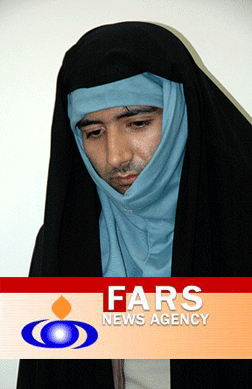
Following his arrest, pro-government news agencies claimed Tavakoli had been caught trying to escape dressed as a woman and published a series of photographs showing him wearing a headscarf and chador — a common version of the “modest” garb (hejab) mandated for women by the Islamic Republic. Attempts at flight in such gender-bending disguises are a classic trope in Iranian political history. The best-known instance was when the first president of the Islamic Republic, Abol-Hasan Bani-Sadr, after his deposition in 1981, allegedly fled the country in women’s dress — the Fars News Agency put a photo of him in a scarf next to that of Tavakoli. But in pre-revolutionary Iran clerics, too, such as Ayatollah Bayat, are said to have evaded the Shah’s authorities by concealing themselves beneath chadors, which pro-government media outlets now choose to ignore. Continue reading Broken Taboos in Post-Election Iran

Richard Antoun, 1932-2009


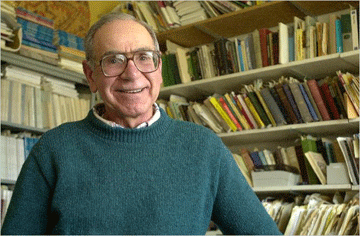
Richard Antoun

Last Friday, like many of my fellow anthropologists, I was attending the annual meeting of the American Anthropological Association in Philadelphia. I was excited to be back in Philly, where I went through the graduate program in anthropology in the 1970s. At a session on Saturday I heard the alarming news that emeritus Prof. Richard Antoun had been killed the day before. Following on the continual newsworthy but ethically unworthy chain of killings in the media spotlight, this was all the more a shock since it involved someone whose work I knew and whom I had met at previous professional meetings.

Details are emerging about who did it, but the “why” is no doubt locked away in the mind of the graduate student who committed the crime. I attach information from a memorial presented on EphBlog:

Student Held in Killing of New York Professor

A 46-year-old Binghamton University graduate student from Saudi Arabia was charged on Saturday with killing a retired anthropology professor, a specialist in Islamic and Middle Eastern studies, with whom he had worked, the authorities said. Continue reading Richard Antoun, 1932-2009

Talal Asad on Anthropological Inquiry

[Note: In preparing for my role to respond to presentations on the work of Talal Asad and the Anthropology of Islam at AAR recently, I reread portions of the edited volume Powers of the Secular Modern (edited by David Scott and Charles Hirschkind, Stanford University Press, 2006, pp. 206-207). In doing so I found a valuable excerpt at the start of Asad’s specific responses to the essays int he volume. Given the interest at the AAR meeting in anthropological and ethnographic approaches to Islam, I think Asad’s general comments below on the role of anthropology are relevant and worth perusing.]

The only point I want to stress at the outset is that for me anthropology is a continuous exploration of received ideas about the way given modes of life hang together. More precisely: What is included or excluded in the concepts that help to organize our collective lives? How? Why? With what probable consequences for behavior and experience? Such an inquiry requires that one be ready to break out of the coercive constraints of Sociological Truth — the axiom that the social is the ground of being. The results, however provisional, can be uncomfortable, and they may sometimes point to politically incorrect conclusions. What we eventually do with them is another matter, because we are not abstract intellectuals. All of us live in particular forms of life that constantly demand decisions and that in general presuppose a variety of commitments. And we all have particular memories, fears, and hopes. Continue reading Talal Asad on Anthropological Inquiry

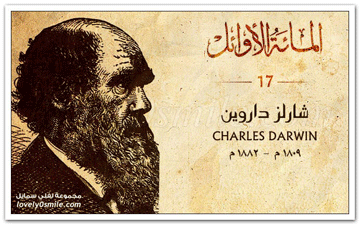
Darwin, Egyptian Style

MEMO FROM ALEXANDRIA
Harnessing Darwin to Push an Ancient Intellectual Center to Evolve

By MICHAEL SLACKMAN, The New York Times, November 26, 2009

ALEXANDRIA, Egypt — It is not that Charles Darwin and the theory of evolution are unknown here. But even among those who profess to know something about the subject, the common understanding is that Darwin said man came from monkeys.

Darwin, of course, did not say man came from monkeys. He said the two share a common ancestor. But to discuss Darwin anywhere is not just to explore the origin of man. It is inevitably to engage in a debate between religion and science. That is why, 150 years after Darwin published “On the Origin of Species,” the British Council, the cultural arm of the British government, decided to hold an international conference on Darwin in this conservative, Sunni Muslim nation.

It was a first.

“A lot of people say his theories are wrong, or go against religion,” said Martin Davidson, chief executive of the British Council. “His ideas provoke, but if we are going to understand each other, we have to discuss things that divide us.” Continue reading Darwin, Egyptian Style