Category Archives: Anthropology/Sociology

Horn Talk in Lamu


Dhow near Lamu at sunset

I am writing this from the exquisite Island of Lamu in Kenya. As someone who has spent over thirty years rambling around Yemen, across the Gulf of Aden, it is quite eye-opening to take a look up at the southern part of the Arabian Peninsula from an African perspective, especially a view that has been influenced in many ways by earlier generations of migrants from Yemen. It would be nice if I was here only because it is such a beautiful tourist spot with a rich cultural heritage, and indeed all this is nice, but I am actually attending an annual seminar on the Horn of Africa hosted by the Rift Valley Institute. The organizers recognized that cultural history and contemporary politics in the Horn can hardly be separated from Yemen, which lies so close across the Red Sea and Gulf of Aden. Hence I was invited to contribute on the links between Yemen and the Horn and also to discuss the relevance of Islam and the contentious issue of “Islamism.” Continue reading Horn Talk in Lamu
Islam and Feminism


Photograph by Tom Hartwell

Islam and Feminism

by Hania Sholkamy, Contestations, Issue #1

Islam and feminism have had a troubled relationship. Over the last two decades, scholars and activists have questioned the western credentials of feminism and claimed justice as a purpose and possibility that can be captured via religious routes. Religion provides women with an ethical framework and a moral foundation that recognizes their rights as individuals and as a collective, albeit redefining equality in the process. The mosque movement in Egypt has empowered women to find dignity, companionship and comfort through piety and conformity to a religious ideal and challenge the less-than-perfect world around them. Moreover by engaging with religion, Muslim women are able to redefine the tenets that have endowed Islam with an unnecessary bias for men; one which feminist scholars of Islam are certain is antithetical to the spirit and philosophy of our religion.

Such serious engagements are, however, quite separate and distinct from the popularization of religion as a veneer that enables anyone to get away with anything! Continue reading Islam and Feminism

ON MILITANCY AND THE ART OF THE EGG

The Colloquium for Unpopular Culture and NYU’s Program for Asian/ Pacific/ American Studies present a new series: AUSCULTATIONS: sound, noise, (nervous heart)beats

FLAGG MILLER (University of California at Davis)
ON MILITANCY AND THE ART OF THE EGG: THEOLOGICAL LESSONS FROM THE OSAMA BIN LADEN AUDIOCASSETTE COLLECTION

Cosponsored by NYU’s Hagop Kevorkian Center for Near Eastern Studies

When: Monday 19 April 2010, 12:30pm
Where: Room 471, 20 Cooper Square (East 5th and Bowery)
Free and open to the public

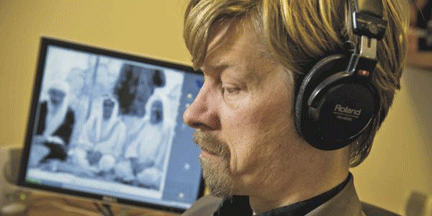
The alleged fantasies of Islamic militants provide Western audiences with an ample repertoire not only for stereotyping Muslims but also for severing acts of terror from realms of human experience. With the aim of bringing Muslim militants’ narratives of violence back to the complexities of situated cultural interaction, Flagg Miller will investigate the ways in which militancy is conceptualized through audiocassette-mediated sound production. In the winter of 2002, over 1500 audiocassettes from Osama Bin Laden’s former compound in Qandahar, Afghanistan were acquired by Cable News Networks. Miller will focus on one cassette entitled “With the mujahidin” (ma` al-mujahidin) that features participants cooking breakfast in a makeshift Afghan Arab kitchen. Continue reading ON MILITANCY AND THE ART OF THE EGG

Islamic Folk Astronomy #5

The Pleiades Conjunction Calendar

One of the indigenous calendars from the Arabian Peninsula is based on the monthly conjunction of the Pleiades with the moon. The moon conjuncts with the Pleiades about once every 27 1/3 days. This conjunction was visible monthly from autumn through spring and occurred about the same time each year; thus it coincided with the main parts of the pastoral cycle on much of the Arabian Peninsula. According to Abû Laylî (in al-Marzûqî 1914:2:199), these conjunctions began at the time of the autumn wasmı rain. This observation is still found among contemporary Sinai Bedouins (Bailey 1974:588). Ibn Qutayba (1956:87) noted that when the moon conjuncts with the Pleiades on the fifth day of the lunar month, winter goes away. The new moon coincides with the Pleiades during the month of Nîsân or April during the naw’ of simâk. This was considered to be one of the most fortunate star movements in the sky, perhaps because of its unique annual character. Shortly thereafter the Pleiades disappears from view at the start of the heat. Continue reading Islamic Folk Astronomy #5

Ann Dunham and Indonesia

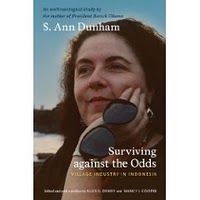
Last fall Duke University Press published the Ph.D. thesis of S. Ann Dunham, President Obama’s mother, who just happened to be an anthropologist. I can certainly sympathize with the editors, as my own dissertation also bordered on the 700 page level (which may be one reason it was never published as a book). Details on the book can be found at Duke University Press. But I attach here a valuable account by Michael Dove for the New York Times last August.

Dreams From His Mother

By Michael R. Dove, The New York Times, August 10, 2009

PRESIDENT OBAMA’s late mother, Ann Dunham Soetoro, was famous for the good cheer and optimism that she preserved in the face of a complex and challenging world. Her personality went hand-in-hand with her career as an anthropologist in Indonesia and Pakistan, where she studied and worked with village craftsmen, slum-dwellers and countless others. I knew Dr. Soetoro as a friend and colleague for many years before her death from cancer in 1995. Though I only met her son once, briefly at her memorial service, I’ve watched him as he’s taken on the hardest job in the world, and often found myself wondering how her worldview might have shaped him. Continue reading Ann Dunham and Indonesia

On the honor of being dissed

About two and a half years have passed since my Reading Orientalism: Said and the Unsaid was published by the University of Washington Press. Being an academic book, as opposed to a short-life trade paperback written for anyone who might have failed Middle School English, the reviews have come in a trickle rather than due to a publisher’s promotional media torrent the week of launch. One of the first reviews came in the TLS from Robert Irwin, one of the most qualified reviewers and an astute student of Orientalism himself. Irwin found that my book is “closely argued” and “makes for exhilarating reading,” despite the annoying (intentionally so) stream of puns. I appreciate a thorough German review by Siegfried Kohlhammer, who was kind enough to remark: “Jede Verteidigung von Orientalismus wird sich mit dieser sorgfältigen und präzisen Summa der Said-Kritik auseinandersetzen müssen.” In Common Knowledge, David Cannadine continues sweet music to an author’s ear by concluding that my book “is an important and impressively documented work, which deserves a wide audience.”

But now along comes a review that is breathtaking (I tend not to breathe when I am convulsed in laughter), however, one that I am honored to receive. The venue is telling: the Middle East Forum, which is affiliated with the websites of Campus Watch, Daniel Pipes and Islamist Watch. Were I to receive a favorable review from this forum-idable group, I could only conclude that my book was an utter failure and would be tempted to buy back all the existing unsold copies for a large Obsession-triggered book burning. I can now breathe a sigh of relief that a site defending the offensive opinions that I set out to counter has seen fit to dismiss my book as an uninformed and witless screed. Continue reading On the honor of being dissed

Warren’s Geography #2: Mirage in the Desert

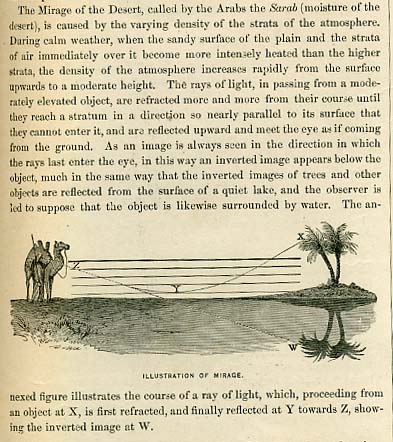
In a previous post I discussed two lithographs from the 1873 edition of Warren’s geography. One of the more fascinating illustrations is one explaining the desert mirage. Here is the discussion and image from the text.

Excerpt from D. M. Warren, An Elementary Treatise on Physical Geography. Revised by A. von Steinwehr. (Philadelphia, Cowperthwait & Co., 1873), p. 67.

to be continued …