Category Archives: Anthropology/Sociology

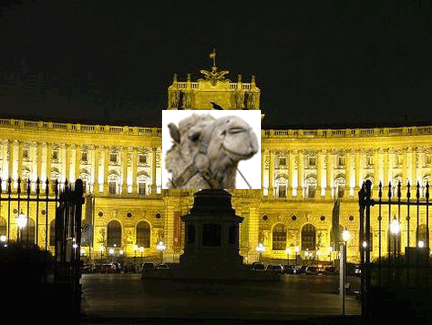
Camels in Vienna


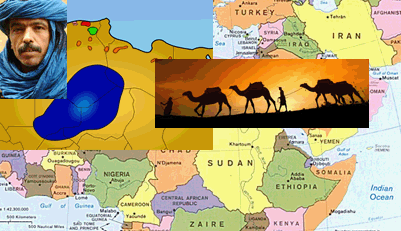
Today I am leaving for Vienna and the forthcoming “Camels in Asia and North Africa
Interdisciplinary workshop” to be held Tuesday & Wednesday 5-6 October, 2010 at the
Austrian Academy of Sciences, AAS, Dr.-Ignaz-Seipel-Platz 2, 1010 Vienna. If you have an interest in any aspect of camels and are near Vienna, Austria, you might want to join in.

Here are the details, also available in pdf from the website.

This workshop aims at a comprehensive discussion on Old World camels (Dromedary and Bactrian camel) including the following topics:
• Origin and domestication
• Conservation of the wild Bactrian camel
• Veterinary folk medicine
• Socio-economic significance: Breeding, caring, trading
• Art: Petroglyphs, poetry and music
• History and Symbolism of camels in Asia and Austria

These issues will be addressed by scholars from the natural sciences as well as from the social sciences and humanities Continue reading Camels in Vienna

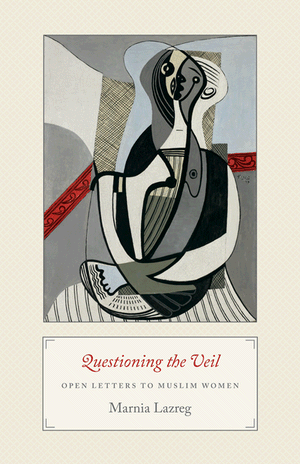
Questioning the Veil


[Editor’s note: Marnia Lazreg’s Questioning the Veil: Open Letters to Muslim Women (Princeton: Princeton University Press, 2009) is a refreshing unveiling of the long debated arguments on the use of some sort of “veil” in Muslim societies. These letters, concise and impassioned arguments in essay format, are for all to read. Modesty? Protection against sexual harassment? Newly formatted cultural identity? Conviction and Piety? Lazreg draws on her own upbringing in Algeria and research as a sociologist to frame her conviction of why Muslim women should not wear the veil. No one interested in the ongoing discussion should fail to read her important contribution. I provide here a brief excerpt from her Introduction.]

I do not approach veiling from the perspective of the struggle between “tradition” and “modernity,” which purportedly women resolve by opting for the veil, as a number of studies have claimed. New styles of veiling are less confining to a woman’s ability to move about than old ones, and a number of veiled women throughout the Muslim world have been carrying out their professional activities side by side with men in their workplaces. Nor do I consider wearing a veil at work as ushering in a new form of “modernity.” Furthermore, I do not intend to characterize veiling as representing women’s “alienation,” “enslavement,” or “subjugation” to cultural norms. Such characterizations are unhelpful as they can easily be applied to our postmodern condition, marked as it is by a retreat from a meaningfully shared human experience and the flaunting of privatized forms of consciousness, which result in conceptions of women that are as detrimental to women’s integrity as the veil might be. Continue reading Questioning the Veil

Is there one “Islam” or many “islams”?


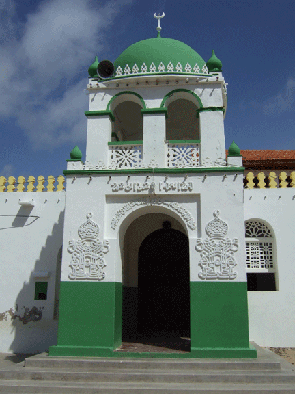
Riyadiya Mosque, Lamu

The essential problem in the study of Islam is precisely that: essentialist reduction of a diverse religious tradition across cultures into an ideal essence. In a provocative article published three decades ago, Muslim anthropologist Abdul Hamid el-Zein wondered in print “if a single true Islam exists at all.” (1) This was not an attempt to dismiss the faith of Islam, but a challenge to scholars who blithely assume the existential ‘truth’ of concepts. “But what if…” asked el-Zein, analysis of Islam “were to begin from the assumption that ‘Islam,’ ‘economy,’ ‘history,’ ‘religion’ and so on do not exist as things or entities with meaning inherent in them, but rather as articulations of structural relations, and are the outcome of these relations and not simply a set of positive terms from which we start our studies?” (2) If so, he reasoned, it would do no good to start with a textbook version of the five pillars, a famous scholar such as Ibn Khaldun, or a Western sociologist like Max Weber, because all this is what Islam is supposed to be. For el-Zein, true to his anthropological roots, it was important to start with the “native’s model of Islam” as it is articulated in a given social context. This is not because the native is “right,” a nonsensical term for non-theologian el-Zein, but in order to see how Muslims adapt what analysts call “religion” to everyday life. Continue reading Is there one “Islam” or many “islams”?

Dance Workshop & Discussion: Leila of Cairo and Anthropologist Najwa Adra


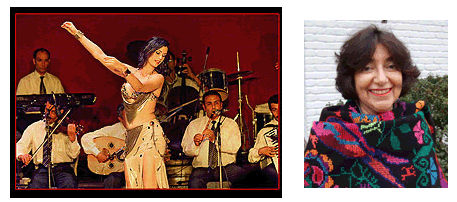
Leila, left; Dr. Najwa Adra, right

Dance Workshop & Discussion: Leila of Cairo and Anthropologist Najwa Adra
Wednesday, September 1, 2010 6:00 pm at Alwan for the Arts

Workshop: 6:00-8:30 pm
Discussion: 8:30-10:00 pm

This evening of dance and discussion provides an opportunity much needed in the bellydance scene: to both embody the feeling of Egyptian raqs sharqi through movement and music, and also to speak to the controversial issues surrounding the dance through dialogue with experts. Alwan welcomes acclaimed dancer Leila of Cairo, and esteemed scholar Najwa Adra, to kick off its 2010-2011 season of culturally contextualized, quality dance and performance.

Dance Workshop with Leila of Cairo

Understanding Classical Egyptian Music for Dance

6:00-8:30 pm

The historic songs of Oum Kalthoum, Abdel Halim Hafez and Warda can be intimidating for dancers of all levels. Join Leila as she navigates through the musical structure of these complex compositions. Explore Egyptian versus Western interpretation of these songs, and utilize Egyptian technique to express the music and ultimately, yourself, within the dance.

Take advantage this rare opportunity to learn with Cairo-based, American-born Leila, who has won over Egyptian audiences with her dance, film and stage appearances.

Discussion with Najwa Adra PhD and Leila

Raqs, What’s the Point? Diverging Bellydance Traditions in Egypt and the U.S.

8:30-10:00 pm

This discussion focuses on differences of perception, meaning, context and technique of the dance known simply as raqs or raqs sharqi in the Arab world, and as bellydance in the US. Leila draws upon her experiences as a US-born dancer who has an exceptionally successful career as a performing artist in Eygpt, while Najwa highlights related issues from her fieldwork research, writings and lifetime of participating in social dance traditions of the Arab world. The talk-back will touch upon notions of authenticity, cultural appropriation and orientalization in the dance. Come with questions and comments! Continue reading Dance Workshop & Discussion: Leila of Cairo and Anthropologist Najwa Adra

Yemen: not on the verge of collapse

by Steven C. Caton, The Middle East Channel, August 11, 2010

The Republic of Yemen is often spoken of in the press and in policy circles as a society on the verge of collapse (last year it was “another Somalia”), based largely on two claims, the first being the supposed weakness of its state, the other the supposed lawlessness of its tribal population that makes up the majority ethnic group (about seventy-five percent are settled agriculturalists in the mountains and another five per cent, nomadic Bedouin in the eastern desert). And supposedly being on the verge of collapse, Yemen is seen as vulnerable to take-over by terrorist organizations such as al-Qaeda that threaten America’s and the region’s security. Let us consider how tribe and state, law and conflict operate in Yemen that few analysts seem to grasp when they make these pronouncements.

History may provide some perspective. There has been a state or dawlah in Yemen for thousands of years, whether the Sabaean state that built Marib Dam and was the reputed homeland of the Queen of Sheba, or the Islamic state created shortly after the advent of Islam which lasted for a thousand years, or the republican state that came into being in 1962 and has lasted until the present day, despite two bitter civil wars. To be sure, the state has waxed and waned in power and contracted or expanded in territory during this history, and it has faced formidable outside opponents, beginning with the Romans and most recently with al-Qaeda, but it has never fully collapsed or disappeared from the scene. It is unlikely to do so in the present in spite of arguments that the current regime is at a tipping point and about to fall apart because of an unprecedented number of seemingly intractable problems facing it (an ever weakening economy, unsustainable water consumption, projected diminished oil reserves, conflicts between the state and certain regional populations, rampant corruption, and let us not forget al-Qaeda). Continue reading Yemen: not on the verge of collapse

Worth a Response: Why Yemen is not Afghanistan


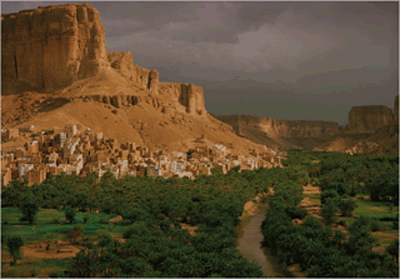
“The village of Rihab in Wadi Dawan, a valley that is the ancestral home of Bin Laden”; Simon Norfolk/Institute, for The New York Times

Yemen hardly ever makes the news unless a journalist wants to rail against the green-dribbling khat habit of grown men who wear skirts or trump with the terrorism card. In the Sunday Magazine of The New York Times, Robert F. Worth asks the provocative question: “Is Yemen the Next Afghanistan?” For an article that begins with a photograph of the valley “that is the ancestral home of Bin Laden” and mentions an American cruise missile in the first line, it hardly takes a Ph.D. to figure out what the answer is most likely to be in the mind of the reader. Worthy reporter that he is, The New York Times Middle East correspondent does not directly answer the question. He does not need to, since the Al Qaeda-laced narrative itself hinges on the comparison. The article ends with a visit to an “old man with a deeply lined face” and who walks with a cane. When asked if his son, an Al Qaeda figure described in the story, was really part of the plot in the 2000 bombing of the U.S.S. Cole, the father responds:

‘No,’ he said, ‘ I don’t believe this.’ He was silent for a long time, staring at the closed door of the house, which was illuminated at its edges by a bright rectangle of afternoon sunlight. then he spoke again.
‘He is a mujahid,’ he said, or holy warrior. ‘He is fighting those who occupy Arab lands. He is fighting unbelievers.’

I have read a number of articles by journalist Worth, usually with a favorable view of his ability to introduce nuance into what is generally a black-and-white portrayal of things Arab and Islamic. For this article, he contacted diplomats (former Ambassador Hull) and scholars (Gregory Johnson) who are knowledgable about recent political events in Yemen. He is also to be commended for learning some Arabic, although I am not sure his year-long training in classical will be of much help in casual conversation in dialect. Yet he visited Yemen and actually talked to local people and not just the other reporters in the pool. In this sense, the reporting is not bad, certainly not like The Daily News or Fox News engineering. The problem is that neither is the article very good. The question in the title, which perhaps was not the journalist’s choosing given the control of editors, is blatantly rhetorical, not a genuine search for an answer that goes beyond the verbal War on Terror jousting on all sides of the aisle in Washington and in much of the media. Continue reading Worth a Response: Why Yemen is not Afghanistan

Berbers out of Yemen?


Why they thought the Berbers came from Yemen

by Lameen Souag, Jabal al-Lughat, June 23, 2010

A long-standing tradition in North Africa, convincingly rejected by Ibn Khaldūn but perpetuated by poets and curricula alike, claims that some major Berber tribes descend from Yemeni Arabs through semi-mythical pre-Islamic kings and their wholly mythical vast conquests. This idea has little to support it, and probably became popular because it allowed these tribes to claim prestigious connections in the context of a high culture dominated by Arab ideas; but why should the connection be specifically Yemeni, rather than, say, North Arabian or perhaps Persian? Linguistics suggests a possible answer. Continue reading Berbers out of Yemen?

The racist fascist in the Queen’s Garden, the fundamentalist preacher on the plane


by Gabriel Marranci, Islam, Muslims, and an Anthropologist, June 21

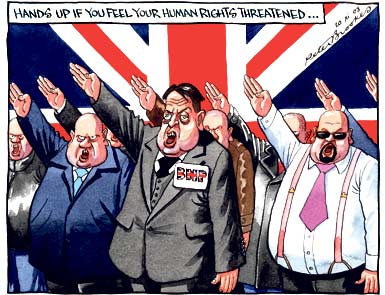
Recently two events made me question how the UK, and Europe in general, understand the concept of ‘freedom of speech’ – the invitation to attend the annual Buckingham Palace garden party extended to white supremacist BNP’s Nick Griffin and the Home Secretary’s decision to ban the popular Muslim tele-preacher Dr Zakir Naik from entering the UK.

There is no one single definition of ‘freedom of speech’ and an attempt to formulate one can only result in empty theorizing and utopian visions. Freedom of speech is linked to local, regional and international contexts, social realities, cultural differences and an understanding of what freedom means. What for one person is ‘freedom of speech’, for another is just ‘freedom of insult’ or ‘unacceptable behavior’.

States, as well as communities, limit individual rights of expression not because of the pleasure of doing so, but for fear of seeing their status quo, and hence power, challenged or questioned. However, the limitation of individuals’ right to express their thoughts and ideas is often justified by the argument that those ideas are ‘repulsive’ or ‘objectionable’ to the system of values held by a supposed majority (i.e. power holders). Said that, many of the ideas, values and concepts that are both well accepted and well liked today have been considered ‘objectionable’ or ‘repulsive’ at one time or another. Continue reading The racist fascist in the Queen’s Garden, the fundamentalist preacher on the plane