Category Archives: Anthropology/Sociology

Iraq, Islam and Sweden


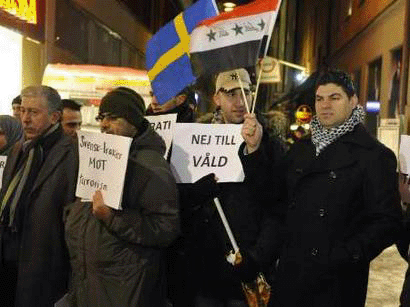
Swedish-Iraqi immigrants protest in central Stockholm, where a car bomb exploded two days ago December 13, 2010. The placard on left reads, “Swedish Iraqis against terrorism”. REUTERS/Bertil Ericson

The recent bomb attempt in Sweden has been linked to an Iraqi who grew up in Sweden. Not much has been written about the influx of Iraqis to Sweden, whose open door policy in the past has led to it being a haven for refugees. However, one of my students, Sarah Skiold-Hanlin conducted an ethnographic project on Swedish reactions to the Iraqi community in the summer of 2008. Her research paper, an Honor’s Thesis in the Department of Anthropology at Hofstra, is available online and I recommend it for anyone wanting more information on the subject of Iraqis in Sweden.

I attach Sarah’s introduction below, but encourage you to read her entire paper:

“One place where many Iraqis have found refuge from the war is Sweden,” stated Renee Montagne, the host of NPR’s Morning Edition. This was her opening line as she introduced the news story titled: Sweden Begins Sending Iraqi Refugees Home. The story aired March 25, 2008. Renee goes on to explain how the “many Iraqis” numbered somewhere in the range of 20,000. A momentary flash of elation followed this opening as my mind began turning over the meaning, estimating its possible weight. Perhaps Sweden, a nation with which I have close family ties, could help rectify the political actions of my country of birth. But like trying to dam the Mississippi River with a box of pop sickle sticks and a bottle of Elmer’s Glue, the flow of refugees fleeing the war in Iraq is far to numerous for one small Scandinavian country to hold. Renee’s voice fervently interjected as she continued washing away my melodic dreams of relief and solution to the persistent humanitarian crisis plaguing so many civilians. “The Swedish government is stopping that flow of Iraqi refugees and sending some back home against their will,” she reported. Continue reading Iraq, Islam and Sweden
Building Southern Sudan


Building southern Sudan through promotion of our history and culture

Dr. Jok Madut Jok, New Sudan Vision, October 15, 2010

(New York) – To be a nation means having a citizenry that takes pride in citizenship in “South Sudan” first and in tribal citizenship second. Such a nation can no longer assume that shared interests alone will continue to unite us. So far, our struggle to wrestle our freedom from the grips of the Khartoum-based successive governments has been the most unifying force for South Sudan. Now that this struggle has seen some success, what will unite us is the desire to build a strong nation together, and such a nation will need a shared identity. Such a shared identity will need to be harnessed, it needs to be politically constructed, and it is our task to forge it.

To this end, I envision my task as undersecretary of the Ministry of Culture and Heritage as joining a collective effort with the minister, the staff of the ministry and other branches of GOSS to set a policy for constructing our nation’s identity.

A solution begins with the correct identification of the nature of the problem. The most significant enemy of South Sudan’s cohesion, national loyalty and the citizens’ pride in their nation will be a growing sense of exclusion from the national platform, media, government programs and access to services. Any citizen who will feel excluded will never develop that important sense of pride in his/her nation. A starting point to addressing the feeling of exclusion is to state the obvious, that South Sudan belongs to all South Sudanese; it does not belong to any ethnic, religious or political group. Continue reading Building Southern Sudan

Pizza my mind


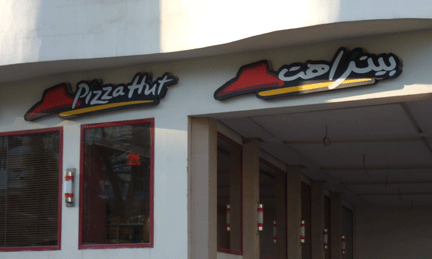
Pizza Hut in Beirut, 2009; photograph by Daniel Martin Varisco

Being Italian by family name, and Sicilian at that, I feel qualified to talk about pizza. Whether or not pizza really was invented in Italy, Italian Americans have made pizza parlors the strip mall contender with Chinese takeouts. Pizza was not invented once, any more than the wheel. Once you start baking flat bread, and that goes back millennia, all you need is a few of the right kinds of droppings and the rest is culinary evolution. In the current global economy food has been ethnicized and consumer friended around the world. The Pizza Hut, with humble beginnings a half century ago in Kansas (yes Kansas!), now boasts franchises throughout the Middle East. There is even a website in Arabic. Of course, real Italians (those with the requisite last names) go to local parlors rather than give in to the fast food giant.

But this commentary is not really about pizza; it’s about what we choose to eat rather than what we actually eat. Choosing Pizza Hut in Beirut is branding yourself, even if you convince yourself it tastes good. Continue reading Pizza my mind

Performing Islam


Performing Islam is the first peer-reviewed interdisciplinary journal about Islam and performance and their related aesthetics. It focuses on socio-cultural as well as historical and political contexts of artistic practices in the Muslim world. The journal covers dance, ritual, theatre, performing arts, visual arts and cultures, and popular entertainment in Islam influenced societies and their diasporas. It promotes insightful research of performative expressions of Islam by performers and publics, and encompasses theoretical debates, empirical studies, postgraduate research, interviews with performers, research notes and queries, and reviews of books, events and performances.

Call for contributions for the second issue: Continue reading Performing Islam

Yemen is Not a Terrorist Factory


Yemen is not a terrorist factory
By Daniel Martin Varisco, Special to CNN, November 8, 2010

Editor’s note: Daniel Martin Varisco is a professor of anthropology at Hofstra University and has visited Yemen over a dozen times for development consulting and research since 1978. He moderates Tabsir, an academic blog on Islam and the Middle East.

(CNN) — Domino theorists love the Middle East. Because of this, a number of media pundits have recently added the little-known country of Yemen as a front in the unsettled aftermath of George W. Bush’s War on Terror.

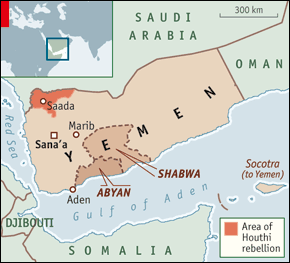
First came the overthrow of the Taliban in Afghanistan, then a protracted war there and in Iraq. Iran is still in the hawkish gun-sights of conservative pundits, but the focus has now shifted to Yemen, a country most Americans could not find on a map. Is Yemen really the terrorist haven we should fear the most?

For the rest of my post on the CNN blog, click here.

Those Yemeni parcels


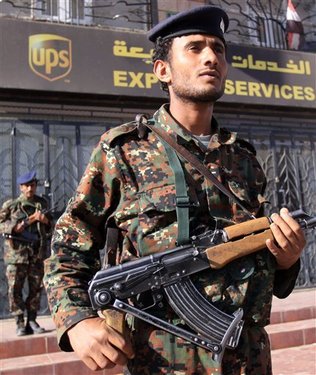
Armed Yemeni police stand guard next to the closed UPS office Thursday, Nov. 4, 2010, in Sanaa, Yemen

[Webshaykh’s Note: The latest from Greg Johnsen, one of the most informed commentators on AQAP and one who needs to be much more widely read.]

Initial Notes on AQAP’s statements
by Gregory Johnsen, Waq al-Waq, Friday, November 5, 2010

I have just finished a first reading of the three statements AQAP posted to jihadi forums earlier today. The one that is getting the most attention – not surprisingly – is the one that takes credit for two parcel bombs and the downing of a UPS plane in Dubai in September.

But for me, by far the most interesting statement is #27, which denies that AQAP had anything to do with two bombs outside a sports club in Aden on October 11. I will return to this below, and talk about why I think this statement is so significant. but first a couple of notes.

Note 1: Statement #28 talks about the fighting in Mudiya on October 14, 2010. I wrote about this fight here, in which the brother of the governor of Abyan was killed. Now we have AQAP’s version of the fighting, interesting details, but probably only to me. So I’ll save you the full discussion.

Note 2 : Another thing that I have noticed is the change in references to President Ali AbdullahSalih now and in the pages of Sada al-Malahim back when it was under the editorial guidance of al-Qahtani, who was killed in an airstrike. Continue reading Those Yemeni parcels

Sudan Open Archive


The Sudan Open Archive offers free digital access to knowledge about all regions of Sudan. It is an expanding, word-searchable, full-text database of historical and contemporary books and documents. The current version, SOA 2.0, incorporates a comprehensive, interactive guide to internet resources on Sudan.

The Sudan Open Archive (SOA) is designed and implemented by the Kenya and UK-based Rift Valley Institute, working with institutional partners in the north and south of Sudan. The Archive was created by DL Consulting using open-source Greenstone archive software developed by the New Zealand Digital Library project at the University of Waikato. It is maintained with support from the J.M. Kaplan Fund. Other partners include UNICEF, UNEP and the Southern Sudan Centre for Census, Statistics and Evaluation.

Abayas for backpacks


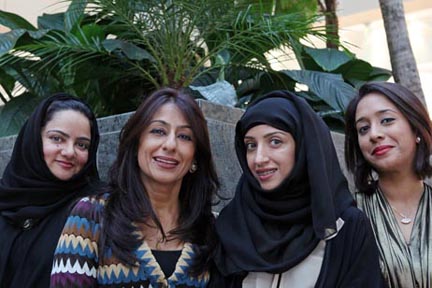
Left to right) Salwan Al Shaibani, 39, Hala Kazim, 47, Maha Jaber, 32, and Aida Al Busaidy, 27, all of Dubai. Kazim recently took the other women on an 80-kilometer hike in Austria through her program, Journey Through Change; Photo by Amy Leang / The National

Hike across Austria raises profile of Emirati women

by Maey El Shoush, The National, October 15, 2010

DUBAI // Five Emirati women who traded their abayas for backpacks have returned from a successful five-day hiking trip through Austria aimed not only at their own personal development but also at breaking down stereotypes outside the UAE.

Their tour was organised through Journey Through Change, a Dubai life coaching and organising company run by Hala Kazim, 47.

Mrs Kazim said: “I wanted to show the ladies and men in our communities, there are more things to life. This was not just a walking trip: I exposed them to different cultures, showed them how to absorb the beauty around them, and counselled them as we walked.”

The group, composed of women from their mid-20s to 40s, walked 80 kilometres, starting at Vienna through Fuschl towards St Wolfgang, across mountainous terrain and past green fields, farms and villages. Dressed down and wearing no makeup, with minimal internet access at the bed and breakfasts where they spent each night, the trip took the women back to basics. Continue reading Abayas for backpacks