Category Archives: Anthropology/Sociology

Mubarak did not get the message


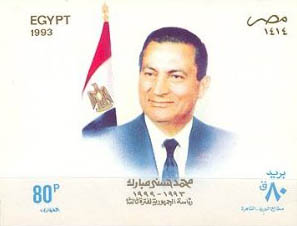
In 1993 Anthropologist Fadwa El Guindi wrote a provocative call for President Mubarak of Egupt to resign. This was almost two decades before events forced him out of office. I post the 1993 commentary by El Guindi here, courtesy of the author.

Mubarak Should Call an Election and Step Aside

Egypt: The country is a wreck; before radicals force a bloody change, he should allow open elections for a successor.

By FADWA EL GUINDI, Los Angeles Times, FRIDAY MARCH 26. 1993

If President Hosni Mubarak is smart, he will take a hard look at the shambles Egypt has become and step down, before he is overthrown or assassinated. An honorable exit might earn him forgiveness for his otherwise disgraceful record.

Egypt had its revolution in 1952, yet it remains a dependency. For example, Egyptian cotton, the highest-quality cotton in the world, is marketed in the United States as towels and bed sheets made in Israel, Britain and America. Egypt’s only part is to provide the natural resource produced by the sweat and labor of peasants living under substandard conditions. This is how it was for Egypt under British colonialism. If Egypt cannot use its very fine cotton to also make and internationally market towels, after 40 years of the revolution that promised industrialization, and if most of its income comes from Westerners visiting the accomplishments of Egyptians of millennia past, something is fundamentally wrong. And it is not fundamentalism, as the government wishes to believe or portray. Continue reading Mubarak did not get the message

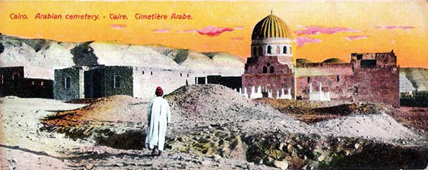
A Geography Lesson from 1879: #4: Arabia and Turkey


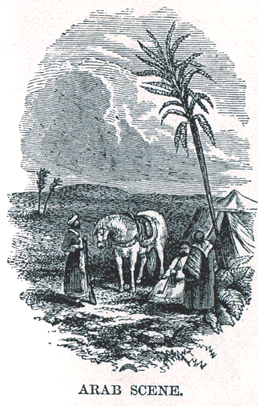
In a previous post I continued a thread from an 1879 school geography text. At the time much of the Arab World was under the control, nominal at times, of the Ottoman Empire. This text divided the Ottoman holdings into those in Asia, discussed below, and those in Europe, to be given in a separate post.

1. Arabia is a great plateau, abounding in deserts, and possessing but few fertile districts, except along the coast. Its area is about 1,000,000 square miles.
2. The Climate is the dryest in the world, rain seldom falling anywhere, and the heat being intense, especially in the lowlands and deserts.
Arabia has been divided into three parts: – ARABIA FELIX, happy or fertile; ARABIA PETRAE, stony; and ARABIA DESERTA, desert. The fist of these divisions borders on the Persian Gulf, the Indian Ocean, and the Red Sea; the second lies on the northeastern shore of the Red Sea; and the third includes all of the central portion of the country. The cultivated tracts are generally near the mountains, from which rivers descend in the rainy season and thus enrich the soil. Numerous oases re found in the desert regions. Continue reading A Geography Lesson from 1879: #4: Arabia and Turkey

Arab Americans’ Hybrid Identity


Arab restaurant in Brooklyn, NY; photograph by El-Sayyid el-Aswad

by El-Sayed el-Aswad, United Arab Emirates University

The concept of travel or movement implies the spreading of cultural elements beyond the confinements of locality. Being positioned on the boundary, signifying the division between home and away, inspired Arab Americans to identify themselves with both Arab and non-Arab or Western and non-Western cultural elements. Put differently, Arab Americans have experienced a gradually emerging sense of unified identity, or a reconfiguration of Arab identities, framed by the American culture as well as by the deep consciousness of, and identification with, the heritage of their old homelands, encompassing, for example, Arabic language, traditions or social customs, religious values, art and music. This is especially so since the events of 9/11. Arab Americans have been viewed by many non-Arab Americans as being terrorists or in sympathy with terrorism. They have made open attempts to offer clarification about their heritage and to teach others about their religion (especially Islam) in an attempt to dissuade reluctances, intolerances, and injustices against them. Continue reading Arab Americans’ Hybrid Identity

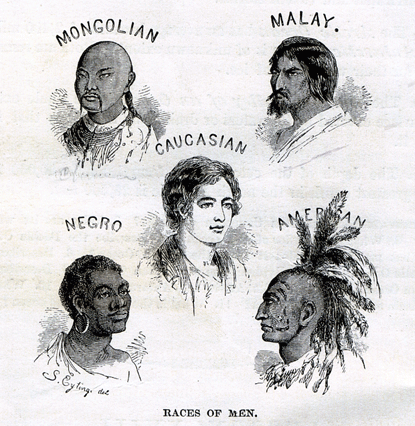
A Geography Lesson from 1879: #3: Racial as Facial


In a previous post I provided an account of the five different states of civilization from an 1879 geography text once owned by my great, great aunt. Apparently the author was enamored with the number “five,” since he also divided the human race into five distinct races. Let’s face it, race at the time was a visual matter of face (and hair) and notice in the image above who was in the middle. Here is the breakdown:

“1. The people inhabiting the different regions of the globe have been divided into five varieties, or races; namely, the Caucasian, or European; the Mongolian, or Asiatic; the Ethiopian, or African; the Malay; and the American or Indian.
2. The Caucasians are distinguished for their light complexion and straight hair. They inhabit nearly the whole of Europe, southwestern Asia, and a large part of America. The comprise the most enlightened and civilized nations of the world. Continue reading A Geography Lesson from 1879: #3: Racial as Facial

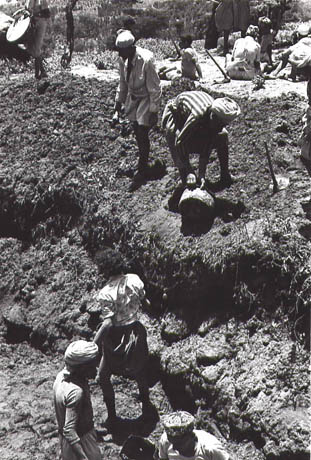
Tribal Mediation in Yemen


Community cleaning of cistern in al-Ahjur, 1979; photograph by Daniel Varisco

TRIBAL MEDIATION IN YEMEN AND ITS IMPLICATIONS TO DEVELOPMENT

by NAJWA ADRA, AAS WORKING PAPERS IN SOCIAL ANTHROPOLOGY
2010, Volume 19: 1–17.

Introduction

An international phenomenon that has captured the interest of scholars and international development organizations is a continued tendency to resolve conflict through indigenous methods rather than in state courts (Chirayath et al.; Corrin Care 2000; Syria-News.com; UNDP). In Yemen, as in countries as diverse as Kenya and the Solomon Islands, traditional justice is often perceived as familiar, transparent, and participatory. Its focus is reconciliation rather than punishment (Dempsey and Coburn 2010; Dimitrijevic 2006). Specifically in Yemen there is considerable flexibility and adaptability in indigenous tribal procedures and decisions, more so than one usually finds in state justice systems, and decisions are restitutive rather than coercive. Furthermore, indigenous dispute mediation, where fi nes are shared by the entire community, is less costly than the formal legal system. On the other hand, there are concerns that traditional justice may perpetuate social hierarchies by favoring the powerful or discriminating against women (Corrin Care 2000; Kameri-Mbote 2005; Kollapen 2005; Tripp n.d.). In Yemen, as elsewhere, “local strongmen” may co-opt traditional mechanisms by using force in ways that would not have been permitted historically (Dempsey and Coburn 2010). Political scientists worry that resort to traditional justice may undermine state sovereignty.

In this article, I explore these issues as they apply to self-identified tribal communities in Yemen’s Central Highlands through case studies of mediation that I collected during extensive fieldwork between 1978 and 2005 in al-Ahjur. Continue reading Tribal Mediation in Yemen

Dreams in Egypt


[The following is an excerpt from a recent article published by contributor el-Sayed el-Aswad, entitled “Symbolic Transformations of the Seen and the Unseen in the Egyptian Imagination” in ANTHROPOS, 105:441–453, 2010.]

The study has shown that the world is constructed by Egyptian worldview and imagination as a place of seen and unseen dimensions. These dimensions necessitate two kinds of knowledge. One is related to the knowledge of everyday observation, the other to the knowledge of hidden reality, religious or otherwise. Taken in their totality, as far as they indicate psychological, social, and spiritual realities, dreams necessitate the two kinds of knowledge. Dream visions or dreams belong to the unknown or unseen sphere and assert the effectiveness of that sphere in the reconstruction of people’s everyday reality. Dreams serve as lenses through which individuals see or glimpse the hidden or unseen aspects of the world.

Put differently, dream experiences are open to possible interpretations generating possible worlds. Dream phenomena and related notions of spirituality and unseen realities are not dealt with here within the oppositions between tradition versus modernity, common sense reality versus dream reality, or belief versus science because such oppositions do not exist in Egyptian multidimensional worldviews, visible and invisible, in which there is always intermediate realm or barzakh connecting them. Continue reading Dreams in Egypt

Breadom


by el-Sayed el-Aswad, United Arab Emirates University

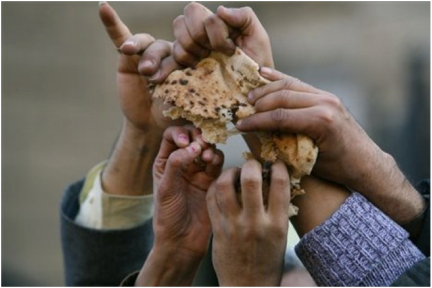
The word “Breadom” is not a spelling mistake; rather it is a combination of the words “bread” and “freedom” indicating, respectively, the “body” and “soul” of the Mother of the World (umm ad-duniya, Egypt), which is currently being affected by a novel form of revolt. In the bread uprising of January 18-19, 1977, falsely depicted by Sadat as “the uprising of thieves” (intifada haramiyya), Egyptians, especially the poor, were interested in securing the ‘bread of their livelihood’ (luqmat al-‘aysh), while in the revolt beginning on January 25th, 2011, they showed profound interest in both bread and freedom. The Arabic word “‘aysh” means both “bread” and “life or living.” These two inseparable meanings have made the phrase “‘aysh al-huriyya” (life of freedom) the best iconic gift crafted, engraved and offered, through victorious young Egyptians of victorious Cairo (al-Qahira), in the Freedom Square (Tahrir Square) opening a new chapter of Egyptian (Arab) history.

It is not surprising to hear people in Tahrir Square, directing their chanting to the government and its businessmen, shout forcefully, “thieves, thieves, thieves” (haramiyya). Also, there was a phrase written in huge letters on the ground of Tahrir Square that says “catch a thief” (imsik haramy). Such phrases resonate and reverberate in the Egyptian folk saying, “its guard is its thief”, (hamiha haramiha), with reference to a plundering and deceitful governor. Continue reading Breadom

New book on Hanna Batatu and Iraq


Professor Hanna Batatu (1926-2000)

In 2008, CCAS invited prominent scholars of Iraq to reflect on the lessons of Hanna Batatu’s legendary 1978 work, The Old Social Classes and the Revolutionary Movements of Iraq. The end result of that conference is Uncovering Iraq: Trajectories of Disintegration and Transformation, edited by Middle East Report editor Chris Toensing and CCAS editor Mimi Kirk. The book’s seven chapters explore three aspects of Batatu’s scholarship: his contribution to current understandings of Iraqi history (chs. 1 & 2); his categories of analysis as applied to Iraqi sociopolitical affairs (chs. 3, 4, & 5); and his influence (or lack thereof) on portrayals of Iraq by non-academic producers of knowledge (chs. 6 & 7).

Table of Contents: Continue reading New book on Hanna Batatu and Iraq