Category Archives: Anthropology/Sociology

The State of Agriculture in Late 13th Century Rasulid Yemen, #2

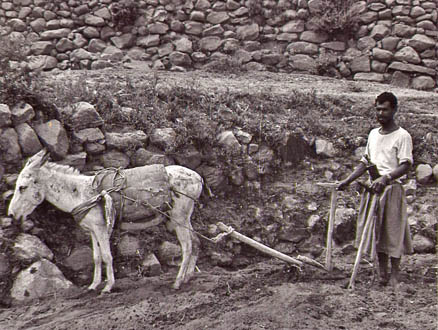
Yemeni tribal farmer in al-Ahjur, Central Highlands

By Daniel Martin Varisco

[In 2003 I attended a conference in Rome and gave a paper which was eventually published in Convegno Storia e Cultura dello Yemen in età Islamica, con particolare riferimento al periodo Rasûlide (Roma 30-31 ottobre 2003 (Accademia Nazionale dei Lincei, Fondazione Leone Caetani, 27, pp. 161-174, 2006). As this publication is virtually inaccessible, I am reprinting the paper here (with page numbers to the original indicted in brackets). For the previous part of this article, click here. The references are provided at the end of the first entry.]

VIEWING THE FIELD THROUGH AL-ASHRAF’S AGRICULTURAL TREATISE

I begin with al-Muẓaffar’s short-reigned son, al-Malik al-Ashraf Yūsuf, whose treatise Milḥ al-malāḥa not only defines the genre of Rasulid agricultural texts but is a primary source for the later, larger and more cosmopolitan Bughyat al-fallāḥīn of al-Malik al-Afḍal al-‘Abbās, which has been studied in part by the late Professor Serjeant. (5) Milḥ survives in at least two copies, both defective; one is in the Glaser collection in Vienna and the other was discovered in southern Yemen less than two decades ago by ‘Abd al-Raḥīm Jāzm. This consists of seven chapters. The first deals with the knowledge connected to times for cultivation, planting and preparing land. The next five chapters are arranged according to the type of crop or plant, with elaborate details on how each is cultivated. The final chapter, which has not yet been found apart from quotations in the Bughyat, discusses agricultural pests. The information provided on crops is almost exclusively for Yemen, unlike the penchant of the later Bughyat’s author to quote extensively from earlier non-Yemeni sources such as Ibn Waḥshiya and Ibn Baṣṣāl. Indeed, there is no explicit mention of other texts in Milḥ.

After the obligatory salutation of thanks, al-Ashraf begins his treatise with a poetic quatrain:

Fa-hādhā kitāb jama‘atuhu bi-ḥasab al-ṭāqa wa-al-ijtihād
wa-ista‘tab ‘alā dhālik bi-rabb al-‘ibād.
Waḍa‘tuhu ‘alā ḥukm iṣṭilāḥ ahl al-ma‘rifa fī al-Yaman
ba‘d al-baḥth ma‘ahum fī kulli mā fīhi min ṣanf wa-fann.
[p. 164] “I compiled this book according to diligence and capability
and solicit for proof of this the Lord of all humanity.
I recorded it from the wise practice of those Yemenis who know
only after research among them for all that is within their classifying and artful show.”

Continue reading The State of Agriculture in Late 13th Century Rasulid Yemen, #2

The State of Agriculture in Late 13th Century Rasulid Yemen


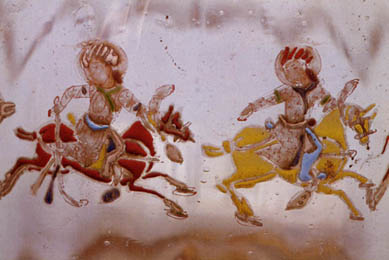
Rasulid polo players

By Daniel Martin Varisco

[In 2003 I attended a conference in Rome and gave a paper which was eventually published in Convegno Storia e Cultura dello Yemen in età Islamica, con particolare riferimento al periodo Rasûlide (Roma 30-31 ottobre 2003 (Accademia Nazionale dei Lincei, Fondazione Leone Caetani, 27, pp. 161-174, 2006). As this publication is virtually inaccessible, I am reprinting the paper here (with page numbers to the original indicted in brackets).]

INTRODUCTION AND SOURCES

[p. 161] About seven and a half centuries ago the second Rasulid sultan, al-Malik al-Muẓaffar Yūsuf ibn ‘Alī, was thrust into power in his youth after his father’s murder, just about the time the Genoan Marco Polo was born. The overlap between the Italian merchant mercenary and mercenary descendant sultan is fraught with irony. Al-Muẓaffar, the untested state builder came to power just a decade before the overthrow of the Abbasid caliphate, which had blessed Rasulid rule as a buffer against the Zaydī imams of Yemen’s northern highlands, while the future Italian diplomat set out on his trek only a decade or so after the Mongols had destroyed Baghdad. Polo was destined to serve an aging Kublai Khan, returning to Italy in 1295, the very year that the seventy-year-old-plus Rasulid ruler died. When Polo referred to the immense wealth of the sultan of Aden, “arising from the imposts he lays” in the Indian Ocean trade, he meant al-Muẓaffar. Marco Polo and al-Malik al-Muẓaffar never met, except in print, but the world that they both embraced was centered on an important trade network linking the Mediterranean and Africa with Persia, India and ultimately the lands of the great Khan.

Fortunately for the Rasulids, the merciless Mongol warriors never reached Yemen, apart from a few individuals who later assisted a Yemeni sultan in compiling a “King’s Dictionary” also known as the “Rasulid Hexaglot.” (1) [p. 162] Yemen also escaped the incursions of crusading medieval knights, although the legacy of Saladin played a major role in defining its political fortunes until the arrival of the Ottoman garrisons and Portuguese galleons in the sixteenth century. My focus is on the zenith of the Rasulid era near the end of the long reign of al-Muẓaffar, the preeminent state-builder of the dynasty. By 1252 he consolidated his hold over the coastal zone (Tihāma), southern highlands and Aden, as well as achieving periodic control over á¹¢an‘ā’, thus driving the ZaydÄ« imams back to their firm base in á¹¢a‘da. The sultan’s forces in the late 1270s took control, by land and by sea, of the important southern harbors at al-Shiḥr and Dhofar, two important sailing venues along the trade route to the Persian Gulf and India. In 682/1283, despite the ZaydÄ« loyalties of many of the tribes, al-Muẓaffar was able to briefly take hold of á¹¢a‘da, even striking coins there. Military success led to increased diplomatic recognition for the Rasulids; later delegations are described in the chronicles as arriving from Persia, Oman, India and China. Fortunately, al-Muẓaffar was an avid patron of architecture and learning, so that the material and written records of Rasulid activities are quite extensive. (2) Continue reading The State of Agriculture in Late 13th Century Rasulid Yemen

Be careful what you pray for


Today’s New York Times contains a commentary by Timothy Egan on “Rick Perry’s Unanswered Prayers.” Perry, who today is declaring his bid for the Republican presidential nomination, has been governor of Texas since his predecessor George W. Bush left that office to become president. Despite the fact that both Bush and Perry wear religion on their sleeve, the front of their chest, indeed on just about every bit of clothing (I am not sure about tattoos), both seem to have a poor record of getting their God to do their bidding. Unless this God west of the Pecos has a wicked sense of humor, I think the debacle of the Iraq War is an answer only to the prayers of arms dealers and Blackwater International. But Perry has no problem putting the ball (like the economy or the drought in Texas) in Jehovah’s court. Last April he declared a three-day prayer for rain. Not a drop has fallen since. Now he thinks the time is ripe for another Texas governor to run for president. Let us all hope he does not have a prayer.

I mention this goobernatorial prayer fiasco as a contrast to an istisqā’ (Islamic prayer for rain) that I witnessed in the highlands of Yemen in the spring of 1979. At that time, when I was conducting ethnographic fieldwork in a highland valley full of tribesmen and women (with nary a terrorist in sight, as is the case today), the usual spring rains were late in coming. There is within Islam a specific prayer that the community can offer up to Allah in times of drought. I have no way of knowing whether Allah has a better track record of sending rain than Jehovah does in Texas, but here is my own experience. Continue reading Be careful what you pray for

Where Are All the Islamic Terrorists?


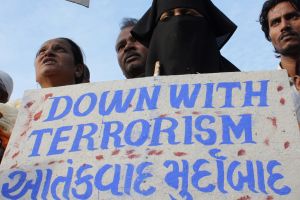
Islamic terrorism has not posed as strong a threat as many feared, in part because of the failure of most Muslims to join the movement. Above, a veiled Muslim woman was among those protesting against the deadly attacks that took place in Mumbai in 2008;
photo by Amit Dave, Reuters

By Charles Kurzman, The Chronicle Review, July 31, 2011

Last month, a few hours after a bomb exploded in downtown Oslo, I got a call from a journalist seeking comment. Why did Al Qaeda attack Norway? Why not a European country with a larger Muslim community, or a significant military presence in Muslim societies? I said I didn’t know.

A second media inquiry soon followed: Given NATO’s involvement in Afghanistan and Iraq, and the number of disaffected Muslims in Europe, why don’t we see more attacks like the one in Norway? This question was more up my alley. I recently published a book asking why Islamic terrorism has been rarer than many of us feared after 9/11. Before answering, I checked the news. Norwegian officials were reporting that the attacker was not Muslim. I was no longer an authority on the incident.

A third reporter called the next morning: Has the focus on Islamic terrorism distracted us from the threat of non-Islamic extremism?
Continue reading Where Are All the Islamic Terrorists?

In Memory of BJ


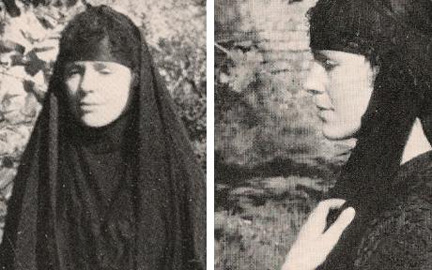
Elizabeth Warnock Fernea pictured wearing traditional tribal women’s dress of the southern Euphrates area. The headscarf with fringe is the asha, the chin scarf is the foota. These garments are worn under the abbaya or outer cloak Photo: KATHARINE RAMSAY

For many students and professors, the go-to text for Middle East ethnography for several decades has been Elizabeth Warnock Fernea’s Guests of the Sheik, still in print, about her life with anthropologist husband Bob Fernea in an Iraqi village during the 1950s. BJ, as her many friends knew her, went on to an academic career in several parts of the Middle East, producing books, articles and films of lasting value. Her passing in December, 2008 was a loss for us all. Now there is a short videography of her life available on Youtube. Check it out. And, if you have not read it in awhile or at all, get a copy of Guests of the Sheik and read it again or for the first time.

New blog on Yemen


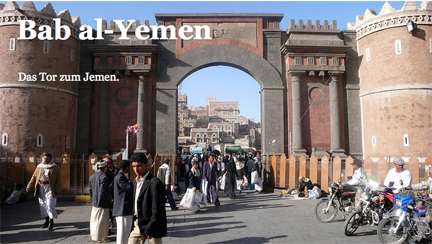
There is a new blog on Yemen: Bab al-Yemen: Das Tor zum Yemen; this is created by Marie-Christine Heinze, who is a graduate student at the Bielefeld Graduate School in History and Sociology. Marie-Christine is working on her Ph. D. about the “Social Life of Weapons in Yemen,” including the famous Yemeni jambiyya. In her new blog she has posted a review of a recent book privately published by Stephen Gracie entitled Jambiya: Daggers from the Ancient Souqs of Yemen.

French Center for Yemeni Studies threatened


Le CEFAS : un instrument indispensable de compréhension de la péninsule Arabique

by Laurent Bonnefoy (chercheur, Institut français du Proche-Orient)

En 2011, jamais la France et l’Union européenne n’ont autant eu besoin de comprendre les sociétés arabes. Jamais les chercheurs spécialistes du monde arabe contemporain n’ont autant répondu à une demande sociale venant tant des médias et des diplomates que même parfois des entreprises. A l’heure où le Yémen connaît un profond mouvement de révolte et où s’expriment des aspirations au changement, à la liberté et à la démocratie, le ministère des Affaires étrangères songe à mettre fin à l’expérience du Centre français d’archéologie et de sciences sociales de Sanaa (CEFAS).

Ce centre, créé sous le nom de Centre français d’études yéménites en 1982 sous la double tutelle du ministères des Affaires étrangères et du CNRS, a en près de trente ans permis à des centaines d’étudiants et de chercheurs de se familiariser avec les sociétés de la péninsule Arabique, d’apprendre l’arabe et de mener à bien de nombreux projets de recherche avec les partenaires locaux qu’ils soient yéménites, saoudiens, omanais ou autres. Son travail d’interface avec les institutions yéménites et du Golfe, sa bibliothèque exhaustive ont fait du CEFAS un instrument unique au monde, valorisé à l’échelle internationale. Les archéologues liés à cet institut ont été à la pointe des découvertes sur les cités antiques de l’Arabie Heureuse. Ses historiens ont pu analyser et réévaluer tant les spécificités que l’intégration ancienne de la péninsule Arabique dans le système monde. Ensemble ils ont directement contribué à valoriser, mais également à préserver, un patrimoine d’une richesse inestimable qui reste encore pour une grande part inconnu. Les chercheurs en sciences sociales ont pour leur part travaillé à rendre intelligible les sociétés et systèmes politiques de cette région du monde arabe. Le rôle de chacun, dans un Yémen et dans un Golfe arabo-persique en transformation, est dès maintenant d’appréhender et d’analyser les transformations et, à l’usage de chacun en France, en Europe et dans le monde, de fournir de nouvelles grilles de lectures indispensables. Continue reading French Center for Yemeni Studies threatened

India Orientalized for War, 2

During World War II the Smithsonian Institution issued a number of “War Background Studies.” I recently came across #18 in this series entitled Peoples of India by William H. Gilbert, Jr. (Washington D.C.: Smithsonian Institution, April 29, 1944). I was struck by the archaic presentation of images and the overtly Orientalist writing of Gilbert, who is billed as a “Specialist in Sociology and Anthropology, Legislative Reference Series, Library of Congress” and posted an excerpt from his Introduction in a previous post. The following comments are in reference to this earlier post.

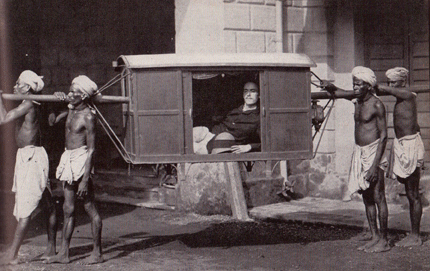
First, the old saw that a picture is worth a thousand words is as apt today as ever. In the last post the image provided there (and again above) of a British “sojourner” in a palanquin shows the Brit, prone and pith helmut at his side, staring outside his box of privilege, while there are two bare-chested bearers in front and two behind. What a compelling metaphor for the colonial view of India. There is no direct engagement between the foreigner and the people; they are merely there to take him from place to place by hand. Ironically, the caption notes that the palanquin is no longer used since the arrival of the railroad, so this image becomes a vestigial reminder of how the present occupies the past for its own comfort. Int his case the white man’s burden is turned upside down; the white man is quite literally the burden here.

Second, notice the adjectival mode in the paragraphs cited in the previous post. Continue reading India Orientalized for War, 2