Category Archives: Anthropology/Sociology

Tabsir Redux: With Ratzel in North Africa

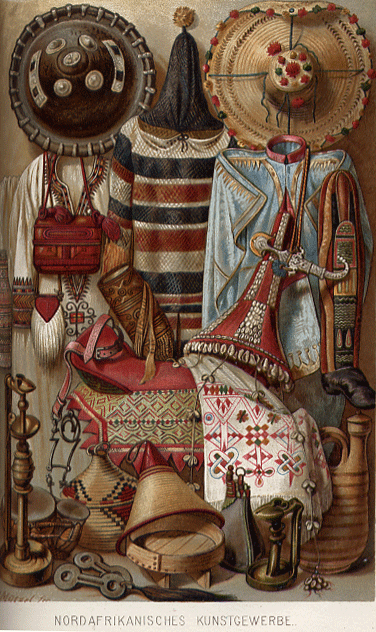
One of the most important German geographers of the late 19th century was Friedrich Ratzel (1844-1904), whose three-volume Völkerkunde (Leipzig and Vienna, Bibliographisches Institut, 1890) is one of those encyclopedia cultural accounts that circulated just as the discipline of anthropology was getting off (in this case literally “on”) the ground. While now a text for curiosity rather than critical scholarship on peoples and cultures, Ratzel’s work is still a fascinating portrayal of cultures being colonized for both revealing the biases of the day and the then-contemporary illustrations of people and material culture. My university library recently divested itself of uncirculated books in storage and one of these was an 1890 edition of the third volume on “Die Kulturvölker der Alten und Neuen Welt.” Whether it was the eye-watering althochdeutsch script of the volume or the mere fact it was written in German, no student or professor at Hofstra ever checked this volume out.

In salvaging a third of Ratzel’s opus for a mere dollar, I could not help but be drawn to the illustrations, mostly lithographs but with a few beautiful color plates. Continue reading Tabsir Redux: With Ratzel in North Africa

Lecture in New England


On Monday, October 24, 2011, I will be delivering a lecture entitled “What’s Happening in Yemen?” at the Portland campus of the University of New England in WCHP Lecture Hall at 6 pm. For more details click here.

This talk will focus on the impact of the “Arab Spring” political protests that started in Yemen, located at the southwestern corner of the Arabian Peninsula, in February. These led to unrest that brought the country to the brink of civil war and economic collapse. Yemen has been ruled by a military leader, Ali Abdullah Salih, who came to power in 1978. In 1990, North and South Yemen were united, followed by a brief civil war in 1993. Before the recent protests there was a secessionist movement in Yemen’s south and an open tribal rebellion near the border with Saudi Arabia. In the past decade the United States has given millions of dollars in aid to President Salih to theoretically combat al-Qaida in Yemen. Questions addressed include the influence of conservative Saudi-backed salafism, the nature of Yemeni tribalism, the role of youth and students in protesting for their own future in a democratic Yemen, and the exaggerated fears about Yemen as a terrorist haven. President Salih once remarked that ruling Yemen was like dancing on the heads of snakes. Now that the snakes have bitten, what is next?

Walter Dostal (1928-2011)


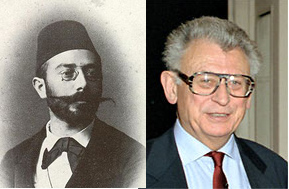
Eduard Glaser (1855-1908), left; Walter Dostal (1928-2011), right

[In early August the academic community lost one of the pioneers of ethnographic study on the Arabian Peninsula, the distinguished Austrian scholar Walter Dostal. Here is the obituary from the Austrian Academy of Sciences website.]

With Walter Dostal’s passing away in Vienna on August 6th/7th 2011, the anthropological communities in Austria, Central Europe and the German-speaking countries lose one of their best-known representatives shaping the field throughout the latter quarter of the 20th century.
Dostal was best known for his ethnographic studies of Arabian and Middle Eastern societies, but he also contributed substantially to anthropological theory – with particular emphasis on the interplay between environment, society, and history. As a leading expert for the Arab peninsula at this Academy, Dostal continued a remarkable research record into the early 21st century which at the Academy of Sciences goes back to the late 19th century.

Dostal had belonged to the first generation of anthropology students trained after the second world war, and his scholarly work was committed to build a new and internationally oriented foundation for the discipline once called “Völkerkunde” in the German-speaking countries after 1945. Born on May 15th 1928 in Grulich near Brno (today: Czech Republic), Dostal and his family moved at the end of the war to Vienna where he began his studies in anthropology. His critical engagement with the so-called “Culture Circles” theory led him to reject any speculative historical models, and to appreciate the empirical archaeological and textual evidence. Formative influences during those early years of his career were Robert Heine-Geldern (a corresponding member of the AAS) and Joseph Henninger. After his dissertation on Semitic-speaking peoples he began a first sequence of ethnographic fieldwork in the Arab peninsula, which he combined with international research sojourns in Frankfurt and Rome, and his first position as Curator for the Middle Eastern section at Vienna’s Ethnology Museum. Continue reading Walter Dostal (1928-2011)

9/11 Raised Unrealized Hopes in US-Iran Relations


by William O. Beeman, New American Media, Sep 11, 2011

As the United States remembers the events of September 11, 2001 on their tenth anniversary, it is important to remember that the tragedy was commemorated around the world, not just in America. And one of the nations that expressed the most profound and sincere grief over the loss of life was Iran.

Candlelight vigils were held throughout Iran and professions of sorrow and sympathy for the United States citizens who lost family and friends were ubiquitous. This was even more impressive when one notes that these were not government organized events, but were the spontaneous outpouring of Iranian citizens. On an official level, many Iranian religious leaders condemned the attacks, despite their differences with the United States administration. It was also noteworthy that no Iranian was involved in any way with the 9/11 attacks.

The 9/11 tragedy also resulted in a brief thaw in U.S.-Iran relations as Iran offered its air space and landing fields to the United States in its attacks on al-Qaeda and the Taliban in Afghanistan. It created increased positive feeling on the part of ordinary Iranian citizens for the United States and its people.

It is a secondary tragedy that this brief halcyon period in U.S.-Iran relations did not last. Continue reading 9/11 Raised Unrealized Hopes in US-Iran Relations

The State of Agriculture in Late 13th Century Rasulid Yemen, 5


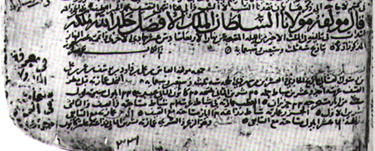
Tax document of al-Malik al-Afḍal, mid 14th century CE

By Daniel Martin Varisco

[In 2003 I attended a conference in Rome and gave a paper which was eventually published in Convegno Storia e Cultura dello Yemen in età Islamica, con particolare riferimento al periodo Rasûlide (Roma 30-31 ottobre 2003 (Accademia Nazionale dei Lincei, Fondazione Leone Caetani, 27, pp. 161-174, 2006). As this publication is virtually inaccessible, I am reprinting the paper here (with page numbers to the original indicted in brackets). For the previous part of this article, click here. The references are provided at the end of the first entry.]

ARCHIVING AGRICULTURAL ECONOMICS

Al-Ashraf’s Milh al-malāḥa provides a textbook survey of the mechanics of the agricultural system, but there is nothing on production costs, yields or the marketing system. Fortunately, some microeconomic details can now be filled in with information from the Muẓaffar archive, compiled from field reports sent to the Rasulid court between 691-95/1292-96 at the very end of al-Muẓaffar’s reign. Particularly valuable is a survey made in Ramadan 692/1293 from the lands of a shaykh Muḥammad ibn IbrāhÄ«m al-Ḥawm (?) of Ta‘izz and shaykh RashÄ«d al-DÄ«n Manṣūr ibn Ḥasan in Mikhlāf Ja‘far, as well as some data from ‘Abadān. (26) Details are provided on fees and shares for ploughing and virtually every agricultural activity with special emphasis on the obligations in sharecropping agreements and regional differences.

For the Ta‘izz case, the grain yields of sown sorghum are said to be up to 400 fold (i.e. one zabadī of seed will yield a crop of 400 zabadī) on good land, 150 fold on middle-range land and only 90-100 fold on poor land. Sorghum is also important in Yemen for its stalk (‘ajūr), used as fodder and fuel. The stalk yield for the sowing on good or medium land will be three camel (?) loads, but reaches five loads on land of poor quality; the reason given for this is that such sorghum is grown mainly for its stalk value. [p. 171]

For wheat in Ta‘izz, the increase is 15 fold on good land, 10 fold on medium land and only 3 fold on poor land. Emmer wheat (‘alas), on the other hand, yields 10 fold on good land, 4 fold on medium land and 2 fold on poor soil. Barley is said to yield 10 to 1; this is sown only in the mountain areas and not usually on the best land. Information is also provided on the straw (tibn) yields. Continue reading The State of Agriculture in Late 13th Century Rasulid Yemen, 5

The State of Agriculture in Late 13th Century Rasulid Yemen, 4


below Manakha towards the Tihama

By Daniel Martin Varisco

[In 2003 I attended a conference in Rome and gave a paper which was eventually published in Convegno Storia e Cultura dello Yemen in età Islamica, con particolare riferimento al periodo Rasûlide (Roma 30-31 ottobre 2003 (Accademia Nazionale dei Lincei, Fondazione Leone Caetani, 27, pp. 161-174, 2006). As this publication is virtually inaccessible, I am reprinting the paper here (with page numbers to the original indicted in brackets). For the previous part of this article, click here. The references are provided at the end of the first entry.]

PLANTING ADVICE: OF FAVA BEANS AND DATE PALMS

The bulk of al-Ashraf’s text provides details on how to plant and where to plant, as well as when to plant. While some of the information is clearly theoretical, as in the case of planting olive trees, much of it no doubt reflects farmer practices at the time in the coastal region and southern highlands, [p. 168] where al-Ashraf spent most of his time. To give an indication of the range of the advice, I will focus on two specific and important crops: the fava bean and the date palm.

Al-Ashraf follows the classical designation of bāqillā’, which is often shortened to gilla in Yemeni dialects. It would, if you pardon the pun, be foolish of me to lecture this audience on the significance of fava beans (most known today as fūl) in the diet. I will read a translation of the entire passage in the text, followed by comments from my own ethnographic observations. (16)

“Fava beans are planted in cool places of the mountain areas. They are not suitable for the coastal plain [nor the wadis in the cold mountain areas] nor very wild places. The best agricultural fields are in the excellent eastern land on which a lot of dew does not fall, (17) as well as in the good soil (18) which is fertilized by dung. It is ploughed for with an excellent ploughing. Most of it is planted between the sorghum plants in Nīsān (i.e., April). The beans can be eaten after three months from the day planted. It finishes producing and is harvested after seven months. There is also that which is planted as qiyāẓ at the end of Aylūl (i.e., September) in the midst of the sorghum plants. This can be eaten after four months. It finishes producing and, if it has yellowed and dried, is harvested after seven months. As for the manner of its cultivation, the seed is cast in the bottom of the furrow with a footstep between each two grains, (19) then covered with soil and packed down by foot. When the sorghum is harvested, irrigate whatever it needs of water after this in the same way as for the sorghum stalk, even for that which is meager, until its time finishes, as God wills.” Continue reading The State of Agriculture in Late 13th Century Rasulid Yemen, 4

The State of Agriculture in Late 13th Century Rasulid Yemen, 3


highland sorghum

[In 2003 I attended a conference in Rome and gave a paper which was eventually published in Convegno Storia e Cultura dello Yemen in età Islamica, con particolare riferimento al periodo Rasûlide (Roma 30-31 ottobre 2003 (Accademia Nazionale dei Lincei, Fondazione Leone Caetani, 27, pp. 161-174, 2006). As this publication is virtually inaccessible, I am reprinting the paper here (with page numbers to the original indicted in brackets). For the previous part of this article, click here. The references are provided at the end of the first entry.]

IDENTIFYING THE MAJOR CROPS

Although al-Ashraf claims to have learned from the farmers themselves, his overall classification of crops and plants suggests that he is fitting that knowledge into a shared textual tradition of scientific agronomy at the time. Al-Ashraf inventories Yemeni production according to five main categories: zurū‘, qaṭānī or ḥubūb, al-ashjār al-muthmira, rayāḥīn, and khaḍrāwāt and buqūlāt. By zurū‘ (the plural of zar‘) al-Ashraf means the cereal crops of wheat, barley, sorghum, rice, two kinds of millet, eleusine (or finger millet) and teff, as well as sesame, cotton, lucerne, madder and turmeric. This goes beyond the English sense of cereal grains to cover the non-food crops of cotton and madder, both of which are reclassified as al-ashjār al-muthmira (flowering trees) in the later Bughyat. In classical Arabic terms, at least according to Abū Ḥanīfa, sesame is classified as qaṭānī. (12)

The second major kind of crop is labeled qaṭānī, which the author glosses as ḥubūb. This includes what we would today call pulses and various kinds of beans, such as chick peas, lentils, cowpeas, fava beans, endive, fenugreek, water cress, mustard, safflower, poppy, flax and black cumin. The term qaṭānī, according to Abū Ḥanīfa, is originally Syrian and refers to crops such [p. 167] as rice, chickpeas, lentils, sesame and most beans. (13) The term ḥubūb (plural of ḥabb) may refer to wheat, barley and the like, but has also been widely used in the agricultural texts for seed plants of various kinds. (14)

The third category, al-ashjār al-muthmira, literally refers to flowering trees and plants. (15) In order of presentation, al-Ashraf includes here dates, grapes, figs, pomegranates, apples, plums, pears, peaches, apricots, mulberry trees, olives, walnuts, almonds, pistachios, betel nuts, carob, bananas, sugar cane, citrons, oranges, lemons, lebbek, christ’s thorn and Indian laburnum. The reference to olives is clearly textual, since this tree was not planted in Yemen; nor do I think betel would have been tried outside the royal gardens. The fourth category comprises rayāḥīn or aromatic plants and ornamental flowers. Of the nineteen specific plants mentioned, most are flowers (such as rose and jasmine), but the list also includes useful herbs such as basil, chamomile and the important dye of henna.

The final part of al-Ashraf’s classification refers to khaḍrāwāt and buqūlāt. This covers a variety of green and root vegetables such as lettuce, cucumbers, eggplant, carrots, cabbage, garlic, onions, radish, endive, mallow, colocasia, chard, spinach, purselane, celery, okra and asparagus. Among the ground “fruits” included here are melons and gourds, although grapes are considered flowering trees. Also included are several spices, such as ginger, mint, parsley, coriander, dill and cumin, as well as “medicants,” such as balsam, rue, fennel and Indian hemp.

FOOTNOTES:

(12) Ibn Sīda, al-Mukhaṣṣaṣ, Beirut, 1965, v. 11, p. 62.
(13) Ibid, v. 11, p. 62. In Kitāb al-Filāḥa al-Rūmiya (Leiden, Or. 414, f. 40) qaṭānī is defined as summer crops like rice which need the heat and water.
(14) Ibn Sīda, al-Mukhaṣṣaṣ, cit., v. 11, p. 49. For example, Ibn Waḥshiya, v. 1, p. 492 includes fava bean in the category of ḥubūb used for food.
(15) This term is used by Ibn Waḥshiya, v. 1, p. 367.

to be continued