Category Archives: Anthropology/Sociology

Worldwide Association for the Study of Religion


Whatever you think about “religion,” you must admit that “religion” is not something that can be avoided. There are countries where a person has little choice but to accept the dominant religion imposed and there are places where one can shop for religion more easily than clothes. As an anthropologist I accept the fact not only that we have evolved (even if Darwin did not start a religion) and that all members of Homo sapiens that have been encountered and studied have something that deserves to be called “religion,” even if only in the minimalist sense of Victorian Quaker Edward Tylor that religion is at bottom a belief in spirits. There are many religions out there and several important scholarly organizations devoted to the study of religion in one way or another, but add a new one to the mix.

Anthropologist Gabriele Marranci, founder of the journal Contemporary Islam, has formed the Worldwide Association for the Study of Religion (WASR perhaps for those who like acronyms) If you do not have a Facebook account, join the Wiki.

This group is open to scholars studying religion or with an interest in religion and aims to develop a worldwide association accessible to any scholar or student wherever they might live. This is a working group to develop ideas and the structure for this new association, which aims also to remove the gap between scholars working in developing countries and those in the West. This group is open to scholars studying religion or with an interest in religion and aims to develop a worldwide association accessible to any scholar or student wherever they might live. As scholars the goal of the association to study religion in all its forms and not to lobby for any particular religion or even for the absence of religion. This is a working group to develop ideas and the structure for this new association, which aims also to remove the gap between scholars working in developing countries and those in the West.

As Marranci notes, his effort is not to replace organizations like the American Academy of Religion, but to expand the network of scholars who study religion worldwide. With the Internet and Skype, scholars are no longer captive to meeting colleagues at professional meetings, important as these remain. Feel free to join today and tell your friends.

On Facebook; you can request joining (which is free) by clicking here. You can also join via the Wiki.
Muslim Hadramis in “Christian Ethiopia”


Muslim Hadramis in “Christian Ethiopia”: Reflections on Boundary Making Processes

by Samson A. Bezabeh, Bergen University

[Note: This is the Introduction to a recent article on the Hadrami experience in Ethiopia. The full article can be downloaded from the Journal of Muslim Minority Affairs.]

Introduction

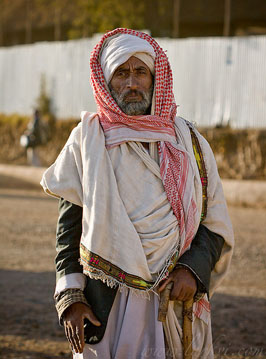
Throughout recorded history sporadic population migration from Arabia to East Africa and Ethiopia has been a noted phenomenon. In the modern era Hadramis started to migrate and settle in Ethiopia at the end of the nineteenth century and the beginning of the twentieth century. Thus, by the beginning of the twentieth century, Ethiopia hosted a number of Arab families who were mainly Yemeni or Hadrami by origin. Although the exact population of the Hadramis at that time is not known, various statistical estimates and narrations, including narration of present day Hadrami families indicate that their number was substantial. This is particularly true in the case of major Ethiopian towns and trading centres such as Harar, Jimma and Asmara.

Despite their pronounced presence, however, their numbers, declined during the second half of the twentieth century as a result of negative factors that have forced them to leave the country. One such factor was the movement of pan-Arab nationalism which gained momentum in the 1960s. To be more specific, in 1969 Hadramis were expelled from Ethiopia for “supporting” the Eritrean Liberation Front (ELF), whom Arab nations, particularly Syrians and Egyptians, were supporting for fulfilling their goal of creating a united Arab land which in their vision also included the highlands of northern Ethiopia. In this scenario, Hadramis along with other Arabs were accused by the Haile Selassie regime4 in Ethiopia of sympathizing with the Arab backers of the Eritrean Liberation Front (ELF), and hence undermining Ethiopian unity. This has led many Hadrami families to voluntarily and involuntarily relocate themselves to Yemen and to oil reach countries in the Gulf such as Saudi Arabia. Continue reading Muslim Hadramis in “Christian Ethiopia”

Fantasy, action and the possible in 2011


by Samuli SchielkeØŒ “You’ll be late for the revolution!”: Samuli Schielke’s Diary of the Egyptian Revolution, December 11, 2011

[Webshaykh’s note: The following is an excerpt from an essay by Samuli Schielke “about Lenin, Tahrir, Islamists, poetry, choice and destiny in an attempt to provide some sort of theoretical synthesis of a confusing experience. It is the very slightly modified transcript of a lecture I gave at the University of North Carolina in Charlotte on 6 December 2011.” For the full essay. click here.]

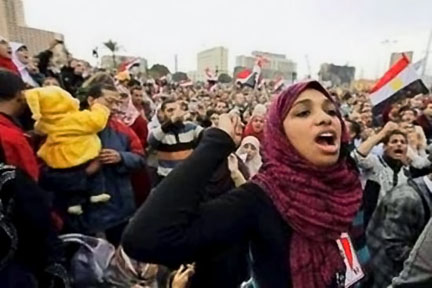
The elections are now bringing a landslide victory of Islamic religious parties. I was just reading the results of the first round – we don’t have the final results because the elections take place in three rounds, different provinces voting at different times (the electoral law requires every polling station to be supervised by a judge and there are not enough judges in the country). One third of Egypt’s provinces have voted now. The results show that about sixty per cent of the vote of the party lists go to two Islamist party alliances, one of them the Muslim Brotherhood who are conservative, and one of them the Salafis who are badass fundamentalists. This has completely surprised some people, but anybody who has actually been following the situation in the streets has not been surprised at all. Actually the Muslim Brotherhood got less votes than one would think. With 36% of the vote, they actually did badly. They should have gotten 50%.

In a country that just had a revolutionary uprising against a corrupt system that was not an uprising in religious terms but one in terms of social justice, or freedom, or human dignity, why did people vote for Islamic parties? One of them, the Muslim Brotherhood, supported the revolution (but sided with the Army very soon afterwards), the other, the Salafis, were actually supporting Mubarak. Why did people vote for them? Continue reading Fantasy, action and the possible in 2011

Authenticity, Identity and the Spirit of the UAE Union


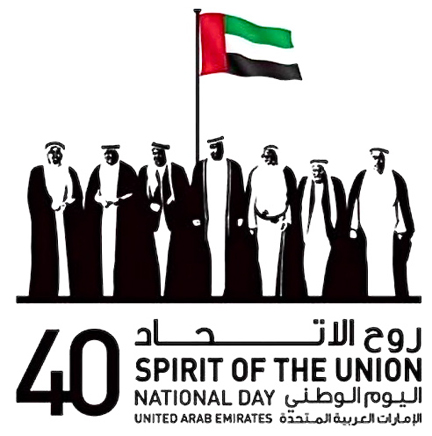
Spirit of the Union (UAE)

by el-Sayed el-Aswad, United Arab Emirates University

Over the past forty years there have been rapid transformations of the United Arab Emirates from rural and tribal communities to modern national states. Such transformations raise critical concerns related to authenticity, heritage, and social memory and identity construction. Heritage, indicating past and authentic lifestyles that people use in the construction of their identity, can be redefined according to a modern significance. Identity refers to the continuity of inherent constituents that last through all the various transformations individuals might undergo. Identity is not a given, but an ongoing activity that people engage in all the time.

In the UAE one observes continuous negotiations over ideas of authenticity, tradition, identity, modernity, leadership, and local-national performances. For example, this year the UAE is celebrating its 40th anniversary in terms of authenticity. The official site of the UAE National Day, “Spirit of the Union”, includes such phrase as “Our Heritage, Our Pride,” “the Union shall forever remain,” and “It is the Spirit of the Union that celebrates our culture and heritage, and yet shapes our future.”

Tradition is negotiated because it enters into the construction of social identity that is based on the concept of authenticity (aṣāla). For the Emirates, aṣāla (or aṣīl) is a multiple meaning concept that can imply values of rootedness, descent, origin, nobility, honor, self-sufficiency and social status. Authenticity also refers to good manners of people, men and women, defining gender relations. Continue reading Authenticity, Identity and the Spirit of the UAE Union

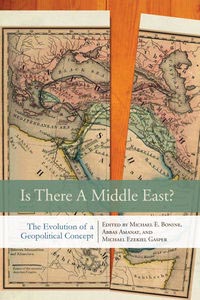
Is There a Middle East?


Announcing a new book from Stanford University Press…

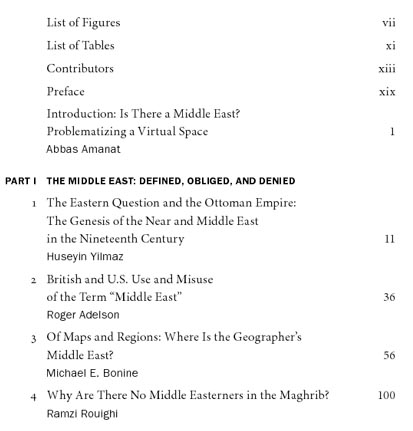
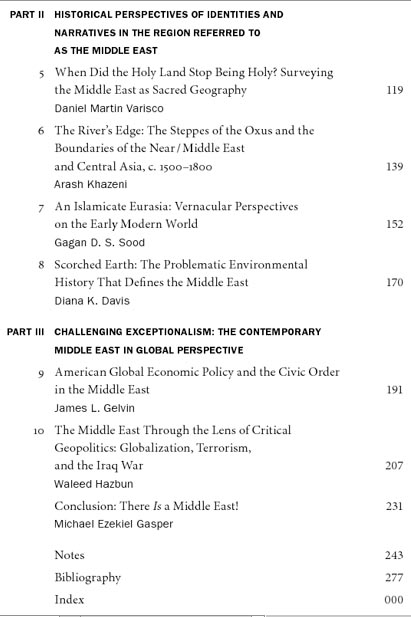
Is There a Middle East?: The Evolution of a Geopolitical Concept
Edited by Michael E. Bonine, Abbas Amanat, and Michael Ezekiel Gasper
Stanford: Stanford University Press, 2011.

Is the idea of the “Middle East” simply a geopolitical construct conceived by the West to serve particular strategic and economic interests—or can we identify geographical, historical, cultural, and political patterns to indicate some sort of internal coherence to this label? While the term has achieved common usage, no one studying the region has yet addressed whether this conceptualization has real meaning—and then articulated what and where the Middle East is, or is not.

This volume fills the void, offering a diverse set of voices—from political and cultural historians, to social scientists, geographers, and political economists—to debate the possible manifestations and meanings of the Middle East. At a time when geopolitical forces, social currents, and environmental concerns have brought attention to the region, this volume examines the very definition and geographic and cultural boundaries of the Middle East in an unprecedented way.


Postcard from Tehran


Mellat Park Cineplex by Fluid Motion Architects, Iran

by Wiiliam O. Beeman, Chair of Anthropology, University of Minnesota

Dear Friends

My musings seem to have been of interest to a number of you, so I hope you will indulge me with another postcard. I’ll be here until Sunday

Two other Americans showed up for our conference, entitled “The First International Conference on Human Rights and Cultures: Cultures in Support of Humanity.” It is being held at the Ministry of Foreign Affairs and heavy in attendance are the students from the Foreign Policy School run by the Ministry. Some G2K members may find the subject of the conference “ironic,” but in fact the organizers, the Non Aligned Movement Center for Human Rights and Cultural Diversity, has assembled quite a large and stellar international group of scholars, NGO officers, Peace Movement functionaries and government officials for this.

The 64 presentations have been on a high level, and would meet a significant academic standard anywhere.Some titles:

“Protection of Cultural Property in Armed Conflicts”
“Constructing the Other”
“The Role of Cultural Diversity in Promoting a Culture of Peace”
“Establishing a Normative Framework for Evaluating Diverse Cases of Transitional Justice” 

The graduate students in international relations are especially impressive. They all have impeccable English, are extremely charming, and are working on serious dissertation topics, such as: “Iran’s Developing Relations with Egypt 2000-2011,” “International Economics in non-petroleum sector in the Gulf Region,” “Iran’s prospects in West Africa” and many more. A group of them at dinner surprised me: “Do you speak Spanish?” Well I do, and so do they–quite impressively! They are all learning Spanish and plan trips to Latin America in the Near Future–even the young man posted as political officer in Sweden.

The young women graduate students have been formidable. Several are giving papers. They make up more than half of the student body. They ask great questions, don’t back down and have facts and figures at the fingertips. Forgive me for noticing sartorial details, but although they are dressed in impeccable hejab, every one of them has something that makes her dress stand out. It seems the fashion is now to turn the naghma’eh into a flattering accessory. There is the naghma’eh with a kind of rhinestone band at the forehead, one with little extensions in the front that can be wrapped in a clever loose bow, one with discreet embroidery around the edge. The women pair long skirts and jackets with front panels in white or pastel colors. They are in effect wearing the equivalent of the skirted suit. It is very smart and very professional while being distinctive. Continue reading Postcard from Tehran

Hostages and the Yemeni Crisis


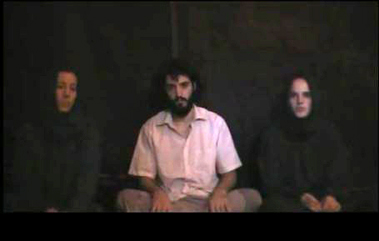
Taking hostages is hardly a new phenomenon. In far too many cases a hostage is nothing more than a political pawn, perhaps for a showcase video or as an “eye-for-an-eye” beheading. In Yemen the majority of hostages in tribal areas are negotiation acts. When Hunt Oil worked the Marib fields, local tribes would periodically “detain” American workers in order to get the government to do what they wanted or needed. The workers were treated as guests, for the most part, and it was a recognized game which generally led to the government doing what it should have done all along. This changed in the mid 2000’s with several high-profile al-Qaida killings of tourists. But generally when someone is taken hostage, the point is to get something out of it and not just to get publicity for a cause. This is especially the case when the context is tribal, since there are mechanisms within customary law for mediating such disputes.

Three French hostages kidnapped by al-Qaida fighters in Yemen more than five months ago have arrived in the Omani capital Muscat after being freed. Al Jazeera is reporting a recent release of three French aid workers who had been kidnapped last July in Hadramawt, one of the safer areas in Yemen at the moment, by suspected Al-Qaida operatives. They were released to Oman after a round of negotiations, as discussed in the news report: Continue reading Hostages and the Yemeni Crisis

Will Congress disrupt diplomacy?


by William O. Beeman, Star Tribune, November 6, 2011

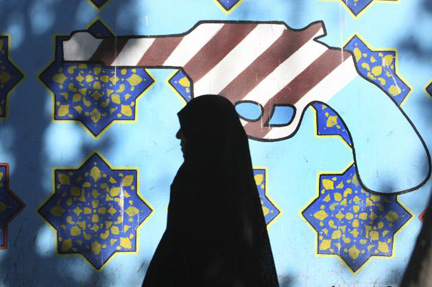
In an ill-advised piece of legislation, Congress is using opposition to Iran as an excuse to attack President Obama’s executive authority.

The “Iran Threat Reduction Act” (HR1905), passed on Nov. 2 by the House Foreign Relations Committee, neither reduces an Iranian threat nor puts significant pressure on Iran’s leaders to change policies.

The bill would make it illegal for any American diplomat to speak to or have any contact with an Iranian official unless the president certifies to Congress that not talking to the Iranian officials “would pose an unusual and extraordinary threat to the vital national security interests of the United States” 15 days prior to that contact.

Minnesota cosponsors of this bill are GOP Reps. Michele Bachmann, Chip Cravaack, John Kline and Erik Paulsen.

A corresponding bill has been introduced in the Senate (S1048), cosponsored by Sens. Amy Klobuchar and Al Franken, both Democrats.

In addition to tying the president’s hands on diplomacy, the bill also prevents the president from issuing waivers to existing Iran trade sanctions for any reason, singling out the sale of vital airplane parts for civilian aircraft.

Iran’s civilian air fleet is aging, and without replacement parts, air travel on Iranian carriers poses a danger to the public, including American citizens who travel to Iran. Continue reading Will Congress disrupt diplomacy?