Category Archives: Anthropology/Sociology

It’s still a rocky road


A few weeks ago I wrote a commentary which was eventually published in my “Middle East Muddle” column on Anthropology News. This was entitled “Between the Rock of Ages and a Hard Sell.” This was a month before the debate held earlier this week. Below I provide the first two paragraphs of my commentary, but you can read the whole thing here. After reading it, you can return here and see my update after the first debate.

As the 2012 presidential election draws near, the debate thus far has been anything but civil. Attack ads from all sides have been fact-checked and found wanting. A recent Pew poll found that 17% of registered voters still think President Obama is a Muslim and only 49% said he was Christian. Only 60% of registered voters are aware that Republican challenger Mitt Romney is Mormon. Of those who know Romney is Muslim 19% admit they are uncomfortable with his affiliation. To the extent religion matters, and anyone who thinks religion does not matter in American politics needs to think again, both the current Vice-President Joe Biden and the Republican candidate Paul Ryan are Catholic.

For voters in the Bible Belt this puts the choice on November 6 between a rock and a hard place, making it a hard sell for those who sing “The Rock of Ages” in Sunday morning services. Growing up decades ago in a proudly “fundamentalist” Baptist church in northern Ohio, I was told that Mormons were a cult, the Catholic church was Satanic and Muslims were obviously bound for hell along with all the others who were not born-again Bible believers. Jimmy Carter and Bill Clinton were Baptist, but as astute politicians they did not promote the more extreme beliefs of their faith just as John F. Kennedy did not mandate Catholic doctrine. The last time around Obama was attacked for having belonged to a church of the Rev. Jeremiah Wright. Both Obama and Jon McCain submitted to a religious litmus test in a televised forum hosted by Rick Warren, senior pastor of the one of the largest Protestant churches in America. This time, however, religion is taking a back seat to the economy, but the religious faith of each candidate is still the elephant in the room.

The first daily tracking polls after the debate, which the pundits gave to Romney hands down, show that there has yet to be a big bounce on the ground; even Rasmussen (which usually leans Republican) has Obama ahead nationally by 2 points on Thursday and Friday. Beyond the polls and pundits, however, it is still a very rocky road for Romney, whose etch-a-sketch performance in the debate will be hard to stretch against all the things he has been saying previously. Today’s drop in the unemployment rate to 7.8%, the same as when Obama took office, will blow out the tires of a campaign bus already in the ditch. But to my mind, the biggest mistake Romney made was promising to end the career of Big Bird. I realize that 8-year olds cannot vote (and depending on their skin color may not find it easy to vote when they grow up in certain states), but they can grab onto their parent’s arms and beg them to save Big Bird and Sesame Street. If Romney loses by a nose, it will be a combination of his own Pinocchio moments and the beak of an unemployed Big Bird.
Academic Freedom and Professional Responsibility


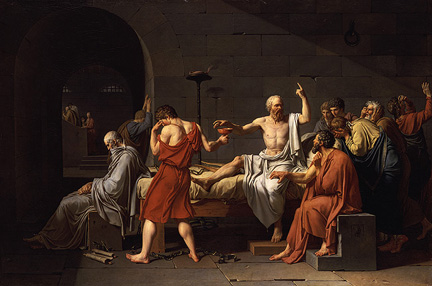
“Death of Socrates” by Jacques-Louis David, 1787, Metropolitan Museum of Art

Academic Freedom and Professional Responsibility:
A Handbook for Scholars and Teachers of the Middle East

Attempts to undermine professors’ abilities to teach and do research are increasingly directed at scholars who seek to provide a contextualized and critical view of recent international developments and their interaction with US foreign policies and practices.

The first draft of the handbook was based on research undertaken by the Taskforce on Middle East Anthropology to understand available institutional resources, as well as on ethnographic interviews conducted with academics who have encountered obstacles in their teaching and scholarship. The handbook was revised in 2012 by a group of current graduate students and recent PhDs in Middle East Anthropology, at the behest of the original handbook committee.

The revision aimed to evaluate the current atmosphere of academic freedom via a survey distributed to faculty and graduate students studying the Middle East, update the document to reflect legal changes that impact the ability of academics to carry out their scholarship and teaching, review major controversies over academic freedom since the original version of the handbook was published, and update links, citations, and contact information.

The handbook provides concrete suggestions for how to respond to attacks on academic freedom and to avoid them in the first place. It considers the potentials and limitations of internal university structures, professional organizations, legal recourse, and media outlets. Finally, it contains useful pedagogical tools for dealing with difficulties in the classroom, and an informative bibliography of recent writings on academic freedom.

“Academic Freedom and Professional Responsibility: A Handbook for Scholars and Teachers of the Middle East” (2012). Click here for information on how to download a pdf of this report.

New Online Issue of CyberOrient


CyberOrient, the online journal of the Middle East Section of the American Anthropological Association, has just published its 2012 issue on “The Net Worth of the Arab Spring.” The guest editor is Ines Braune, who writes in the Introduction:

When I was asked to be the guest editor of the current issue of CyberOrient, I realized this is a welcome opportunity to arrange and re-sort some aspects, points, and arguments about the role of the media during the Arab Spring. In the course of the events late in 2010 and early in 2011, I felt enthusiastic and overwhelmed – not primarily as a scholar with a background in Middle Eastern and media studies, but as someone who was part of the peaceful German revolution in 1989 as a young teenager. Upon reflection, I took up the role of a media researcher considering how the use of media shaped these events. Though much has already been said and written about the media and Arab Spring, it would be worthwhile after a bit more than a year to reflect and reevaluate the relationship between the media and revolutions. Due to my involvement in this edition, and after numerous discussions with colleagues, and students in my media seminar in the summer term, I frequently came across the following three points: the significance of mediatization processes, the online-offline dichotomy, and various kinds of amnesia.

The articles discuss the role of social media in Egypt, Iran, and Al Jazeera, along with two book reviews.

Body Politics: Muhammad and Middleton


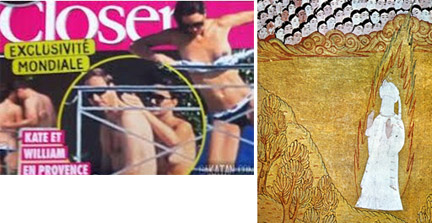
The offending photographs of Kate Middleton, left; an Islamic depiction of Muhammad by not showing his face, right


[Note: The following commentary has been posted to my column “Middle East Muddle” on the online website of Anthropology News, published by the American Anthropological Association. To read the entire commentary, click here. For more commentaries on “Middle East Muddle, click here.]

Two scandals have dominated the news, at least in Europe and America, over the week following the 9/11 anniversary. The first, which has yet to abate as I write this, is the widespread protests against a pathetic anti-Muslim film trailer trolled from Youtube, rhetorically warmed over in Arabic and promoted by extremist Muslims to stir up violence. The troll took a toll with the American ambassador and several other Americans killed in Libya, violent clashes in Egypt and in Yemen and a range of protests (many of which have remained peaceful) across Muslim communities. The second, which is equally absurd as a pretext, is the voyeuristic publishing by French, Irish and Italian tabloids of a long-distance photograph of the naked breasts of Kate Middleton, the newly wed wife of Britain’s Prince William. The paparazzi have once again harmed Britain’s royal family, first by chasing Princess Diana and now by turning a powerful lens on a private moment in a private home while Diana’s son vacationed in France. In both the body is all about politics…

For the entire commentary go to “Middle East Muddle” by clicking here.

Syrian Refugees in Lebanon


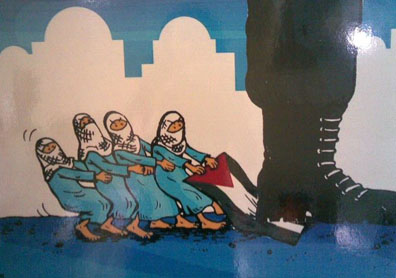
Image from Museum of Resistance in Lebanon; photograph by Estella Carpi

Syrian refugees in Lebanon: when the Apollonian cannot expect anything from the Dionysian

by Estella Carpi

While based in Lebanon, I personally find no way of getting out of the emotional whirlwind of suffering that the Syrian revolution, the merciless state repression and the subsequent armament of the revolutionaries have been giving rise to for 18 months. Without aiming at prematurely assessing the size of the emergency response to the “Syrian humanitarian crisis”, I would like to discuss here the Lebanese phenomenological approach to the current events by using the Syrian refugees’ lens.

Although used to regarding Syria as a model of stability and harmony, and as a place where people allegedly identify through the imposed order, the Lebanese suddenly find themselves taking care of the Syrian Leviathan. If Lebanon has always embodied the Dionysian, with its several war scars, social open wounds and its incontrollable emotionalities, Syria has always represented the rational, organized and balance-keeper Apollonian to the outsider’s eye. Continue reading Syrian Refugees in Lebanon

The Quran as a Great Book: Muslim Perspectives, 2


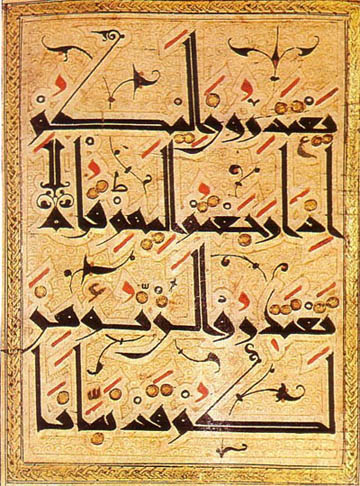
Quran in Naskhi script written by the celebrated Turkish calligrapher Hamd Allah (15th century, Topkapi Museum


[The following is part two of a series on a lecture presented in the Hofstra Great Books Series on December 5, 1993. For part one, click here.].

So why am I here?

Let me begin with my discipline. I am an anthropologist by training and experience and a life-long student of Arabic (as a dynamic language and as an extraordinary corpus of folklore and formal literature). You may wonder why an anthropologist would stand before you to discuss a great book, an anthropologist who should seem to be more at home studying “primitive”, non-literate people (who can sadly boast of no “great books”.. Perhaps we should have a “Great Oral Traditions” series).

You see, as an anthropologist, I do not so readily discriminate between societies with books and societies technically without them. More specifically, as a cultural anthropologist, my ethnographic research (that is, my personal observations and documentation of what people do, say they do, or don’t do and think they should do) was in the Arab Islamic country of Yemen (located southwest of Saudi Arabia across the horn of Africa from more newsworthy Somalia). While many of the Yemeni men and women I knew in the field were not formally literate, they were clearly part and parcel of a religion of the book; as Muslims with an impressive local history they all related to the Quran as a vital text and they all (even if unschooled) knew by heart portions of the Quran, at a minimum the fatiha I recited at the start. To talk meaningfully about the Yemen I observed and studied and not to know something reasonably substantial about the Quran that Yemenis revere, would seem to me absurd, or at the very least the sloppiest sort of scholarship. Continue reading The Quran as a Great Book: Muslim Perspectives, 2

Ethnic Indo-European languages?


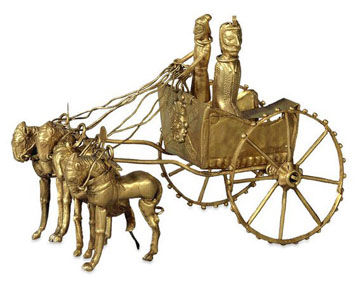
gold chariot from a hoard found near the Oxus River in Central Asia ca 500 BCE, British Museum

Family Tree of Languages Has Roots in Anatolia, Biologists Say
By NICHOLAS WADE, New York Times, August 24, 2012

Biologists using tools developed for drawing evolutionary family trees say that they have solved a longstanding problem in archaeology: the origin of the Indo-European family of languages.

The family includes English and most other European languages, as well as Persian, Hindi and many others. Despite the importance of the languages, specialists have long disagreed about their origin.

Linguists believe that the first speakers of the mother tongue, known as proto-Indo-European, were chariot-driving pastoralists who burst out of their homeland on the steppes above the Black Sea about 4,000 years ago and conquered Europe and Asia. A rival theory holds that, to the contrary, the first Indo-European speakers were peaceable farmers in Anatolia, now Turkey, about 9,000 years ago, who disseminated their language by the hoe, not the sword.

The new entrant to the debate is an evolutionary biologist, Quentin Atkinson of the University of Auckland in New Zealand. He and colleagues have taken the existing vocabulary and geographical range of 103 Indo-European languages and computationally walked them back in time and place to their statistically most likely origin.

The result, they announced in Thursday’s issue of the journal Science, is that “we found decisive support for an Anatolian origin over a steppe origin.” Both the timing and the root of the tree of Indo-European languages “fit with an agricultural expansion from Anatolia beginning 8,000 to 9,500 years ago,” they report.

But despite its advanced statistical methods, their study may not convince everyone. Continue reading Ethnic Indo-European languages?

Revealing the News


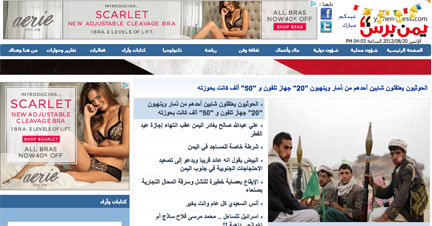
In attempting to keep up with the news in Yemen, I surf a number of Yemeni news sites. When I tried the usually reliable almasdaronline.com this morning, I was redirected to a commercial site called Mojo Pages. So I switched to yemen-press.com, where the top story was about the Huthi forces arresting two individuals in Sa‘da. While reading the article I realized that it was impossible to ignore the Gestalt of the total screen page, which I reproduce above. Here is a scene of several Yemeni fighters, clearly in a qat-chewing mode, and holding what I suspect (not being a military expert) are grenade launchers. What struck my attention was the advertisement adorning the banner and taking a prominent space on the left of the screen: Scarlet, the new adjustable cleavage bra. I have not been in the market for a bra, so I do not think the ad showed up due to any sophisticated Facebook-style marketing strategy. But I am male, so perhaps the assumption is that any Western viewer is in the market for a bra, since the ad is in English after all. And ten minutes later a new ad took its place: this time for a car rental place in New York.

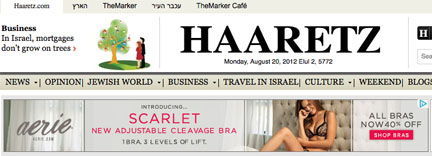
Then a couple of hours later I happened across an article on Haaretz and there she was again: dear Scarlet hawking her gawking adjustable discount bra. Perhaps I am a victim of cookies twisting, but what a coincidence that is probably not a coincidence. Criss-crossing the endemic violence in the Middle East, the ongoing plight of the Palestinians and the voices in the Zionist wilderness of left-leaning Israelis there is the seductive power of an ad, as if politics did not really matter. In this case the bra fits all sizes of religious persuasions and the model is available to be ogled by anyone, at least from a Western computer. How ecumenical can commercial immodesty get.

It is the multifarious irony of these pages that weighs me down. I will focus on the Yemen website, since that was the first encounter with Scarlet. First, how ironic that I devour news by scouring multiple websites, most of which do not explicitly state their de facto bias. While there are a couple of Yemen News sites that are available in English (like Yemen Times and Yemen Post), they tend to be days old and in need of better English editing. Yemen Times, for example has a most recent post of August 15, five days ago, which is hardly Time Magazine timely. Yemen Post has a story only a day old, but its presentation is nowhere near as slick as any of the major Yemeni sites in Arabic. Irony #1 is that what is available but not in Arabic is old and out-of-date internet-wise. This is only an irony for the hubris with which English-speakers assume that news must be packaged in their native language.

The second irony is the critical crux. Where else can you find images of a seductive woman in a bra revealing cleavage (and at 40% off) counterposed with a truckload of qat-chewing Yemenis holding grenade launchers or on a major Israeli online newspaper in English? Continue reading Revealing the News