Category Archives: Anthropology/Sociology

On the beauty of late medieval florilegium


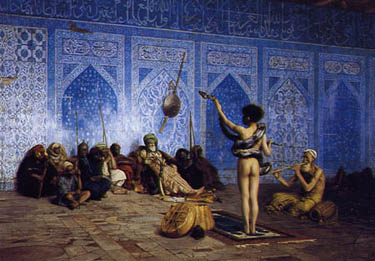
Jean-Léon Gérôme’s Le charmeur des serpentes, 1880

In 2007 I published Reading Orientalism: Said and the Unsaid with the University of Washington Press. The build-up to its publishing is a story that spans almost six years. Originally I had planned to include a chapter on Said’s Orientalism in a book I was writing called Islam Obscured: The Rhetoric of Anthropological Representation, which was published in the SAR series of Palgrave in 2005. But as I began to work on the chapter, it quickly took on a life of its own. I had first read Orientalism when returning from ethnographic fieldwork in Yemen in 1979. It sat on my bookshelf and I dutifully included the author’s “introduction” (the most readable part of the book for undergraduate students) in my course on Middle East anthropology. But as I delved back into Said’s book and started collecting the original reviews (which turned out to be more than 50) and the plethora of writings about Orientalism, I discovered that this dense book was fraught with errors of fact and methodological missteps.

While working on both books-to-be, I delivered a paper at the annual meeting of the American Anthropological Association in 2001 entitled “Dissing Orientalist Discourse: What Said Said and What Ethnographers Did,” followed by talks on my evolving text at the University of Pennsylvania, Harvard, the University of London and New York University. The AAA talk prompted a young employee of Routledge to ask if I was thinking of writing a book on the subject. Naively, I said yes and after another year had a draft ready to drop off in their New York office. Time went by and by and there was no word from Routledge. Eventually, after several months, I received a letter from the Sociology editor noting that Routledge at the time no longer had an Anthropology editor and my manuscript was not of interest to him. I thus learned that there were sociologists who seemed not to know much about Edward Said. But they did send the reviewer’s comments and these were well taken. In fact my first draft was in need of major revision.

So revise I did and then I accidentally stumbled across a website of a book agent inviting queries. Continue reading On the beauty of late medieval florilegium
Tribes and Terrorism: Myth and Reality


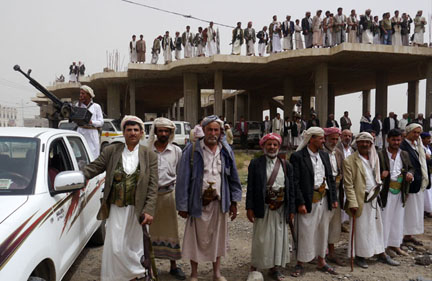
Tribesmen from Yemen´s Bakil tribal confederation waiting for a decision at a tribal law-based conflict resolution session (Mikael Strandberg)

by Khaled Fattah, opencanada.org, October 18, 2012

With the recent stepping up of controversial U.S. drone attacks in tribal areas of Yemen, and post-Arab Spring confrontations with militant jihadist groups in tribal areas of Egypt, Libya, and North Africa, a number of misconceptions surrounding the links between tribes and terrorism in the Arab Middle East continue to plague press coverage and policy reports. The first of these misconceptions is that tribal areas are lawless, ungoverned spaces – a modern-day Wild West. Another misconception is that the ultra-conservative culture of Arab tribes is fertile ground in which to root the violent ideology of transnational terror cells. The truth is that much of the current commentary about tribes and tribalism in the Arab Middle East reflects the Pentagon’s experiences so far in the American-led “War on Terror.” This war has now shifted from boot-heavy invasions to ghost wars in which drones hover over countries with significant tribal populations: Yemen, Pakistan, Afghanistan, Somalia, Libya, and Mali. The War on Terror is now primarily carried out via “open secret” predator drone missions that increasingly target exclusively tribal areas.

Tribal Areas Today Are Not the Wild West

Over the last 10 years, many comparisons have been drawn between the fabled “Wild West” of America toward the end of the 19th century, and present-day tribal areas of the Middle East. The “Wild West” conjures up images of adventurous cowboys facing off in a dusty street in front of a gambling den or brothel, pistols drawn. The image suggests a lawless era in U.S. history, where violence prevailed in American frontier towns, might made right, and the weak were punished for crimes they did not commit. The Wild West was an anarchic social world shaped by outlawed individuals and their henchmen. This period in American history bares little resemblance to life in the tribal areas of the Arab world today, which are highly socialized, with clear normative controls. The association of tribal areas in the Middle East with the Wild West is simply an attractive analogy to intermittent foreign observers and army generals. Continue reading Tribes and Terrorism: Myth and Reality

The Morale of the Moral Animal


A Christmas message from Charles Darwin

In a New York Times commentary two days ago, Rabbi Jonathan Sacks tackles the consumerist “war on Christmas/Hanukkah” but with a neuro-evolutionary twist traced back to none other than Charles Darwin. He argues that despite the rightwing clamor about the impending destruction of Christmas and all things deemed proper religion, religion is doing quite well “in an age of science” and after “a series of withering attacks, most recently by the new atheists, including Sam Harris, Richard Dawkins and the late Christopher Hitchens.” The proof? Well, “still in Britain three in four people, and in America four in five, declare allegiance to a religious faith.” He might have added that an even higher percentage would work for Islam, and probably Hinduism and Buddhism as well.

For Sacks this adherence to a religious faith “is truly surprising.” Really? It seems that the best explanation for him comes from Darwin, once considered the Great Satan of Scientific Doubt. Here is the dubious (and I believe ultimately “missing”) link between what people say in opinion polls about religion and the scientist whose 200th birthday was celebrated only three years ago:

Our biological and cultural makeup constitutes our “adaptive fitness.” Yet religion is the greatest survivor of them all. Superpowers tend to last a century; the great faiths last millenniums.

So “survival of the fittest” must mean that since something as vague as “religious faith” survives in opinion polls, it must be very, very fit. In this case the evidence does not fit very well. Sacks notes that Darwin was “puzzled” by the fact that the ruthless do not always win in the battle for survival. How could altruism possibly result from natural selection? Darwin was puzzled because he had no idea of genetics or DNA, despite his correct notion that inheritance is always unique; thus, his model provided a mechanism that explained why so-called “fixed” species could actually transform and did not in itself explain why. But Sacks misses the point on what allows humans (and no doubt several of our ancestral cousins) to be moral at all: the ability to think morally rather than simply act according to a programmatic code. The seeming altruism of an insect or bird is not the same as altruism among humans, because it is not thought out as humans do. Nor is it the case that altruism demands self-sacrifice; caring for one’s offspring can be as altruistic an act as sacrificing one’s life for a comrade. If a mother or father sacrifices herself or himself to save a child, this is indeed reproductive success as Darwin would define it.

But Darwin is not really the issue here, unless Sacks wishes to analyze Darwin’s own views on religion. In his Autobiography (a great read at any time of year), Darwin clearly rejected the formal Anglican Christianity of his day, but he did not consider himself an atheist. The term “agnostic,” created by his friend and public relations bulldog Thomas Huxley, is a closer fit to what Darwin is suggesting about the transformation of his own faith. He did not reject the idea of some intellectual force setting the whole universe in motion or keeping it together, but he did not see any viable explanation in the religions he knew. Continue reading The Morale of the Moral Animal

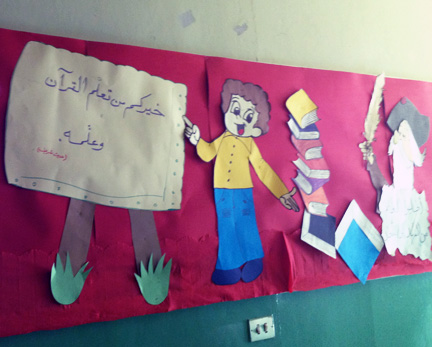
New Syrian Schools in Lebanon


New Syrian Schools in Lebanon: between refugees’ empowerment and unwillingly fueled Social Alienation

by Estella Carpi

Last October 1, the school “Madrasat al-Iman al-Islamiyya” in Abu Samra in the city of Tripoli (North Lebanon) opened to “fresh off the boat” Syrian refugee kids and youth, in order to cope with the need of providing proper education in their everyday existential limbo.

The doors of this originally Lebanese Islamic school open daily to Syrian pupils from 4pm to 6pm in the afternoon, with the exception of Friday and Sunday, as established in the Tripoli district school calendar. When I visited the school on a Friday morning, the space was being used for playing volleyball and other entertainment activities were organized in class. The Back-to-School campaign has been quite large this year in Lebanon. To date, 4,942 children have been enrolled in schools, 1,650 of who are also supported by UNICEF, of a total refugee population of 162,050 individuals according to the most updated statistics provided by UNHCR.

“Soon we’re going to open new classes for high school students as well”, tells me A., administrative staff member of the school. The school director specifies that there will not be any coordination between the Syrian and the Lebanese school programme: “We made certain that, once the kids are done with their studies here and they will be able to get back to Syria in safe conditions, their certificate will be considered valid whatever the political system will be back home, with or without nizam al-Assad” (the current Syrian regime of Bashar al Assad). The school policies, hence, purvey the underlying intention of the whole Syrian refugeehood system to get back to Syria as soon as it is feasible. “We are going to translate all books from French and English – used in the Lebanese school system – into Arabic, and it’s going to be a big job”, explains to me the director of the school, who has been in Lebanon for 31 years, unlike the newly arrived Syrian teachers and the school’s administrative staff, who make up the vast majority. Continue reading New Syrian Schools in Lebanon

Self-inflicted wounds


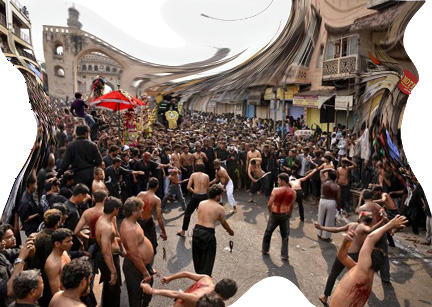
The most potent symbol of the history of the Middle East, indeed of much of human history, is the stuff of life itself: blood. In the sacred history of the three major monotheisms enough blood has been shed since their inception (by and against each one of them) to raise the sea level meters upon meters. Even in the Genesis origin story the first two natural births, Cain and Abel, became the first to introduce bloodshed as a norm. The God of Genesis got into the act, killing animals to make skins that would clothe the naked bodies he created of Adam and Eve and then preferring the animal sacrifice of Abel to the firstfruit figs raised by Cain. The same God went on to substitute a lamb for Abraham’s heir, although only when Abe’s knife was poised to slit his son’s throat, but then in Christian dogma the now-threefold deity shed a third of his essence on the cross. In that same dogma Jesus no longer needs that lost blood as he resurrected to make the trinity a divine threesome once more. But the bloodletting has never stopped.

By all accounts the prophet Muhammad was not fond of shedding blood. The forays and battles that took place while he and his followers were in exile in Medina are remarkable for how few deaths are said to have occurred. When he returned in triumph to Mecca it was not because of any great military victories, nor was their a bloodbath of the Meccans. At the start of Islam the Allah seen through the Quran is neither interested in literal blood sacrifices or a figurative eucharistic variety. Muslims purify themselves with water to make themselves ready for prayer. Calls for jihad have resonated throughout the Islamic era as countless thousands upon thousands have died for not being Muslim, being Muslim or being the wrong kind of Muslim: such is the political baggage common to most religions known to history and probably before recorded history. Continue reading Self-inflicted wounds

Mayans and Mahdis: No End in Hindsight


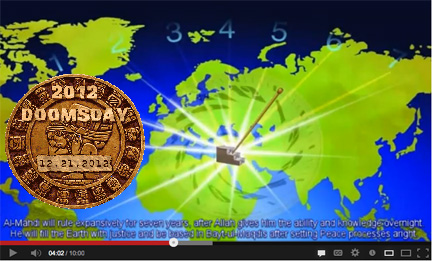
Today is December 21, 2012. For most of us it is just another day. But for some it is the end of the world. The most infamous prediction for today is a claim about the Mayan calendar and the nebulous plant Nibiru. I am not sure what time of the day the end is supposed to happen, but I am taking the precaution of posting my commentary the night before. Of course, since NASA has seen fit to deem this prediction a hoax (imagine that) with a Youtube video, I am perhaps being overly cautious. I suppose NASA took action because there is a Youtube channel out there on the Mayan date and we all know how many people accept anything they see on Youtube as true. Fingers have been pointed at the filmmakers of 2012, said on the official film website to be the “number one movie in the world.” But who knows why Hollywood bothered to make the film at all if the producers won’t be around to cash in on sales. Well, they did make it a couple of years ago and have no doubt been partying right up until December 21.

But just in case Muslims are wondering about this 2012 doomsday scenario, it is comforting to note that Ahlul Bayt News Agency has issued a statement that Muslim scholars have condemned the threat as a hoax. Continue reading Mayans and Mahdis: No End in Hindsight

Suffer the little children


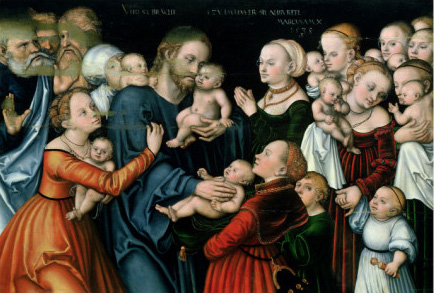
Suffer the Little Children to Come Unto Me, by Lucas Cranach the Elder, 1538

Growing up on the King James Version of the Gospels, I well remember the force of a verse from Mark 10:14 in which Jesus, in anger, said: “Suffer the little children to come unto me, and forbid them not: for of such is the kingdom of God.” The occasion was when several parents brought children to Jesus to be blessed, but were discouraged by his disciples. This past week has seen the suffering of little children around the world. Last Friday America was gripped by the tragedy of twenty elementary children and six adults gunned down by a disturbed young man, who first killed his mother in bed and then at the school took his own life. In a nation that wears its constitutional “right to bear arms” on its political sleeves, this was a shot to the gut. For all of us whose children have gone through the public school system, the shock lingers. It could have been any local school in any state. It could have been any of our children. A killer with a gun has denied them life. This suffering is not what Jesus meant when he said “suffer the little children to come unto me.” One need not be an expert in 17th century English to understand the meaning of the verse.

But children continue to suffer at the hands of adults all over the world. In Pakistan on Monday six health workers engaged in a project to immunize children were shot to death by extremists who have been told that such a program to save children’s lives is actually a Western plot to undermine Islam. Along with five brave women and one man, the Pakistani children who will not have immunity from polio will also suffer. The irony that six adults were killed both in Pakistan and in New Town, Connecticut is worth reflecting on. In both cases those trying to save children became victims; in both cases children suffer. Continue reading Suffer the little children

Hark! The Herald Angels Didn’t Sing


by Tanya Lurhmann,The New York Times, December 14, 2012

We are in Advent, but over the transom has come the sobering news that Image Books has just published a book written by the pope, “Jesus of Nazareth: The Infancy Narratives,” in which he observes that there was neither an ox nor a donkey in the stable where Jesus was born. Nor did a host of angels sing. They spoke.

Is “Hark! the Herald Angels Sing” doomed?

In fact, the news is not so grim. This is not an encyclical; the pope is writing as Joseph Ratzinger. It turns out that he tolerates, even encourages, the presence of lowing animals in the manger. He writes: “In the Gospel there is no reference to animals at this point. But prayerful reflection, reading Old and New Testaments in the light of one another, filled this lacuna at a very early state by pointing to Isaiah 1:3: ‘The ox knows its owner, and the ass its master’s crib, but Israel does not know.’ ” A few pages later, the pope explains that “Christianity has always understood that the speech of angels is actually song.” Continue reading Hark! The Herald Angels Didn’t Sing