Category Archives: Anthropology/Sociology

Digital Heroes: Video Games and Identity Construction in Iran


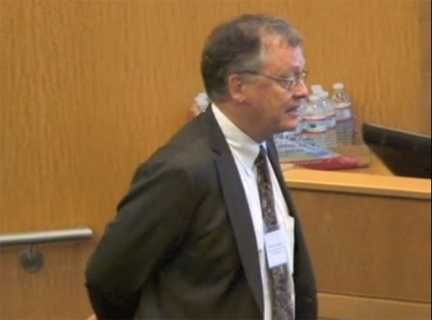
The Middle East and Middle Eastern American Center of The Graduate Center at CUNY announces a lecture by Vit Sisler (Charles University) entitled Digital Heroes: Video Games and Identity Construction in Iran. This will be held February 11, 2013 from 6:30 PM TO 8:30 PM in Rom 9204 of The Graduate Center. For more information, click here. Admission is free.

Abstract:
Video games are a popular leisure time activity for a substantial part of Iranian youth. At the same time, most games on the Iranian market are of US, European, or Japanese origin. Unsurprisingly, the Iranian authorities are concerned about the negative influence of such games on Iranian youth. Therefore, they established the National Foundation of Computer Games in Tehran in 2006 in order to subsidize development of games in Iran, conceived in accordance with Iranian and Islamic values. Consequently, a variety of independent producers have become involved in this emerging industry. The lecture analyzes contemporary Iranian video games and explores the ways in which they communicate different concepts of identity. Essentially, whereas the Iranian government perceives games as a new semiotic language of the youth and utilizes them to promote Islamic values and foster national pride, many independent producers maneuver within the and around state’s interests, presenting instead their own, oftentimes quite different ideas. Therefore, the resulting concepts of identity are achieved through sensitive negotiations between the demands, funding and restrictions of the Islamic state and the visions and engagement of private entrepreneurs.

Vit Sisler is an assistant professor at the Faculty of Arts at Charles University in Prague. His research deals with the problematic of contemporary Islamic law, the relation between Islam and digital media, normative frameworks in cyberspace, and the topic of educational and political video games. Vit Sisler was a visiting Fulbright scholar at Northwestern University in 2008-2009. He is also a managing editor of CyberOrient, a peer reviewed journal founded by the Middle East Section of the American Anthropological Association.
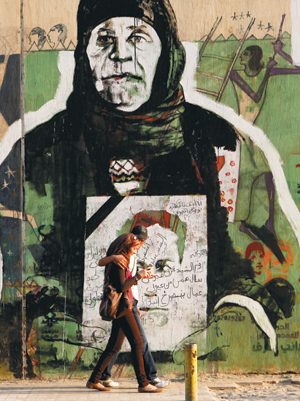
Drone Strikes


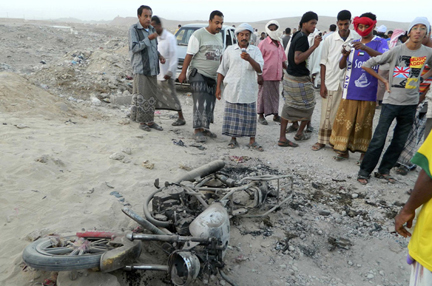
New America Foundation says that US drone attacks in Yemen have risen from 18 in 2011 to 53 in 2012 [Reuters]

[Drones are now at the top of the news cycle. This commentary was originally published in the January online edition of Anthropology News.]

The Error in the War on Terror

In 1978 I arrived in the Yemen Arab Republic to begin 18 months ethnographic fieldwork. At the time North Yemen, as it was called, was in full development mode. A protracted civil war after the fall of the traditional Zaydi imamate had ended only a decade before. Aid was pouring in from the United Nations, the United States, Germany, France, The Netherlands, Russia and mainland China as the country was in the throes of building itself up by its sandalstraps. Once settled in my field site, the beautiful spring-fed highland valley of al-Ahjur, I could not help but notice that just about everyone was armed, many with kalashnikovs. This was a tribal area, where the central government exercised little control, but I never felt safer in my life.

I felt safe because as a foreigner I was protected under tribal customary law. At this time the United States was well liked, often in contrast to the atheist communists of the Soviet Union who supported the socialist regime in South Yemen. This was before any hint of terrorism, before the Iran hostage affair and long before al-Qaeda. Osama Bin Laden had just turned 21 and was still in college. In this tribal area there was an honor code, exemplified by the Yemeni term qabyala, that required protection of unarmed guests, as it did women and children. In 2004, on a return visit to the valley, I found myself in the difficult situation of explaining why I did not support the U.S. invasion of Iraq. One of my Yemeni friends noted that he used to think that America was different, but now he believed that the U.S. president was as bad as his own, Ali Abdullah Salih. Continue reading Drone Strikes

iOrientalism: Fooling around with Arab princesses


The late Edward Said lamented the biased representation of the “Oriental” in his influential Orientalism, published 35 years ago. Most of the scholarly and voyeuristic tomes he critiqued are rarely read these days, although his intellectual nemesis Bernard Lewis is well represented in your local Barnes and Noble bookstore (in part thanks to a desire for selling books rather than seriously vetting them by some of the editors at Oxford University Press). Few students of the Middle East or Islamic studies these days have ever heard of Lord Cromer or William Muir or Raphael Patai, let alone would read and be influenced by their aged volumes. The ugly ethnocentrism, racism and sexism that once could be found in the broad (far too broad) discourse labeled “Orientalism” is still quite evident, although moreso in the media, political punditry on the right and rantings of career Islamophobes than by serious scholars. But we are now in the digital age and iOrientalism is now propelled through Facebook, Twitter and Youtube via iphones, ipods and their technological clones.

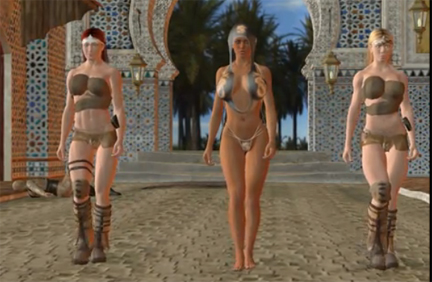
One Youtube video that recently appeared on a Youtube search that had nothing to do with the subject I was searching is a mock video-game fight between three hefty-bosomed and bursting-at-the-bra-straps Arab princesses and a swarthy Mike Tysonish evil guy. This appears to be a promo for Poser Pro Animation rather than a cultural statement per se. The three Arab princesses are so scantily clad that it is more the tile-glazed architecture and palm trees that orientalize than the costume or look. Of the three kung-fu trained ladies, one has red hair, one is a blond and the other is wearing what looks to me like the kind of aviator helmet worn by Amelia Earhart in the 1930s. The bully wears a leather waist band, but otherwise the shaft he was endowed with by nature is visible to the three princesses, but not to those of us viewing the video. Ironically, this parallels Said’s choice of the Gérôme’s painting that graced the cover of the original paperback of Orientalism: this features a naked boy with a snake wrapped around him and a group of grizzled Walnetto perverts staring at his organ, while we voyeuristic viewers can only see the glistening buttocks of the youth. Continue reading iOrientalism: Fooling around with Arab princesses

Sex in the Muslim City


by Carlin Romano, The Chronicle of Higher Education, January 14, 2013

Is it possible all those young men clashing in the streets of Cairo and Damascus aren’t getting enough?

Democracy? No, I mean that other thing people seek and are willing to die for.

Talk of the “Arab Spring” now forms a clichéd part of pundit chatter in America, with plays on “Arab Winter” and “Arab Fall” depending on the politics of the speaker and the troubled country dissolving at the moment. But few talking heads know enough about Arab culture to tie the massive Mideast street actions we’ve seen to matters behind surface politics. And those background matters include the state of Arab marriage, the tension between so-called Western norms and Islamic pieties, and the suppressed sexuality among Arab youth who face financial and theological obstacles to fulfilling their desires.

Is it tasteless to mix somber stuff like political rebellion with sub-rosa lust and denial? Could be it’s truthful rather than tasteless.

Thank you, then, Shereen El Feki—Cambridge-educated immunologist, former science writer for The Economist, current vice chair of the U.N.’s Global Commission on HIV and Law—for adventuring beyond the headlines in Sex and the Citadel: Intimate Life in a Changing Arab World, forthcoming from Pantheon Books. It’s a trenchant exploration of the uncertainties filling the humble abodes that Tahrir Square demonstrators go home to. A truthful book may not set you free when you’ve suffered under centuries of misguided interpretations of Islam and sex, but one prays that El Feki gets an Arabic edition.

In the West, her blunt examination of sex and its attendant practices and paraphernalia—topics include vibrators, Viagra, virginity codes, marital rape, and homophobia—would hardly raise an eyebrow. We Westerners live now in a Fifty Shades world, a publishing culture in which Naomi Wolf’s Vagina gets reviewed on the front page of The New York Times Book Review by former ballerina Toni Bentley—she of The Surrender (a title meant to evoke the offering of another body part)—and one hopes the kids aren’t watching. Continue reading Sex in the Muslim City

Iranian Studies Directory Online


Putting the world’s scholars and organisations at your fingertips, the Iranian Studies Directory (ISD) is a pioneering initiative to develop a comprehensive reference and research facility that will open up the fields of Persian and Iranian studies to academics, teachers, students, curators, professionals and lay enthusiasts across the globe.

If you are in any way involved in the world of Iranian or Persian studies, get networked now! Register with this public resource and connect yourself to other professionals and institutions in your field throughout the world.

On War: A Sociologist’s Take


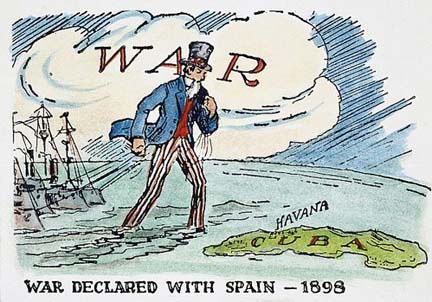
Sociologist William Graham Sumner was an outspoken critical of American imperialism in the Spanish American War

by William Graham Sumner (1903)

Can peace be universal? There is no reason to believe it. It is a fallacy to suppose that by widening the peace-group more and more it can at last embrace all mankind. What happens is that, as it grows bigger, differences, discords, antagonisms, and war begin inside of it on account of the divergence of interests. Since evil passions are a part of human nature and are in all societies all the time, a part of the energy of the society is constantly spent in repressing them. If all nations should resolve to have no armed ships any more, pirates would reappear upon the ocean; the police of the seas must be maintained. We could not dispense with our militia; we have too frequent need of it now. But police defense is not war in the sense in which I have been discussing it. War, in the future will be the clash of policies of national vanity and selfishness when they cross each other’s path.

If you want war, nourish a doctrine. Doctrines are the most frightful tyrants to which men ever are subject, because doctrines get inside of a man’s own reason and betray him against himself. Civilized men have done their fiercest fighting for doctrines. The reconquest of the Holy Sepulcher, “the balance of power,” “no universal dominion,” “trade follows the flag,” “he who holds the land will hold the sea,” “the throne and the altar,” the revolution, the faith — these are the things for which men have given their lives. What are they all? Nothing but rhetoric and phantasms. Doctrines are always vague; it would ruin a doctrine to define it, because then it could be analyzed, tested, criticised, and verified; but nothing ought to be tolerated which cannot be so tested. Continue reading On War: A Sociologist’s Take

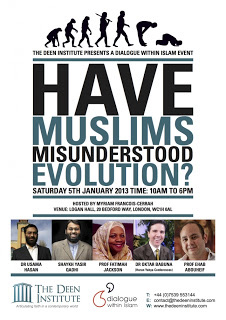
Have Muslims Misunderstood Evolution


The importance of Evolution and Islam debate in London

by Salman Hameed, Irtiqa’, January 7, 2013

I’m now back in US and I’m glad that I had a chance to attend the London debate, Have Muslims Misunderstood Evolution? It was organized by The Deen Institute and I posted some quick thoughts on Saturday.

You can find a good summary of each speaker’s presentation at Farrukh’s blog.

Here are a few reasons why I think the London debate on evolution and Islam may turn out be a game-changer in the way Muslims look at evolutionary biology, and science, in general.

This was an intra-faith debate. There is no question that the topic was controversial. However, the conversation on evolution often gets derailed by common misconceptions and juvenile creationist ideas. The debate would have been a failure, had it been simply between biologists and those who follow Harun Yahya. There is no common ground – as Yahya’s group has no understanding of science.

The reason for the success of the debate was that almost all of the speakers (with the exception of Harun Yahya acolyte, Oktar Babuna) accepted the scientific consensus on evolution. Then the question became: Can Muslims reconcile human evolution with their faith? Now this is an important question.

Here are a few take-aways from the London debate: Continue reading Have Muslims Misunderstood Evolution