Category Archives: Orientalism

The Immovable East


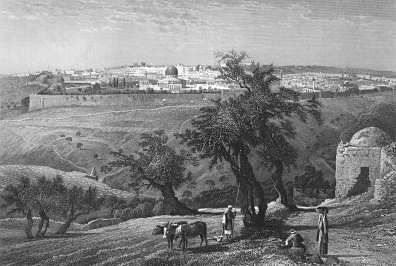
Jerusalem from the Mount of Olives

It is easy to dismiss past travel writing about the “Orient” as mere “Orientalism,” the kind that Edward Said disparaged as a style for dominating the supposed “Oriental” other. But viewing such texts through a politicized post-colonial lens thus becomes a kind of scorched-earth form of literary criticism. True enough, there are many narratives, especially by Christian writers, that approach the physical ‘Holy Land’ with a schizophrenic ax to grind: an over-appreciation of the biblical character of the land coupled to an under-valuing of the people who lived in the land at the time. But occasionally there are texts that dig beneath the surface if the reader has the patience to read beyond the surface rhetoric. One of these is a delightful first-person narrative by Philip J. Baldensperger, published in 1913 about experiences in Palestine during the last half of the 19th century. Continue reading The Immovable East
Bulldozing the [Arti]Facts

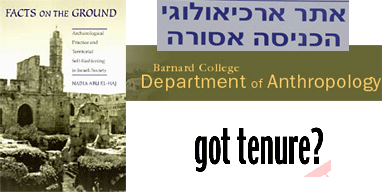
As an individual in Academe who has already achieved the career-defining rite of pedagogical passage known as “tenure,” the issue of a fellow scholar potentially being denied tenure in a highly politicized media campaign becomes an issue of concern. I am not so puffed up to think that tenure status is ipso facto a mark of praiseworthy expertise. There are far too many examples out there of professors who are not any better for having been collegially granted a life sentence or who drop out of publishing and professional sight once they are “in.” Some use the bestowed honor to promote their own partisan views at the expense of teaching others by example to enhance critical thinking. But one thing that I do find sacred about the status is that it is necessarily judged in the local academic context. If one’s peers and administrative lords agree that a certain professor deserves tenure, then so be it. It is not as though a pope is being elected to shepherd the whole flock. Outside interference is indeed interference, especially when the deliberated judgments of a range of responsible individuals at a major college are being challenged.

One current case at Barnard College has hit the media, a rarity except when an outside group has a strong partisan bias. This is the case of Nadia Abu El-Haj, who teaches anthropology. Continue reading Bulldozing the [Arti]Facts

The Land and the Book #3: Under the Cedars of Lebanon

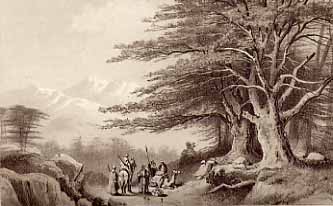
The Land and the Book by William Thomson revels in the open countryside, where the author would have the pilgrim join in under the stars, especially when the bed is stretched out in a grove of cedars on Mt. Lebanon. Here is the missionary’s description of the magic of the cedars over 150 years ago.

Have you ever visited these cedars?

Many times. They are situated high up on the western slope of Lebanon, ten hours south-east from Tripoli. Besherrah is directly west, in the romantic gorge of the Khadusha, two thousand feet below them, and Ehden is three hours distant on the road to Tripoli. In no other part of Syria are the mountains so Alpine, the proportions so gigantic, the ravines so profound and awful. You must not leave the country without visiting the cedars. Continue reading The Land and the Book #3: Under the Cedars of Lebanon

Sahara, My, My but it’s Dry

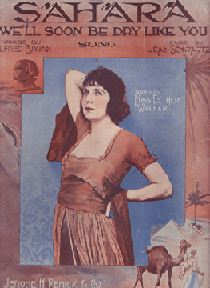
Vaudeville loved Orientalism. By the time Valentino played The Sheik, images of Middle Eastern scenes were well represented on stage and in music. Some of the lyrics from this time period are very clever. My personal favorite is a prohibition song from 1920 called “Sahara, We’ll Soon Be Dry Like You,” sung by the great comic singer Billy Murray. To hear this original Edison Diamond Disk recording in a digital format, click here.

Here are the words. Why not click above and sing along…


Sahara (We’ll Soon Be Dry Like You)

Words by Alfred Bryan, Music by Jean Schwartz

Verse 1: King Rameses went to pieces seven thousand years ago,
And pass’d a law that Egypt must go dry.
He took the liquors from the “shickers” all the way to Jericho,
But kept his little toddy on the sly.
The desert of Sahara flow’d with honey so they say,
Till prohibition came along and dried it up one day. Continue reading Sahara, My, My but it’s Dry

An Unbelievable White Man


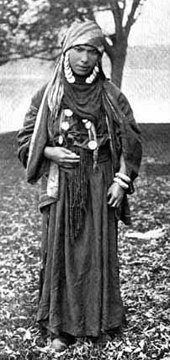
Syrian Bedouin girl at the 1893 Columbian Exposition

In his picturesque memoir of life in late 19th century Palestine, Philip J. Baldensperger recounts a number of adventures he had as a young man visiting his parent’s land with a Bedouin group. One of the foods loved by the Bedouin was the fruit of the doum palm. One day a group of Bedouin girls were surprised to see Philip’s white skin, something of a novelty at the time in rural Palestine. Here is his account:

“Being the only European, it was thought, in those days (1874), to be safer for me to wear Bedawi-clothing: a long shirt with broad, pointed sleeves hanging to the ground, a Sayé, and, on my head, a silken Kafiyé. With the exception of the girdle, which held the skirt and the Sayé together, the ‘Akal, or head-cird, wound around the Kafiyé, and a fringe of hair hanging over my forehead, in accordance with the fashion among Bedawîn youngsters, I was a figure in spotless white. In order to be able to walk more easily whilst on the march, I used to gather up the long folds of my dress and stick them in my girdle, leaving my legs bare. No wonder that one day four Bedawiyat, gathering Dôm-apples in the forest, fled with loud screams at my approach. Continue reading An Unbelievable White Man

The Land and the Book #2: Smoke on the Water


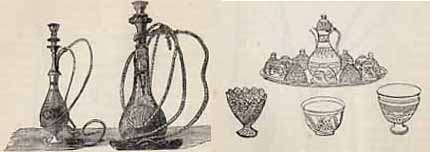
Water Pipes, left; coffee set, right; from Thomson’s “The Land and the Book”

The rustic American style pilgrim’s progress of Rev. William M. Thomson in the 1830s through the 1850s in Palestine was not just about places where the locals swore that Abraham bought a cave or Jesus preached. There were real people along the way and Thomson takes the reader inside a diwan from time to time. In one of his accounts he would be in good company with legislators who ban smoking in public places. Although cigarettes were just taking off in popularity, the traditional approach to tobacco in Syria and Palestine was smoke on the water to be followed by Turkish coffee. Let’s return a century and a half to this precursor of the modern sheesha bar. Continue reading The Land and the Book #2: Smoke on the Water

For Lust of Reading

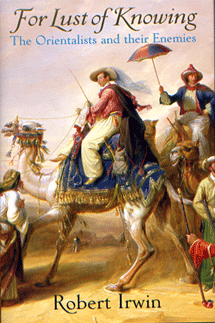
The publisher, author and Arabist historian Robert Irwin recently published a readable and passionate defense of academic Orientalism, a once-respected field that has seemingly been in post-colonial freefall (perhaps more accurately a free-for-all) since Edward Said wrote his seminal polemic Orientalism in 1978. Lust of Knowing (or Dangerous Knowledge: Orientalism and Its Discontents in the American edition), Irwin’s take on the motivation of most past Orientalist scholars, is subtitled “The Orientalists and their Enemies,” a list which extends far beyond Edward Said. “I have done my best to make this book interesting,” (p. 2) begins Irwin and all but the most head-in-the-sand devotees of Said’s thesis would have to agree he is successful in this. Like most readers of Said’s text, which is nearing the three decade mark, Irwin does not set out to defend the bias and prejudice hurled in an Oriental direction from generations of European authors, nor does he disparage Said because he was Palestinian or a staunch defender of Arab causes. Continue reading For Lust of Reading

The Wind and the Whirlwind


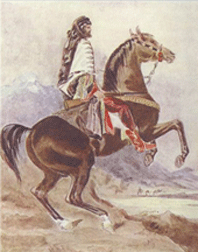
Wilfrid Scawen Blunt on Pharaoh, drawn by Lady Anne Blunt

[Note: The following poem was written by Blunt in response to the British occupation of Egypt in the late 19th century, but its words are apt for the present occupation of Iraq and Afghanistan today.]

by Wilfrid Scawen Blunt

I have a thing to say. But how to say it?
I have a cause to plead. But to what ears?
How shall I move a world by lamentation,
A world which heeded not a Nation’s tears?

How shall I speak of justice to the aggressors,
Of right to Kings whose rights include all wrong,
Of truth to Statecraft, true but in deceiving,
Of peace to Prelates, pity to the Strong?

Where shall I find a hearing? In high places?
The voice of havock drowns the voice of good.
On the throne’s steps? The elders of the nation
Rise in their ranks and call aloud for blood. Continue reading The Wind and the Whirlwind