Category Archives: Orientalism

Norma’s Take on Carthage: Part Two


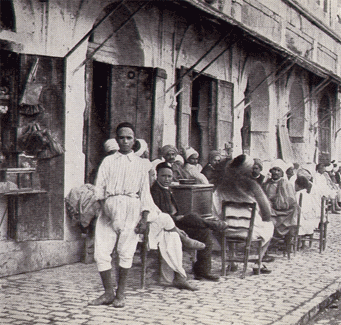
The Café in the Place Halfaouine.

In an earlier post I provided the Orientalist musings of Ms. Norma Octavia Lorimer, whose By the Waters of Carthage (1925) is classic put-down travel mongrelism. If you thought the first part was bad, read on below…

“OH, MY DEAR!

Come and take me to the desert; it lies over there, in the great Beyond, like Death — waiting — waiting — waiting.

I have seen camels in their proper atmosphere, lading their common everyday life of indifference, though so far, I must admit, I have not seen them trying to get through the eye of a needle. These strange supercilious leavings of the prehistoric past are almost as scornful of mankind as new-born babies. A Horse looks as foolishly modern besides a camel as an Englishman in his blue serge suit looks beside a burnoused and biblical Moslem…

I have been in the souks (bazaars), and it is true that there above all places you can hear the East ‘a-calling’; it is there that you forget that Tunis is under French protection and it has fine boulevards and theatres and a Petit Lourve, for all that is on the other side of the horseshoe gate (the porte de France, as it is called), and my hotel is within in. It is in the bazaars before midday that you get a glimpse of how the people live, for the pulse of the city is there, if an Arab city has a pulse. Continue reading Norma’s Take on Carthage: Part Two
The Sheik Comes to NPR


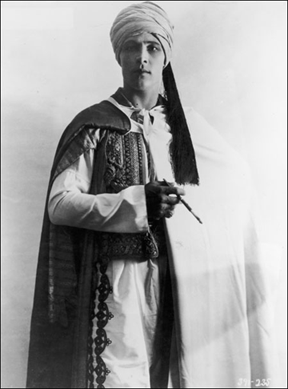
Italian-born actor Rudolph Valentino poses in costume in The Sheik.
Hulton Archive/Getty Images

NPR, Morning Edition, February 4, 2008

In 1921, a silent film transported American audiences to a mysterious, faraway place — and introduced an exotic, erotic character to millions of fans.

The Sheik starred a smoldering Italian immigrant named Rudolph Valentino and featured a title character who bore little resemblance to the venerated Arab leaders commonly known as sheiks. Instead, the character was drawn from the pages of a best-selling romance novel by the wife of a British farmer.

Written in 1919, Edith Maude Hull’s fictional The Sheik inspired a whole subgenre of desert romance, in which hot, swarthy Arabs kidnap reckless white women.

Valentino’s playful treatment of the character captivated female audiences and established him as Hollywood’s first male sex symbol. Mary Brewer Barkley, who was 13 years old when the film was released, recalls newspaper reports that young women were running off to the Middle East in the hope of being abducted by handsome Arabs. Continue reading The Sheik Comes to NPR

Norma’s Take on Carthage

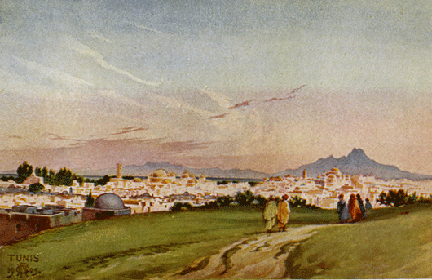
Thousands of English and American travelers have written about their experiences in the Arab World. Quite a few are worth reading, but the majority deserve obscurity. In a recent book sale at my university library, a pitiful travel account of the roaring 20s was remaindered. It bodes well for my institution that it was never checked out, although I wonder how it entered the stacks in the first place. The book in question is By the Waters of Carthage, by Norma Octavia Lorimer, following on her By the Rivers of Sicily and By the Rivers of Egypt. Why she never set sail down the Tigris by the reggae-beloved rivers of Babylon is anyone’s guess. This baneful little volume about a fickle English lady set loose in Tunis represents just about everything wrong with Orientalist inferiorizing of cultures in the Middle East. The only redeeming features are the colorful frontispiece (shown above) and black-and-white photographs of life in Tunisia around 1920.

Sometimes it is useful to read bad text in order to appreciate good travel writing all the more. There is probably no bias that does not surface in Lorimer’s diary-prone prose, all the more chauvanized by her style of filling her chapters with letters to her dear husband. Consider the following tidbits… Continue reading Norma’s Take on Carthage

While in the Other Manger …


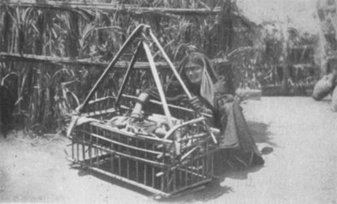
Date Stick Cradle, from Zwemer’s book.

Christmas Eve is the time for reflecting on a baby in a manger in Bethlehem, three kings bringing spices and shepherds blinded by angel light. Christians around the world celebrate this scene, but what do they think of all those other babies who were not destined to become religious icons? Back in 1902 the Christian missionary Samuel Zwemer and his wife Amy teamed up to write a children’s book about Topsy-Turvy Land. For more information on this apologetic diatribe against Islam and Arabs, click here. As the authors claim, “In Topsy-turvy Land all the habits and customs are exactly opposite to those in America or England.” And where is this mythical garden of play for good Christian children? Arabia, specifically an Arabia in which the Ottoman Empire still had steam. For a good-old-boy, old-fashioned religion view of the “Arab” child as a topsy-turvy other, this is as prime a piece of apologetic and Orientalist dismissal as you can find. So take a look in the other manger, as the evangelistic Zwemers did a mere century ago…

ARAB BABIES AND THEIR MOTHERS

An Arab baby is such a funny little creature! In Christian lands babies, as soon as possible, are given a warm bath and dressed with comfortable clothing. But in Arabia the babies are not washed for many days, only rubbed over with a brown powder and their tiny eyelids painted round with collyrium. They are wound up in a piece of calico and tied up with a string, just like a package of sugar. Continue reading While in the Other Manger …

Baghdad in the 80’s

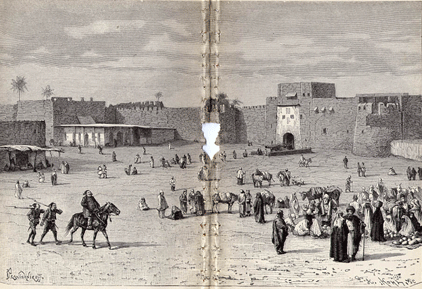
Baghdad in the 1880’s, in case you are curious.

As university libraries desperately look for space to hold old and rarely used volumes, many books fall by the wayside. My university holds an annual sale in which most of the books being discarded deserve to be. But then there are the occasional old and rare books that I cannot bear knowing will end up in a dumpster or landfill. One of these that I recently picked up for a dollar was Geographische Charakterbilder aus Asien. Aus den Originalberichten der Reisenden gesammelt von Dr. Berthold Volz mit 87 Illustrationen (Leipzig, Fues’s Verlag, 1887, 384 pages). The discursive Althochdeutsch aside, this text is a bit of print paradise for the lover of 19th century lithographs, all 87 of them. Continue reading Baghdad in the 80’s

Arabia, A Poem from 1815

While reading old books on Arabia in Oxford’s Bodleian Library two summers ago, I came across a rare book indeed. I had the privilege of being the first person ever to read the book, as the folios were still uncut. Considering that the book was published in 1815 and soon thereafter entered the library, it might be readily assumed that it is a book not worth reading. In fact it proved to be a delight and a rarity. The book is called Arabia, A Poem and the author is a man named Johnson Grant. The author was an Oxford chap of St. John’s and is billed as the Domestic Chaplain to the Countess Dowager of Balcarres. No doubt the Countess enjoyed the work, although generations of Oxford students and scholars have somehow passed it by.

It is a rather long poem with extensive commentary. Not surprisingly, the Christian chaplain does not think Islam is the right religion. Continue reading Arabia, A Poem from 1815

Want to Watch My Harem?

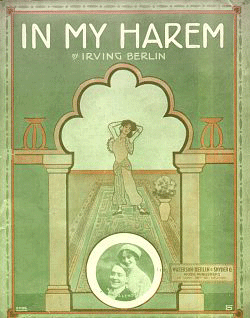
Ah, vaudeville. Before Elvis, the Beatles and the Beastie Boys, there were those corny songs targeting recent immigrants to America. One of those immigrants with a Sicilian last name would have been my grandfather, Martin Varisco, who in 1913 left the Big Apple Blossom to work on the railroad and work his way west. He made it to Ohio, where he married and settled down. But the very year he left New York, the songwriter Irving Berlin produced one of his less memorable songs. This was for the Irish, not the Italians, an important distinction on the streets and in the bars at the time. But here’s what can happen when Tin Pan Alley gets confused with Midaq Alley: an Irishman named Pat Malone with rhyme running amok in a Turkish harem. Continue reading Want to Watch My Harem?

Afghanistan: The Vaudeville Version

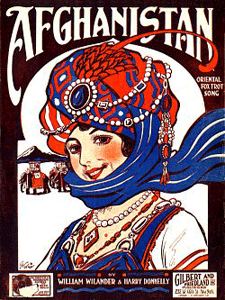
America not only flexes its military muscles and economic clout around the world, but at times takes the rest of the world for a song and dance. Vaudeville, the early 20th century dance hall and stage phenomenon, lyrically used and abused the world as a stage. But it seldom looked much like the real world of the time, and certainly not after almost a century later. Here was popular Orientalism, in the Valentino Sheik mode, for anyone who could afford sheet music. One of the wonderful nostalgic websites documenting this era is Parlor Songs, which publishes an online magazine.

If you would like to see how Vaudeville treated the Orient, check out the article by Richard A. Reublin in the 2005 issue. Among the songs discussed is “Afghanistan” written in 1920 by William Wilander and Harry Donnelly. Click here to listen to the song as you read the lyrics:

Afghanistan
A Romance of Asia
Words and Music by
William Wilander & Harry Donnelly
Published 1920 by Gilbert & Friedland, Inc.

[Verse 1]
In the land of Afghanistan,
There’s a Hindu maid and a man,
She swore by the stars up above her,
That he was the one to love her. Continue reading Afghanistan: The Vaudeville Version