Category Archives: Orientalism

Demise of IsIAO

[Note: IsIAO teaches and researches most Oriental languages and cultures. More information on the situation is available here.]
Dear colleagues and friends,

I have been informed of the shocking news that a decree has been passed by the Italian Council of Ministers to shut down the famous Istituto Italiano per l’Africa e l’Oriente (IsIAO). It is inconceivable that such an extraordinary institution which has been active during the past 100 years in promoting a knowledge of Iran, India, Afghanistan, the Far East, and recently also Africa with amazing success should be abolished.

Professor Giuseppe Tucci and his successor Professor Gherardo Gnoli have done wonders in spreading the knowledge of Iranian lands, their archaeology, their history and their culture. To deprive the Iranian Studies from the services and contributions of this marvelous institution is a severe blow to the promotion of the knowledge of Iran on the international scene.

Professor Tosi has sent an email requesting all supporters of Iranian studies to sign a letter written to the President of the Italian Republic to support the continuation of IsIAO. Please by all means add your signature to this letter and encourage your friends and colleagues to do so as well.

To add your signature visit http://iranica.c.topica.com/maalZ1nabItGzaE1MJ2b/ and please do this as soon as possible, hopefully before the end of the week. Thanks.

With best wishes,

Ehsan Yarshate, Encyclopaedia Iranica
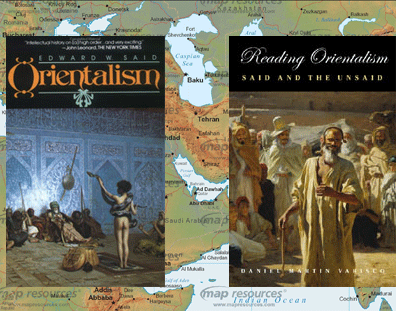
Introducing “Reading Orientalism”


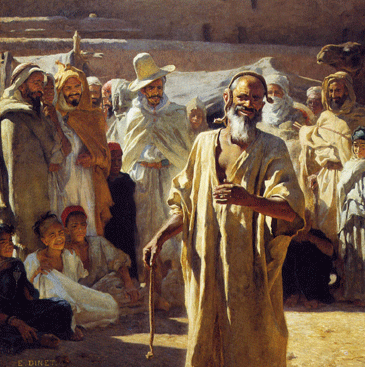
The Snake Charmer, Etienne Dinet, 1889


Last November I published Reading Orientalism: Said and the Unsaid with the University of Washington Press. The issues surrounding “Orientalism” and the legacy of Edward Said’s corpus are ongoing, but much of the debate still centers on personalities rather than pragmatic assessment of the complex intertwining of ethnocentrism, racism and sexism that extends far beyond anything imagined as an “Orient” or a “West.” Here is part of the introductory note to my book.

To the Reader

As an intellectual, I feel challenged by the theoretical incoherence; I feel driven to strive for an answer that, if it has not yet attained universal validity, will at least have transcended the evident limitations of the dichotomized past. Wilfred Cantwell Smith

And is it not further tribute to his triumph to see more clearly what he was battling? Maria Rosa Menocal

You have before you two books about one book.

The one book is Edward Said’s Orientalism, a copy of which should preferably be read before and after you tackle my critical engagement with this powerful text and the ongoing debate over it. More than a quarter century after its first publication, Orientalism remains a milestone in critical theory. Yet, as the years go by, it survives more as an essential source to cite rather than a polemical text in need of thorough and open-minded reading. I offer a commentary, not a new sacred text. Continue reading Introducing “Reading Orientalism”

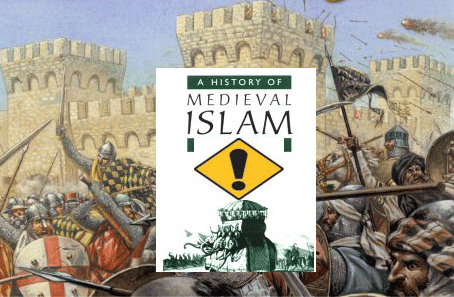
Making “Medieval” Islam Meaningful

[The following is an excerpt from a recently published article in Medieval Encounters 13(3):385-412, 2007.]

In many disciplines, scholars would not dream of taking their terminology from the street. Even if they do not fully succeed in agreeing upon a given set of terms, they recognize that it is essential for each writer to use his terms with precision, and that an attempt to accommodate oneself to popular usage as reflected in a dictionary must be disastrous. Too often, historians (especially in the field of Islamics) still try to avoid recognizing such a necessity and are satisfied to be guided by whatever is ‘common practice.’ (Marshall Hodgson)

Marshall Hodgson, perhaps more than any other historian of the Middle East, knew that the venture of Islam was all the more difficult to describe due to the adventure in trying to escape the strictures of loaded terms. His neologistics, advocating the use of “Islamicate” to distinguish the cultural from the religious dimensions of a regional history, failed to gain a consensus, although his seminal three-volume study of Islamic history remains a valuable resource three decades later. In the current postmodern climate a number of outdated and outsized terms have fallen into disuse among historians. “Muhammadanism,” by the 1960s, and “Orientalism,” since the 1970s, cease to carry weight after being dressed down for their ethnocentric cultural baggage. “Middle East,” moreso than its linguistic sibling rival “Near East,” continues to float across disciplines and the media, in part because Southwest Asia inspires little interest outside geography. But there is still at least one more label that we could all do without.

To be blunt, I suggest that continued use of the term “medieval” in reference to Middle Eastern and Islamic history between the 7th and the 15 centuries, anno dominated, is anachronistic, misleading and disorienting. Continue reading Making “Medieval” Islam Meaningful

I Read It in the TLS

A very positive review of Daniel Martin Varisco’s recent book Reading Orientalism: Said and the Unsaid (University of Washington Press 2007), appears in this week’s issue of the prestigious Times Literary Supplement. In his examination of the evidence and logic of Edward Said’s argument in his classic book Orientalism, first published in 1978, Varisco provides an evenhanded exploration of the subject, thirty years on.

Aside from minor quibbles concerning Varisco’s tendency to pun (a common trait, regretfully, among scholars associated with the University of Chicago’s Anthropology Department), Robert Irwin, the Middle East editor of the TLS, praises the book’s careful research and insight. “Varisco’s book,” he concludes, referring in part to its magnificently detailed and informative footnotes, “makes for exhilarating reading.”

Given the tendency of right-wing pundits to claim that contemporary academe has fallen for Said hook, line, and sinker, what is one to make of a thoughtful and sensitive critique from within? Could it be that the field of contemporary Middle East Studies is no more homogenous and globally misguided than the field Said himself identified as “Orientalism”?

If Lincoln Had Seen Aladdin


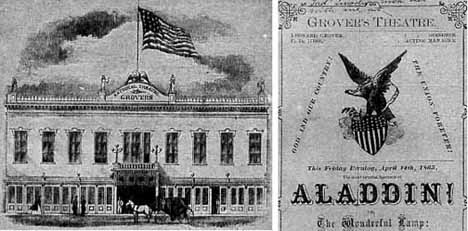
Grover’s Theater, Washington D.C.

April 14, 1865. For Americans, at least above the Mason Dixon line, this is one of those dates that live in infamy. John Wilkes Booth, a rather bad actor on the stage, shot President Abraham Lincoln at Ford’s Theatre. According to an account by Mrs. Helen Palmes Moss in The Century Illustrated Monthly Magazine for 1909, Lincoln had the option of going to a rival theatre, the National or Grover’s, that night where a private box had been prepared for him by Mr. C. D. Hess, the co-manager. Apparently Booth had planned to attempt the assassination at whichever theater Lincoln attended. He much preferred Ford’s, since he had no inside help at the National and would have to shoot Lincoln as he stepped out of the carriage. What does this fateful event have to do with the Middle East? If Lincoln had attended the National Theatre and J. Wilkes Booth had missed, the President would have seen a dramatization of the Arabian Nights tale “Aladdin.” Would that Lincoln had been more of an Orientalist… Continue reading If Lincoln Had Seen Aladdin

Engels on the Ottomans

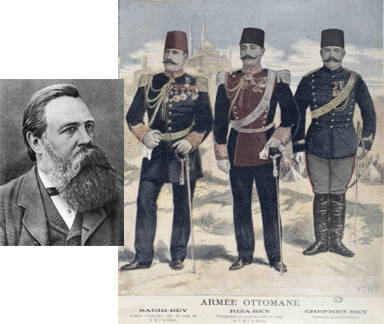
The Communist Manifesto, published by Karl Marx and Frederick Engels in 1848, stands as one of the most important political tracts ever written. It was written at a time when Europe had emerged as the dominant world force, economically and militarily. But even in the mid-19th century, the view in an Oriental direction proved more cluttered with opposition than casual readers of European history might think. The Ottoman Empire, not yet in the throes of its “sick man of Europe” stage, still thrived. In 1855 Engels published a series of articles in Putnam’s Monthly on “the Armies of Europe,” including his assessment of the Turkish army. Given the recent knocking on the EU door by modern Turkey, a re-read of Engel’s commentary is worthwhile…

I. The Turkish Army

by Frederick Engels (1855)

The Turkish army, at the beginning of the present war, was in a higher state of efficiency than it had ever reached before. The various attempts at reorganization and reform made since the accession of Mahmud, since the massacre of the janissaries, and especially since the peace of Adrianople, had been consolidated and systematized. The first and greatest obstacle — the independent position of the pashas in command of distant provinces — had been removed, to a great extent, and, upon the whole, the pashas were reduced to a discipline somewhat approaching that of European district commanders. But their ignorance, insolence, and rapacity remained in as full vigor as in the best days of Asiatic satrap rule; and if, for the last twenty years, we had heard little of revolts of pashas, we have heard enough of provinces in revolt against their greedy governors, who, originally the lowest domestic slaves and “men of all work,” profited by their new position to heap up fortunes by exactions, bribes, and wholesale embezzlement of the public money. That, under such a state of things, the organization of the army must, to a great extent, exist on paper only, is evident. Continue reading Engels on the Ottomans

Rethinking Secularism: Why Shariah?


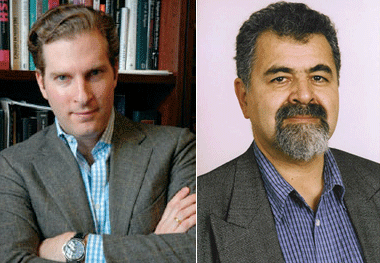
Noah Feldman, left; Said Arjomand, right

by Saïd Amir Arjomand, from The Immanent Frame

Noah Feldman prefaces his plea for the Shariah in his recent article for The New York Times Magazine (”Why Shariah?“) with a reference to the proposal recently made by the Archbishop of Canterbury to allow the Shariah and Jewish law to be considered in voluntary family and arbitration courts. The Archbishop and the Professor are addressing very different issues, however. The situation of a Muslim religious minority having the option of voluntary recourse to arbitration or court settlement in Europe, as proposed by the former, cannot be responsibly compared with that of a Muslim majority using the coercive power of the state to stone women accused of adultery in Nigeria, or to perpetuate patriarchal domination in Pakistan by keeping even those women who are eventually acquitted by superior courts in shackles and behind bars for many years.

In this article, presumably as a forerunner of his new book, Feldman extends the paternalism of the failed American empire in What We Owe Iraq to the entire Muslim world by telling the Muslims how good they really are; surely they would not realize this without the American law professor telling them. In telling them, he displays one of the worst examples of Orientalism. Continue reading Rethinking Secularism: Why Shariah?

With Ratzel in North Africa

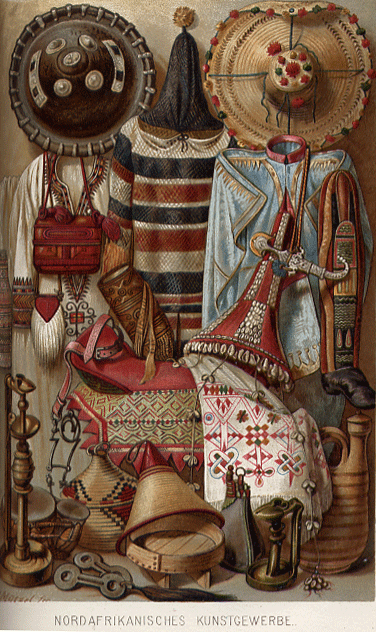
One of the most important German geographers of the late 19th century was Friedrich Ratzel (1844-1904), whose three-volume Völkerkunde (Leipzig and Vienna, Bibliographisches Institut, 1890) is one of those encyclopedia cultural accounts that circulated just as the discipline of anthropology was getting off (in this case literally “on”) the ground. While now a text for curiosity rather than critical scholarship on peoples and cultures, Ratzel’s work is still a fascinating portrayal of cultures being colonized for both revealing the biases of the day and the then-contemporary illustrations of people and material culture. My university library recently divested itself of uncirculated books in storage and one of these was an 1890 edition of the third volume on “Die Kulturvölker der Alten und Neuen Welt.” Whether it was the eye-watering althochdeutsch script of the volume or the mere fact it was written in German, no student or professor at Hofstra ever checked this volume out.

In salvaging a third of Ratzel’s opus for a mere dollar, I could not help but be drawn to the illustrations, mostly lithographs but with a few beautiful color plates. Continue reading With Ratzel in North Africa