Category Archives: Orientalism

Lithographica Arabica 1


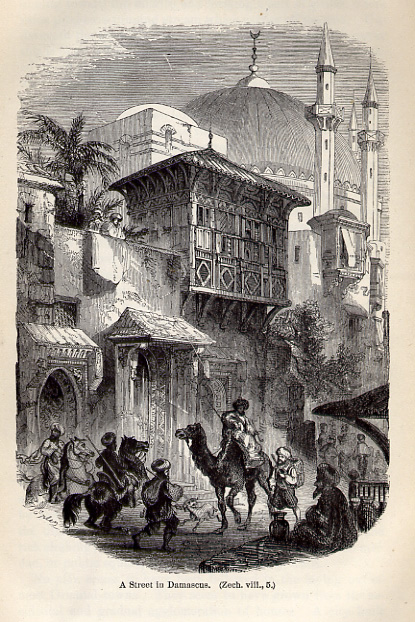
“A Street in Damascus” from Bible Lands by Henry Van-Lennep, 1875, p. 456

Watching vivid color, cable television on an HD screen obscures the art of old black and white movies, which were once able to conjure up fantasies in black, white and shades of gray. Glancing at glossy National Geographic photographs similarly buries further into the archived past all those simple lithographic line drawings storehoused in 19th century travel accounts, Orientalist writings and Bible Custom compendiums. I admire the fruits of progress, but the nostalgia for reaching back into the museum of my book-reading memories demands equal time.

For those who share the tactile thrill of fingers thumbing through brown-edged paper and caressing delicate bindings of century-plus-old books, I dedicate a new theme on Tabsir devoted to the art of lithographic representation of the Middle East. Lithographica Arabica — long live the line drawings and antiquated woodcuts of bibliophilic bliss. Continue reading Lithographica Arabica 1
Connecting Histories in Afghanistan


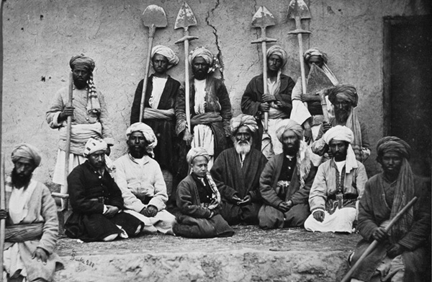
Landowners and Laborers in Kabul from the Burke collection that comprises the first series of photographs relevant to the market region and period of our concern that were taken in the context of the second Anglo-Afghan war. Image courtesy of the the National Army Museum, London.

Connecting Histories in Afghanistan: Market Relations and State Formation on a Colonial Frontier by Shah Mahmoud Hanifi. New York: Columbia University Press, 2008.

Preface

This book situates nineteenth-century Afghanistan in the context of British Indian colonialism. The general focus is commerce, mainly how local actors including Afghan nomads and Indian bankers responded to state policies regarding popular and lucrative commodities such as fruit and tea. Within those broad commercial concerns, specific attention is given to developments in and between the urban market settings of Kabul, Peshawar, and Qandahar. The colonial political emphasis on Kabul had significant commercial consequences for that city and its economic connections to the two cities it displaced to become the sole capital of the emerging state. The Kabul hypothesis therefore represents a colonial political strategy, and its effects on Kabul-Peshawar and Kabul-Qandahar economic relations are the subject of this book. Continue reading Connecting Histories in Afghanistan

Animal House in the 15th Century: Part 2

The late 14th century Egyptian savant al-Damiri was introduced in a previous post. His massive Hayat al-hayawan, mostly unknown in English texts, is a treasure trove of esoterica. One way of looking at esoterica is that it is useless information, frivolous and entertaining with little or no pedagogical value. I suppose the same could be said for many of the subjects taught on college campuses, past or present. The previous post focused on remarks about camels, but al-Damiri is not without his pragmatic advice for humans. After all, animals should be our friends and not just our dinner. The following recipe may have few takers in contemporary society, especially the overweight citizens of America; but just in case you ever wanted to know, here is advice on how to get fat:

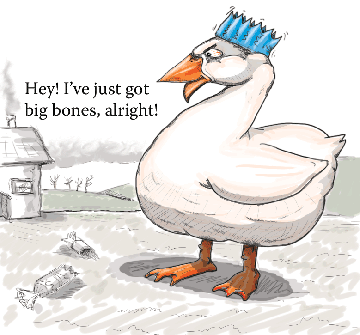
If you wish a woman to become fat, take the fat of a goose (female), pound it and mix with it borax, Karmânî cummin-seed, and the flour of fenugreek, then mix all together with water, make it into bullets and get a black fowl to swallow them for seven consecutive days, after which it is to be killed and roasted; whoever partakes of it or its gravy will become so fat, as almost to be overpowered by the fat, whether the eater is a man or a woman; but if you wish a person to be still fatter than that, take human bile and place it over as much wheat as can be easily prepared with a little water, then wait until the wheat swells out, after which feed a black fowl on it, and do with the fowl as described before; whoever partakes of that fowl whether a man or a woman will see a wonder of wonders in the shape of obesity and fatness, so much so that he or she will not be able even to stand up; this is a wonderful and tried secret.

Given obesity rates in the United States, I would say that either al-Damiri’s secret is out or it really would be useless advice today.

Have Felix, will travel

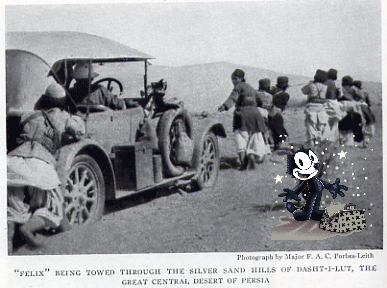
In 1924 Major F. A. C. Forbes-Leith decided to drive a “motor-car” from London to India, a journey that took almost half a year to traverse ten countries. Overall, a total of 8,527 miles were covered, with 3,000 of them devoid of road or track and 1,500 over desert, not to mention detouring around 150 broken bridges. This was three years before Lindy flew from Mitchell Field (next to the university I currently teach at) to France. The rationale for a ridiculously long auto adventure? That was simple: no one had done it before. As Major Forbes-Leith puts it, “Airplanes had already flown to India on several occasions, airships for a regular mail service were in the course of construction, even one of the submarines of the Royal Navy was on its way, but as yet no effort had been made to bridge the distance by mechanical transport.”

Attempting such an adventure at the time no doubt took a sense of humor. In this case the auto was labeled “Felix” after the cartoon character Felix the Cat. Continue reading Have Felix, will travel

Milking the Camel

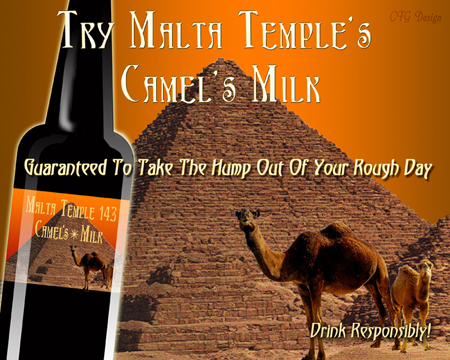
One of the most common Orientalist tropes about the Middle East is the image of the camel, the ship of the desert. Bernard Lewis angered Edward Said by comparing one of the Arabic terms for revolution (thawra) to a camel’s rising, a point made in the old Arabic lexicons. But the camel strikes back on Sharjah Television. On the program “Medicine and Islam” the benefits of camel’s milk are spelled out, including some rather grand claims.

The video on Islamic Tube is accompanied by the following article from the Khaleej Times:

SHARJAH. A research body here is seeking global tie ups to produce drugs to treat deadly diseases including Aids from the unique antibodies found in camel`s milk. Continue reading Milking the Camel

Not your Daily Bread


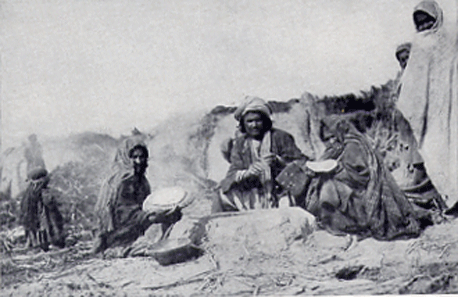
Baking bread in Seyistan on the Afghan Border

[It is hard to find a society in the Middle East without a thriving history of bread preparation. Before the modern loaf and bleached flour assaulted our tastebuds, a variety of flat breads were baked, either in clay overs or other makeshift ovens. Here is a description of both Afghan and Turcoman bread making from a century ago, as reported by Ellsworth Huntington in the National Geographic Magazine in 1909. Webshaykh.]

The method of cooking it was very different from that employed in the oases, where ovens of mud shaped like beehives, with a hole in the top, are heated with a fire of weeds, and the dough is stuck against the inside of the hot oven, where it hangs until it is so far cooked that it falls down into the ashes. The bread of the Afghan caravan was cooked by heating small, round cobblestones in the fire and then poking them out and wrapping dough an inch thick about them. The balls thus formed were again thrown into the fire to be poked out again when cooked. The bread tasted well there in the desert, although in civilized communities the grit and ashes would have seemed unendurable. Continue reading Not your Daily Bread

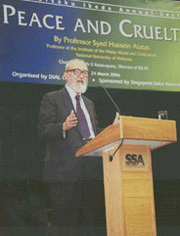
Tribute to Professor Syed Hussein Alatas (1928-2007)

[The following tribute by Alvin Tay is more than a year old, but for those who were unaware of the passing of Prof. Alatas, it is a reminder of the value of his scholarly work, which remains unappreciated in many university settings. Webshaykh.]

23rd January 2007 was a sad day for sociology, Singapore sociology in particular, with the sudden passing of Professor Syed Hussein Alatas, former Professor in Malay Studies at University of Singapore and a pioneer of the kind of sociological theorizing that Singapore, and indeed the region of Southeast Asia, could truly call our own. I did not have the opportunity of the many sociologists before me who had passed through the doors of the department and were taught by him in the university, and so I speak only from the position of one who regrets deeply the loss of a formidable sociologist, and yet feels greatly blessed by the corpus of sociological knowledge which he has left behind. It is the imprint of his many works on me, ranging from religion to race to colonialism, amongst other substantive issues, which impels me to proceed with this modest tribute, albeit with a heavy heart and a prayer for love and peace. Continue reading Tribute to Professor Syed Hussein Alatas (1928-2007)