Category Archives: Orientalism

The Sultan of the East


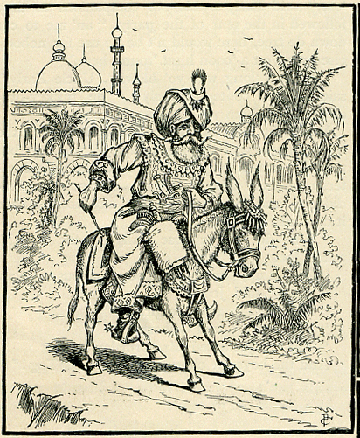
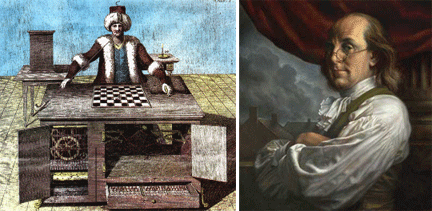
Illustration of his poem by Palmer Cox, 1882


The Sultan of the East

by Palmer Cox

There was a sultan of the East
Who used to ride a stubborn beast;
A marvel of the donkey-kind,
That much perplexed his owner’s mind.
By turns he moved a rod ahead.
Then backed a rod or so instead.
And thus the day would pass around,
The Sultan gaining little ground.
The servants on before would stray
And pitch their tents beside the way,
And pass the time as best they might
Until their master hove in sight. Continue reading The Sultan of the East

Picturing the Exodus

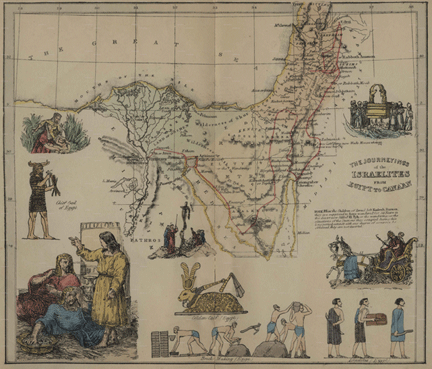
The ubiquity of GPS threatens to leave the old printed map out of the picture. This is a pity, for there is much to be learned from the way maps frame the world. As J. Z. Smith once remarked, map is not territory. True enough, but maps are the way we imagine not only territory but our place in it. When Edward Said wrote his critique of Orientalism in 1978, he cited novelists, travelers, poets and academics, but no mapmakers. But in a way Holy Land maps are what put the Holy Land on the map. Maps not only illustrated what was thought to be the lay of the land, but what people imagined was there.

A splendid example of this is an 1856 pictorial Bible map of the Journey of the Israelites from Egypt to Canaan. I reproduce the image above, but if you
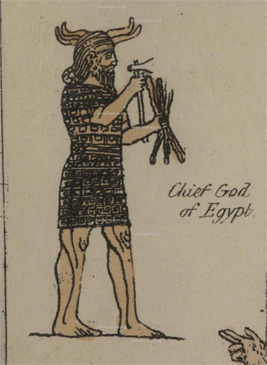
click here you can get a greatly enlarged view to see the details. Mind you, this was 1856, when few of the archeological discoveries in Bible territory had come to light. This is evident in the depiction of the “Chief God of Egypt,” (left side of map) who looks like a cross between an Assyrian and a Viking.

Continue reading Picturing the Exodus

Lithographica Arabica 3: Druse Girl


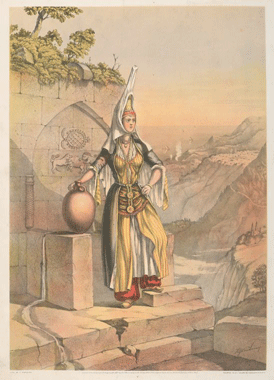
“Druse Girl”(1862) drawn by Henry J. Van-Lennep, Henry J. (1815-1889), Lithographer,
C. Parsons; Printer of plates, W. Endicott & Co. From “The Oriental Album: Twenty Illustrations, in oil colors, of the people and scenery of Turkey, with an explanatory and descriptive text.” By Rev. Henry J. Van Lennep. Online in NYPL Digital Gallery.

For Lithographica Arabica #2, click here.

“Best interests of the state”


[Note: the following parody, written in critique of proslavery arguments in congress, was one of the last articles penned by Benjamin Franklin. Were Franklin almanacking today, what would Poor Richard have to say about the current state of political stalemate in the Middle East? And what would he think of today’s inaugural?]

To the Editor of the Federal Gazette
by Historicus (Benjamin Franklin)
March 23, 1790

Sir,

Reading last night in your excellent paper the speech of Mr. Jackson in Congress, against meddling with the affair of slavery, or attempting to mend the condition of slaves, it put me in mind of a similar one made about one hundred years since, by Sidi Mehemet Ibrahim, a member of the Divan of Algiers, which may be seen in Martin’s account of his consulship, anno 1687. It was against granting the petition of the Sect called Erika or Purists, who prayed for the abolition of piracy and slavery, as being unjust. Mr. Jackson does not quote it; perhaps he has not seen it. If therefore some of its reasonings are to be found in his eloquent speech, it may only show that men’s interests and intellects operate and are operated on with surprising similarity in all countries and climates, whenever they are under similar circumstances. The African’s speech, as translated, is as follows:

“Allah Bismillah, &c. God is great, and Mahomet is his Prophet.

“Have these Erika considered the consequences of granting their petition? Continue reading “Best interests of the state”

A Century of Race Prejudice


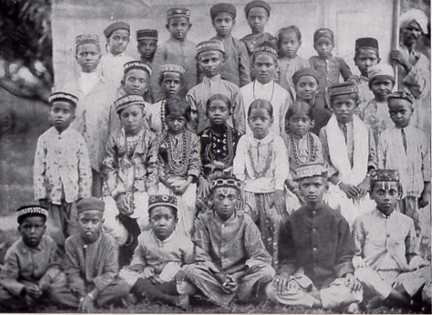
Some pupils of the Methodist Episcopal Day School, Bangalore, South India. The boy’s school has 80, the girl’s school has 50 pupils.

[Note: the following excerpt is from an extraordinary article in the National Geographic Magazine in December, 1910, written some 99 years ago. Time has moved on and the names of the principal players may have changed, but the refrain remains the same.]

Race Prejudice in the Far East
by Melville E. Stone, December, 1910

Although whole libraries have been written concerning Asia and the Asians, there is a widespread belief that, because of the differences in our mentalities, it is not possible for us ever to understand them, or they us. Kipling says that “East is East, and West is West, and never the twain shall meet.” The “oldest inhabitant” in India or China or Japan is sure to tell you that the Oriental mind is unfathomable. I have not the temerity to challenge these opinions. And yet I venture to suggest that there is an older authority holding a different view, and that I still have some respect for Cicero’s idea that there is a “common bond” uniting all of the children of men. Continue reading A Century of Race Prejudice

Entitled to consideration and respect


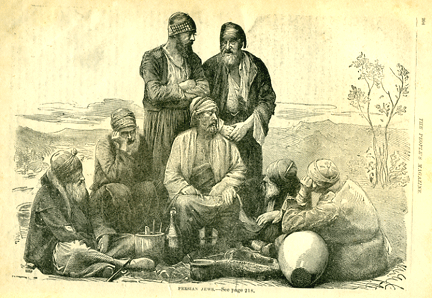
Illustration of “Persian Jews” from the People’s Magazine, 1879

The current fighting in Gaza is a tragedy of Greek dramatic proportions. On the one hand a highly sophisticated military machine wielded at present with Hawkish intent, on the other a ragtag guerilla group bent on lobbing barbs at the Hawk’s fortified lair. And in the middle frightened civilians in a humanitarian nightmare of medieval mindset. The problem is that neither side is really willing to treat the other with consideration and respect. In this unethical tie, of course, the onus must be on the stronger to recognize the limited options of the weaker.

The tragedy does not end with the present loss of life, limb and hope for Gazans. Unfortunately, it overshadows a historical trajectory that created the rise of Zionism as a political ideal in Europe. There is no excuse for the present punishing policies of Israel towards the residents of Gaza. Indeed, it is all the sadder given the sordid history of anti-Semitism in both the Christian-dominated West and Islamic-dominated Near East. Recently I picked up an old magazine from 1879, published exactly 140 years ago. On one page I was struck by the extraordinary pathos of an image of “Persian Jews.” Continue reading Entitled to consideration and respect

Lithographica Arabica 2: An Oriental Cafe


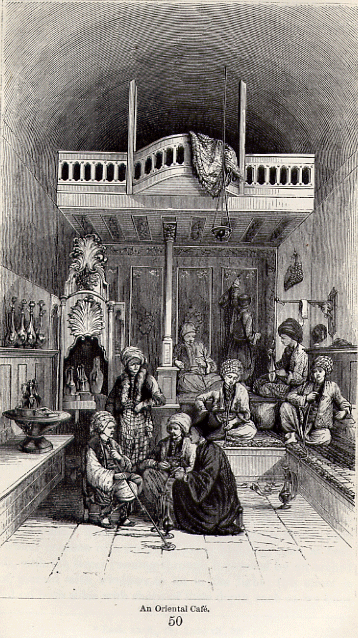
“An Oriental Café” from Bible Lands by Henry Van-Lennep, 1875, p. 779

For those who share the tactile thrill of fingers thumbing through brown-edged paper and caressing delicate bindings of century-plus-old books, I dedicate a new theme on Tabsir devoted to the art of lithographic representation of the Middle East. Lithographica Arabica — long live the line drawings and antiquated woodcuts of bibliophilic bliss.

The café (more properly kahweh) is a nearer approach to Western ideas, and deserves a passing notice, being an important institution of the East. Continue reading Lithographica Arabica 2: An Oriental Cafe

God’s Equal Curse


English poet and traveller Wilfrid Scawen Blunt (1840 – 1922), circa 1880.

Webshaykh’s Note: Given the ongoing crises in the Middle East, it is useful to return to earlier commentaries. In the excerpt below the voice of Wilfrid Scawen Blunt echoes with resonance for events currently in the news about Gaza, Iraq and Afghanistan. Let us all hope that the new year brings tolerance and peaceful intentions for us all.

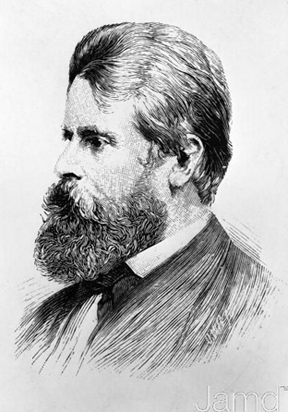
Wealthy and well connected Wilfrid retired from the foreign service in 1869 and soon the traveling Blunts went east. As Wilfrid noted about his first visit to Egypt in 1879, he was still “a believer in the common English creed that England had a providential mission in the East.” After learning about Bedouin customs firsthand in Syria Lady Anne spoke for both travelers about their interest in no longer looking at the people “with the half contemptuous ignorance” of Europeans. Not only were the Blunts aware and appalled at Eurocentric attitudes, but Wilfrid wrote of Islam as a “true religion,” which certainly had far more to offer African converts than Christianity. In 1881 Blunt bought an estate in Cairo, where he became a neighbor and friend of the Islamic reformer Muhammad ‘Abduh. On a visit to England Blunt arranged a visit between ‘Abduh and the reigning social philosopher, Herbert Spencer; the Egyptian reportedly told Spencer that the East was learning the evil rather than the good from the West, but the best of both was the same.

Blunt was perhaps the most famous aristo-critic of British imperialism in Egypt. With the impunity his elite upbringing bequeathed at the time he admonished Lord Cromer, whose “wrong-headed administration” only served to Anglicize Egypt. He used his impeccable social connections to lobby British politicians, including Prime Minister Gladstone, whose “Oriental” policies he deplored. Blunt’s radical critique of the colonial transgressions committed by the burdensome white race is second to none, including Fanon and Césaire. Consider his prescient diary note at the close of the nineteenth century:

The old century is very nearly out, and leaves the world in a pretty pass, and the British Empire is playing the devil in it as never an empire before on so large a scale. Continue reading God’s Equal Curse