Category Archives: Orientalism

When the Fat Lady Sings

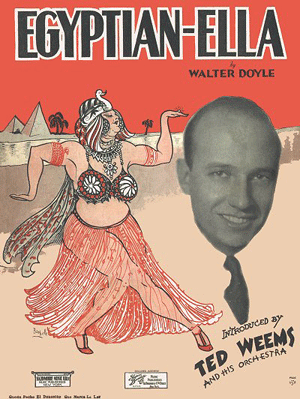
For those fortunate enough to own a MAC computer there is the digital blessing of ITunes. One of the stations listed under “Eclectic” is “The 1920’s Radio Network” which features jazz and vaudeville songs from the 20s through the 40s. Every once in awhile along comes one of those “Oriental” tunes, usually riding stereotypes into the desert on a sand-blasted camel of Araby. One I recently heard manages to offend both Egyptians and obese women (not to mention any serious poet). This is Egyptian Ella, not to be confused with Ella Fitzgerald, who did not debut until four years after this tune was written by Walter Doyle and popularized by Ted Weems and his orchestra.

Egyptian Ella

by Walter Doyle

Ella was a dancing girl who started getting fat
Every day saw three more pounds on Ella
Until one day she found she’d lost her job because of that
And to make it worse, she’d lost her fella
She took a trip to Egypt to forget
And she made such a hit that she’s there yet … Continue reading When the Fat Lady Sings

Reading Orientalism on Rorotoko

Rorotoko? Yes, Rorotoko. Forget about the name, but enjoy a relatively new website which allows authors to describe their books. As the site suggests:

• Rorotoko is an online venue for engaging the ideas and elaborations serious books are made of.
• Rorotoko is exclusive authors’ interviews on some of the most fascinating books coming out of some of the finest nonfiction and scholarly presses.
• But Rorotoko is not about books, it is about what books are about.

The April 3 edition of Rorotoko features an article I wrote about my Reading Orientalism: Said and the Unsaid, published by University of Washington Press in 2007.

Reading Orientalism is literally a re-reading of the late Edward Said’s Orientalism. Said’s powerful critique remains a milestone in the critical theory of academic bias three decades after its first publication. As the years go by, Orientalism survives more as an essential source to cite rather than a polemical text in need of thorough and open-minded reading. Read by academics as well as the general public in almost three dozen translations, Said’s text analyzes novels, travelogues and academic books to argue that a dominant imperialist discourse of West over East has underwritten virtually all past European and American representation of a so-called “Orient.” The debate over these views of Edward Said, a prominent intellectual of Palestinian heritage, continues unabated even after his passing in 2003. Continue reading Reading Orientalism on Rorotoko

Islamophobia 101, A call to analyse

[Webshaykh’s Note: This is the start of a new blog thread dedicated to energizing scholarly and pedagogical attempts to combat, or at least mitigate, the ongoing volume of Islamophobia in the media, especially on the Internet. The question is simple: what can be done to respond to Islamophobia in the media by our efforts in the blogosphere, formal media outlets, classroom, community and scholarly forums? I invite fellow scholars, professors and teachers and anyone concerned with this issue to contribute to the discussion here at Tabsir.]

People of any particular religious faith are understandably offended when someone or something they hold to be sacred is dragged through the media-made mud of ridicule. There is no way to completely stop desecration, even when hate crime laws are in place. As long as there are synagogues with walls and anti-Semites with paint, swatstikas will be painted. As long as there are artists who stretch their creative energies to the limit of tolerance, animal dung will adorn the body of the Madonna. And as long as so many individuals in Western societies fear Islam through the veil of their own ignorance and historically constructed disdain, the Prophet Muhammad will be pictured as a profligate. The Danish cartoon controversy was only the tip of the iceberg, one that created a titanic rift in the Muslim community worldwide. The irony is that portraying Muhammad in any form is considered wrong in Islam, so that placing a stud missile in the turban of a caricatured Mahound (to drop a literary motif of the same controversial dimension) glosses over the level of misunderstanding motivating those who made and appreciated the cartoon images.

So what is the proper response to the volume of prophet bashing out there, not only in the case of Islam. Here are a few suggestions to jumpstart the process of analysis so that we as scholars can mitigate the paralysis created by an Islamophobia that is only a mouse click away.

• Identify resources (books, relevant articles, websites, speakers) which provide a scholarly and objective-as-possible perspective on Islamophobia
• Discuss the merits of whether or not to provide examples of Islamophobic writing, art and videos that are admittedly offensive to many Muslims
• Provide lesson and project ideas to encourage students to critically assess the Islamophobia in specific examples they are likely to find in the media and on the Internet
• Engage with fellow scholars and concerned Muslims about the most effective and least offensive ways to combat and mitigate Islamophobic writing and art
• Link examples of Islamophobia to other forms of verbal and artistic ridicule of sacred materials.
• Expose Islamophobic rhetoric by politicians, celebrities and other people in the news.

Having set out the goals, I invite colleagues contribute comments, commentaries and examples for and against Islamophobia for this series, please email the webshakh at daniel.m.varisco@hofstra.edu. I will post the first commentary tomorrow.

Daniel Martin Varisco
Daydreams and Arabian Nights


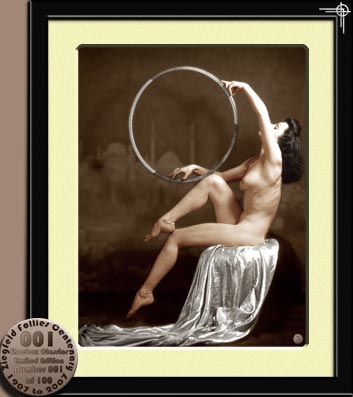
Ziegfeld Follies Girl representing Scheherazade from The Arabian Nights

On a personal note, today is my birthday. It is hard to be serious on such a foreboding occasion, especially when the magic number now exceeds the number of varieties of Heinz pickles. Besides (myself), the sun is shining and it is spring and silliness is in the air. [Isn’t it silly that we drop the ‘y’ to make silliness gramatically correct?] Since I have been preparing a powerpoint for a class on the history of ways in which the human body has been depicted, especially in the art of Adam and Eve in Eden, I have come across a number of Google-ill-begotten images, some of which are hilarious, some risque and some poignant. Take, for example, the picture above, which is not off a current porn site but actually a Ziegfield Follies Centennial print, indeed the first in the series.

So what do you see here? Continue reading Daydreams and Arabian Nights

Captain John Smith and the Turks


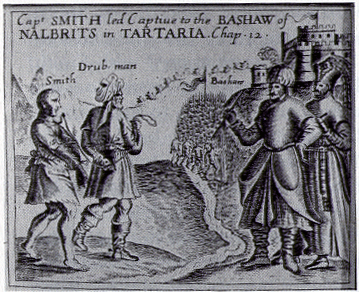
John Smith led into captivity to the Bashaw of Nalbrits by a “Drub-man” (interpreter). From The True Travels, Adventures, and Observations of Captaine John Smith, in Europe, Asia, Affrica, and America, from Anno Domino 1593 to 1629. London, 1630.

by Timothy Marr

Islam has figured in the fashioning of North American cultural definitions since as far back as the first years of European settlement. Inaugurating instances in colonial British America can be seen through brief biographical sketches of the Virginian leader John Smith and the Quaker preacher Mary Fisher.…

John Smith gained experience and credentials fighting Turks in Ottoman Europe well before he ventured across the Atlantic and he prided himself as a hearty crusader against the Muslims. After successfully launching incendiary devices against the Turkish armies in Hungary, for example, he reveled that “the lamentable noise of the miserable slaughtered Turkes was most wonderfull to heare.” Continue reading Captain John Smith and the Turks

Lithographica Arabica 6: Rev. Wood’s Bible Animals, 3

This is the third in a series on the illustrations in Rev. John George Wood’s Story of the Bible Animals. What do you get if you strain at a gnat? Read on…

Gnats

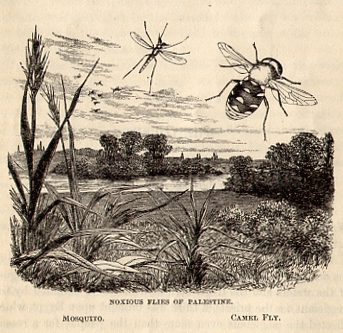
It has already been stated that only one species of fly is mentioned by name in the Scriptures. this is the Gnat, the name of which occurs in the familiar passage, “Ye blind guides, which strain at a ghat and swallow a camel” (Matt. xxiii. 24).

I may again mention here that the words “strain at” ought to have been printed “strain out,” the substitution of one for the other being only a typographical error. The allusion is made to a certain custom which is explained by reference to the preceding article on the fly. In order to avoid taking flies and other insects into the mouth, while drinking, a piece of thin linen stuff was placed over the cup, so that if any insects, as was usually the case, had got into the liquid, they would be “strained out” by the linen. Continue reading Lithographica Arabica 6: Rev. Wood’s Bible Animals, 3

Lithographica Arabica 5: Rev. Wood’s Bible Animals, 2

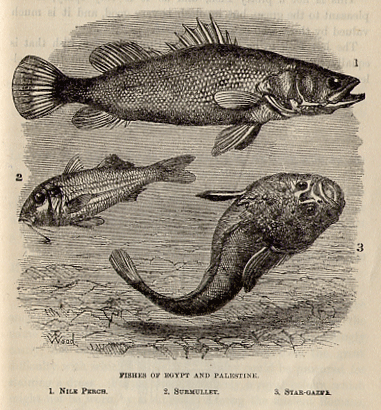
The illustrations provided in the books of Rev. John G. Wood are interesting not only for what they portray, but how they are described. Here is Wood’s folksy spin on three major fishes of Egypt and Palestine:

In order that the reader may see examples of the typical Fish which are to be found in Egypt and Palestine, I have added three more species, which are represented in the following illustration.

Continue reading Lithographica Arabica 5: Rev. Wood’s Bible Animals, 2

Lithographica Arabica 4: Rev. Wood’s Bible Animals, 1


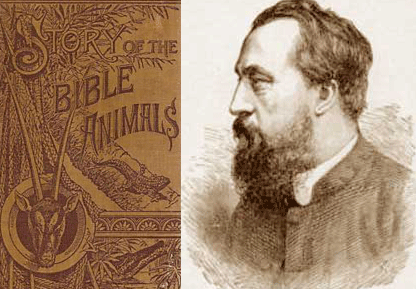
Rev. John George Wood, author of Story of the Bible Animals

Fascination with Bible Lands was so keen in the 19th century that illustrated volumes of scenes and objects were always in high demand. One of the treasures, in a figurative sense, of this age is the work of Rev. John George Wood (1827-1899), an English cleric and writer of popular books on natural history. One of the books passed on to me several years ago is Wood’s Story of the Bible Animals (Charles Foster Publishing Company, 1886), one of several editions of this popular work. The illustrations in my copy are not of the highest quality, but they can still mesmerize across their faded and fraying pages. Continue reading Lithographica Arabica 4: Rev. Wood’s Bible Animals, 1