Category Archives: Orientalism

With Kitto Illustrating Bible History

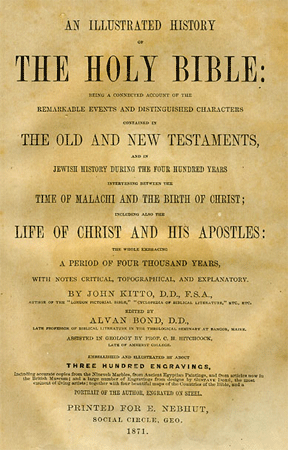
As a child I spent many inquisitive hours leafing through the books in my grandmother’s parlor bookcase. One that especially attracted my attention was John Kitto’s An Illustrated History of the Holy Bible (Social Circle, Georgia: E. Nebhut, 1871). Rev. John Kitto, recognized on the title page as author of the London Pictorial Bible, the Cyclopedia of Biblical Literature, ETC, ETC, retells the entire history of the Old and New Testament, from creation to the destruction of Jerusalem. Kitto was born into poverty in 1804 in Plymouth, England and due to an unfortunate accident ate age thirteen became entirely deaf and was forced into the poor house at the age of fifteen. This is quite an inauspicious beginning for a waif who went on to be a respected theological scholar. Through the local humanitarian efforts of several men in Plymouth, Kitto became a lay missionary to Malta and then for three and a half years in Baghdad. “While residing in that city,” writes Alvan Bond in the preface to Kitto’s book, Cairo “was visited by the plague, the terrific ravages of which swept off more than one-half the inhabitants in two months. Amidst this fearful desolation he remained calm and active at his post.” Once back in England he married and produced a travel account and several pictorial histories of the Holy Land. In 1844 the University of Giessen conferred upon him the degree of D.D. His ill health forced him to seek help in the spas of Germany, where he died after a mere half century in 1854. Continue reading With Kitto Illustrating Bible History

Toronto Talks

If you are reading this post today, Wednesday, I may very well be in the air on my way to Toronto, where I will be giving two lectures. Anyone who is interested is invited to attend.

Thursday, January 14th, 2010

Interdisciplinary Perspectives on Science
presents:

Daniel Martin Varisco (Hofstra University)

Star Gazing through Religious Phrasing: The Origins of a Lunar Zodiac in Early Islamic Astronomy

At Ryerson University in ENG LG14, George Vari Engineering and Computing Centre, 245 Church St. from 6:00pm to 8:00pm.

One of the most important astronomical time-keeping calendars from the Arabian Peninsula is the so-called anwâ’, which early Muslim astronomers equated with the tradition of 28 lunar stations (manâzil al-qamar). Through a study of this calendar in pre-Islamic Arabic poetry and Arabic lexical texts and by comparison to ethnographic accounts of existing Arabian star calendars, I argue that the system described in the evolving Islamic science of astronomy is one that did not arise in the Arabian Peninsula but was the result of cleansing the magical elements out of the earlier star lore and modeling this on the lunar zodiac of Sassanid Iran and India.


Refreshments will be served after the discussion.

The second talk will take place at the University of Toronto on Friday, January 15:

Anthropology Colloquium Series

Daniel Martin Varisco (Hofstra University)

The Culture Concept without a Textual Attitude: Reading against Orientalism and between the lines of Culture and Imperialism

Friday, January 15th, 2010. 2-4pm. Room 246.

Department of Anthropology, University of Toronto, AP 246, 19 Russell St.

My paper for the University of Toronto is available online as a pdf.
The Art of Frederick Goodall


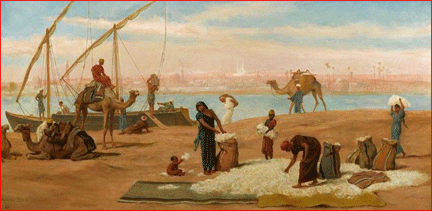
Unloading Cotton on the Nile, painting by Frederick Goodall, mid 19th century

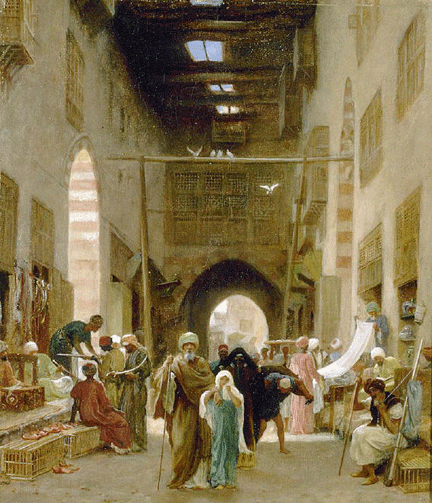
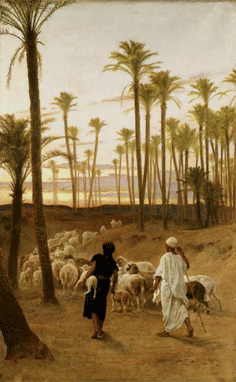
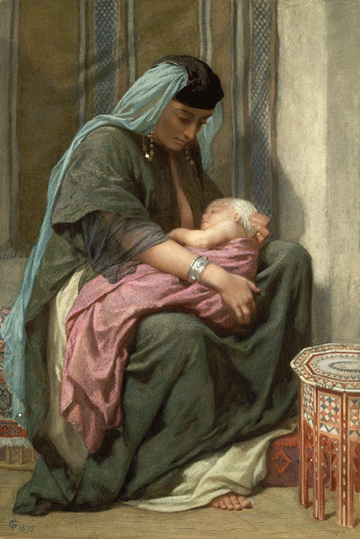
Attention to Orientalist paintings often ignores the lesser artists, some of whom provided valuable descriptive renderings of people and scenes. One of these is the Englishman Frederick Goodall (1822-1904), who moved to the Coptic quarter of Cairo in 1858, sharing space with Carl Haag, a drawing master for Queen Victoria. They spent much time in Bedouin camps, as well as busy suqs, where they were often treated with suspicion. After seven months in Egypt, Goodall had produced 130 oil paintings. He returned to Egypt in 1870 to make more paintings, this time with his two sons. They stayed at the house of the Egyptian archaeologist Mariette-Bey, near Sakkara. To blend in with the context Goodall grew a beard and at times dressed in white with a red fez. His work provides a meticulous “ethnographic” view of Egypt at the time.


Cairo Bazaar, 1891


The Palm Grove, 1894

Following Seward’s Folly: #2 Hopeless Arabia


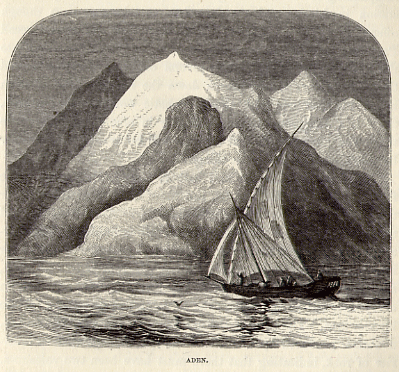
Illustration from Seward’s Travels (1873)

William H. Seward, the American Secretary of State who is forever linked with the “folly” of acquiring Alaska from the Russians, spent a year traveling around the world near the end of his life. In a previous post I recorded his comments on the British rule in India, as reported by his daughter. On April 27, 1871 the Seward party neared the Yemeni port (and British fueling station) of Aden. Here is how the approach is recorded by Ms. Seward:

April 27th. – After eight months travel in the incomprehensible East, with its stagnant civilization, we are now passing into another region still more incomprehensible and hopeless.

On the right hand is Yemen, once ‘Arabia the happy,’ and still known in poetry as a land of light and beauty, but now the dwelling of Arab hordes, who are sinking every day deeper into barbarism. On the left, wee are passing Somali, that part of Africa which stretches from Mozambique to Abyssinia. Continue reading Following Seward’s Folly: #2 Hopeless Arabia

Following Seward’s Folly: #1 Brits and Hindoos


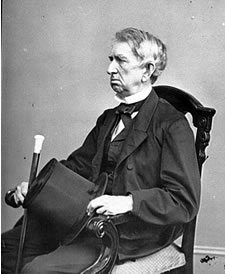
Portrait of William H. Seward, Lincoln’s Secretary of State, ca. 1865; photo by Matthew Brady

William H. Seward (1801-1872) is remembered primarily, to the extent anyone but a historian would bother to remember him, for his folly. An ardent opponent of slavery, this staunch Yankee republican might well have received the presidential nomination in 1860 instead of Lincoln, but he went on to serve as Secretary of State to both Lincoln and the first President Johnson. It was in 1867 that he pushed through the purchase of Alaska from Russia for 7,200,000 dollars, a sizeable sum for a nation coming out of a costly civil war. Horace Greeley in the New York Tribune wrote in criticism that Alaska “contained nothing of value but furbearing animals, and these had been hunted until they were nearly extinct.” Little did the man who famously said “Go west, young man” know that one day a young woman named Sarah Palin would come to power in this once Russian icebox. In 1870 Seward left politics and went on a trip around the world with his adopted daughter, who kept a record of the trip and published this in 1873. From New York to San Francisco to Japan and China to the straits of Malacca, Ceylon and British India to Egypt and Palestine and Europe and finally returning home to Auburn, New York in October of 1871: this was the folly the old man followed shortly before his death. Continue reading Following Seward’s Folly: #1 Brits and Hindoos

A Moorish Girl and an Irish Poet


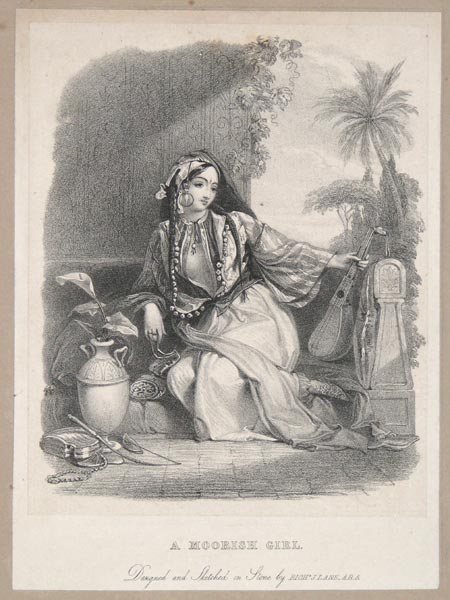
A Moorish Girl, ca. 1828

The image here is entitled “A Moorish Girl” and was designed by Richard James Lane. This lithograph was published in London by Engelmann, Graf, Coindet, & Co., ca. 1828. This would have exemplified the romanticized image conjured in Thomas Moore’s immensely popular Lalla Rookh, written in 1817. Often dismissed as a kind of quasi-pornographic Orientalist doggerel, the poem is a delightful read as a flight of fancy. The entire poem is online in an attractive format. Here is a sample excerpt:

Alas, poor ZELICA! it needed all
The fantasy which held thy mind in thrall
To see in that gay Haram’s glowing maids
A sainted colony for Eden’s shades;
Or dream that he, –of whose unholy flame
Thou wert too soon the victim, –shining came
From Paradise to people its pure sphere
With souls like thine which he hath ruined here!
No– had not reason’s light totally set,
And left thee dark thou hadst an amulet
In the loved image graven on thy heart
Which would have saved thee from the tempter’s art,
And kept alive in all its bloom of breath
That purity whose fading is love’s death!–
But lost, inflamed, –a restless zeal took place
Of the mild virgin’s still and feminine grace;
First of the Prophets favorites, proudly first
In zeal and charms, too well the Impostor nurst
Her soul’s delirium in whose active flame,
Thus lighting up a young, luxuriant frame,
He saw more potent sorceries to bind
To his dark yoke the spirits of mankind,
More subtle chains than hell itself e’er twined.
No art was spared, no witchery; –all the skill
His demons taught him was employed to fill
Her mind with gloom and ecstasy by turns–
That gloom, thro’ which Frenzy but fiercer burns,
That ecstasy which from the depth of sadness
Glares like the maniac’s moon whose light is madness!

The Influence of Edward W. Said

[Webshaykh’s note: I recently came across a book review I had written several years ago, but which was never published by the journal which solicited it. As the issue is still relevant, even after publishing my critical assessment of Said’s Orientalism two years ago, I present the review as written in 2001.]

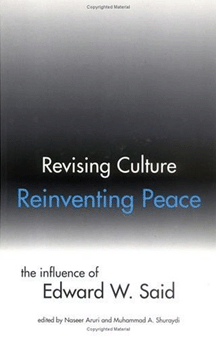
Revising Culture, Reinventing Peace: The Influence of Edward W. Said. Edited by Naseer Aruri and Muhammad A. Shuraydi. New York: Olive Branch Press, 2001. Xvi, 190 pages. ISBN 1-56656-357-7

Review by Daniel Martin Varisco

“Indeed, anywhere that intellectuals with a progressive or internationalist outlook gather on this planet, there is an awareness and appreciation of the indispensable contributions that Said has made to the life of free and independent inquiry, and beyond this, to a whole style and method of thought that takes ideas and cultures seriously as crucially linked to structures of oppression and processes of emancipation.”

If this accolade from Richard Falk’s glowing introduction to a volume of papers under the influence of Edward Said sounds good to you, this is a book you will probably enjoy. If you are looking for something new, that has not already been said or that has even a modicum of critical distance, you may want to skip this recent addition to what has become a virtual cottage industry of Saidiana. Continue reading The Influence of Edward W. Said