Category Archives: Orientalism

Leaves from an old Bible Atlas #5


Hurlbutt’s Atlas, p. 118


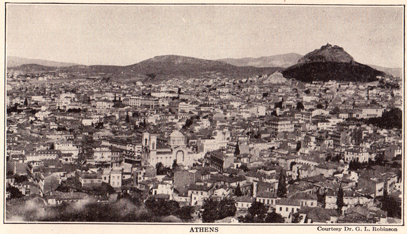
Athens, Hurlbutt’s Atlas, p. 119

The Christian fascination with the Holy Land as a window into interpretation of the Bible has a long and indeed fascinating history of its own. Here I continue the thread on Jesse Lyman Hurlbutt’s A Bible Atlas (New York: Rand McNally & Company, 1947, first published in 1882). One of the interesting aspects of the accompanying illustrations is the sense that what you see in the photograph is essentially unchanged from the days of Paul’s missionary journeys. Both these images appear to have been taken before the turn of the 20th century.

To be continued …

UnOrienting Marx


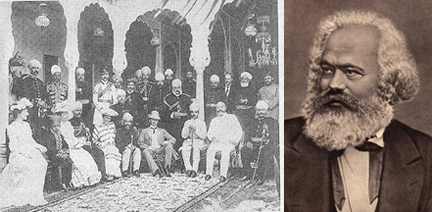
Lord Curzon in white, left; Karl Marx, right (for a change)

Of all the passages in Edward Said’s polemical Orientalism (1978), the one that most offended his natural allies on the left was placing Karl Marx in the den of Orientalist iniquity. What are “the sources of Marx’s conceptions about the Orient”? For Said they are no different than the prejudice of Renan or Lord Curzon.

“These are Romantic and even messianic: as human material the Orient is less important than as an element in a Romantic redemptive project. Marx’s economic analyses are perfectly fitted thus to a standard Orientalist undertaking, even though Marx’s humanity, his sympathy for the mystery of people, are clearly engaged. Yet in the end it is the Romantic Orientalist vision that wins out, as Marx’s theoretic socio-economic views become submerged in this classically standard image…” (Said, Orientalism, 1979, p. 154)

The quote from Marx that follows, and supposedly damns him, is as follows:

“England has to fulfill a double mission in India: one destructive, the other regenerating – the annihilation of the Asiatic society, and the laying of the material foundations of Western society in Asia.”

Said does not bother to note that the above quote is not take from the same article he quotes extensively earlier, although that is the impression given. Continue reading UnOrienting Marx

Leaves from an old Bible Atlas #4


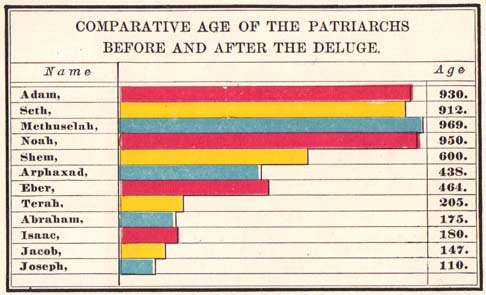
Hurlbutt’s Atlas, p. 17


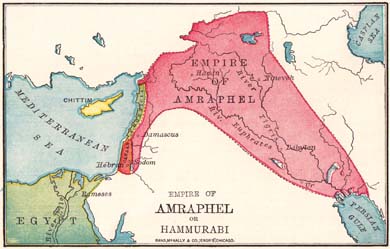
Hurlbutt’s Atlas, p. 17

The Christian fascination with the Holy Land as a window into interpretation of the Bible has a long and indeed fascinating history of its own. Here I continue the thread on Jesse Lyman Hurlbutt’s A Bible Atlas (New York: Rand McNally & Company, 1947, first published in 1882). After describing the physical geography, Hurlbutt proceeds directly the “The Journeys of the Patriarchs.” He writes (p. 17):

The journeys of Abraham extend over nearly all the lands of the Old Testament from Chaldea to Egypt. They represent the separation of a Semitic clan from the great body of the race, which was then ruled by an Elamite dynasty; and they bring to our notice the political relations of the world about two thousand years before Christ, in the early Chaldean period of the East.

Continue reading Leaves from an old Bible Atlas #4

Leaves from an old Bible Atlas #3


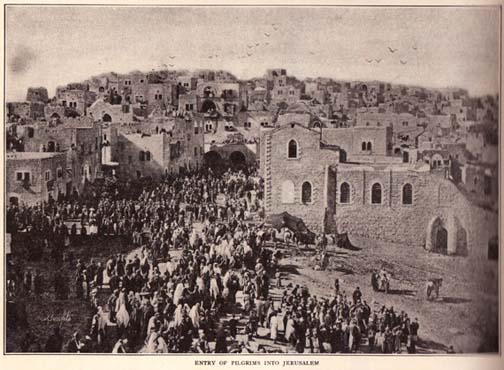
Entry of pilgrims into Jerusalem, Hurlbutt’s Atlas, p. 150

The Christian fascination with the Holy Land as a window into interpretation of the Bible has a long and indeed fascinating history of its own. Here I continue the thread on Jesse Lyman Hurlbutt’s A Bible Atlas (New York: Rand McNally & company, 1947, first published in 1882). The photograph above is actually the last in the atlas, just before a colorful foldout chart of Bible History.

The edition I am using includes an Introduction by Bishop John H. Vincent, whose memories of a visit to Palestine are quite typical of this Holy-Landaphilia. The following is a good example of the preacher’s rhetoric:

At one time I was permitted to spend forty days and forty nights in Palestine. I saw Abraham at his tent door; Rebekah veiling herself at the approach of the stranger; the long caravan of camels and Midianites on their way toward the south. I saw the wailing mourners at the house of death; the roof that might easily have been broken up; the wedding procession; the grass on the housetops; the sparrow making a nest for her young in the synagogues of Jerusalem. I saw the elders in the gates; David the shepherd, with his sheep, on the hillside; the Jewish mother, teacher Timothy, the words of the old Book in the old city on the hill. Verily, it is the old land; it is the old life; it is the memorial presentation in concrete form of what the Book says was true there thousands of years ago.

To be continued …

Leaves from an old Bible Atlas #2


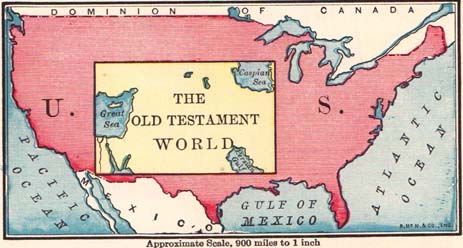
Comparative view of the United States and Old Testament world, approximate scale, 900 miles to 1 inch (in the original map which is only 3 3/4 inches across)

The Christian fascination with the Holy Land as a window into interpretation of the Bible has a long and indeed fascinating history of its own. Here I continue the thread on Jesse Lyman Hurlbutt’s A Bible Atlas (New York: Rand McNally & company, 1947, first published in 1882). I love the irony of the map above. Long before the political map devolved into Blue States vs. Red States, here is the Old Testament squarely in an expanded Bible Belt.

Here is Hurlbutt’s summary of the physical space defined as the Old Testament world:

The Old Testament world embraces the seas and lands between 30° and 54° east longitude, or from the mouth of the Nile to the head of the Persian Gulf; and between 27° and 40° north latitude, from the parallel south of Mt. Sinai to the north of Mount Ararat. The total extent of territory is about 1,400 miles from east to west and 900 miles from north to south, aggregating 1,260,000 square miles. If the space occupied by the Mediterranean Sea and other large bodies of water is deducted from this, the land will include about 1,110,000 square miles, or one-third of the extent of the United States, excluding Alaska. Unlike the United States, however, nearly two-thirds of this area is a vast and uninhabitable desert, so that the portion actually occupied by man is less than an eighth of that included int he American Union.

I wonder what Sarah Palin would think about Hurlbutt excluding Alaska, but at least it was not a state yet and some still referred to it as Seward’s folly.

To be continued …
Leaves from an old Bible Atlas #1

Perhaps there is a geographical inclination gene in my ancestry, since I have always loved Bible atlases. Many years ago my father was given a copy of Jesse Lyman Hurlbut’s A Bible Atlas, first published in 1910; his volume was a 1947 revision. But for the most part I assume the photographs were taken around the turn of the 20th century, give or take a decade. The author lived from 1843–1930 and as early as 1882 had published a Manual of Biblical Geography, the perecursor to this atlas. The 1910 version is archived online. There is also a website devoted to maps from his 1904 Story of the Bible.

So here I begin a thread of photographs of the Holy Land from at least a century ago. Let’s begin in Tiberias … Continue reading Leaves from an old Bible Atlas #1

Hammering home Oriental Studies


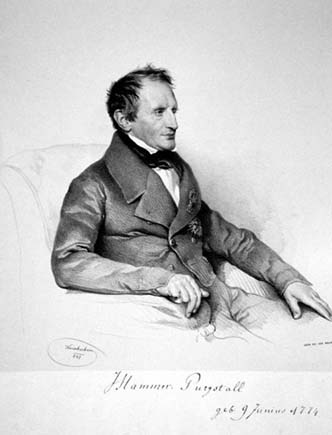
One of the fundamental early attempts to establish Oriental Studies on sound academic footing was Josef von Hammer-Purgstall’s Fundgraben des Orients, established in 1809. It is a pity that in his Orientalism (1978) Edward Said ignored early texts like this, since this was far more influential than many of the prejudicial books he rightly critiques. Rather than dismissing all Western writing about an “Orient” for which accurate information was just coming together, it is relevant to look at the intention of this particular effort. Here is how von Hammer-Purgstall explains the project:

We feel that it is our task to show the true path for the improvement of Oriental Studies, thereby applying the meaning behind our motto: “Say, unto God belongeth the east and the west: He directeth whom He pleaseth into the right way.” Thus all of those in the West who gaze at the East, and vice versa, will meet here, helping each other to extract from the raw mine treasures of knowledge and learning.

Quote from Ziad Elmarsafy, The Enlightenment Qur’an: The Politics of Translation and the Construction of Islam (Oxford: Oneworld), 2009, pp. 170

Viagra for Aladdin Lovers


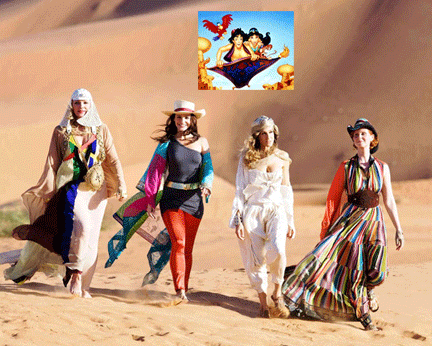
“Sex and the City 2’s” stunning Muslim clichés
It’s hard to overstate the offensiveness of the fabulous four’s exquisitely tone-deaf trip to Abu Dhabi

By Wajahat Ali, Salon, May 26

I’m a heterosexual, Muslim dude who until recently thought pleated khakis and loafers were “hip” and mistook Bergdorf Goodman for an expensive Swiss chocolate. So it is not surprising that 40 minutes into “Sex and the City 2,” a 150-minute cotton candy fantasy accessorized with materialism and fashion porn, I was comatose with boredom.

But I was defibrillated by the film’s detour into Abu Dhabi (really Morocco and studio sets) and what can only be described as an Orientalist’s wet dream. After discovering they will visit the Middle East, the ladies whip out hall-of-fame Ali Baba clichés: References to “magic carpet” (a double entendre, naturally), Scheherazade and Jasmine from “Aladdin” come in rapid succession. Upon hearing a stewardess give routine flight instructions in Arabic, Samantha behaves like a wild-eyed child hearing a foreign language for the first time. “I wonder what she’s saying. It sounds so exotic!”

Michael Patrick King’s exquisitely tone-deaf movie is cinematic Viagra for Western cultural imperialists who still ignorantly and inaccurately paint the entire Middle East (and Iran) as a Shangri La in desperate need of liberation from ignorant, backward natives. Continue reading Viagra for Aladdin Lovers