Category Archives: Orientalism

Buried Texts Recovered: An American Consul goes to Bethlehem, 1

Yesterday, I began a thread on one of the numerous 19th century Bible customs travel accounts by Christian enthusiasts able to travel to their “Holy Land.” The author, Frank S. DeHass, served as the United States Consul in Palestine in the mid 19th century. His text is aptly entitled Buried Cities Recovered, or, Explorations in Bible Lands, giving the results of recent researches in the Orient, and recovery of many places in sacred and profane history long considered lost. My copy, handed down from my grandmother, was published in 1886 in Philadelphia by Bradley & Company; the tenth edition no less! This is a wonderful read and it is worth reading the entire book online, thanks to Google Books.

Bethlehem, and Hill Country of Judea

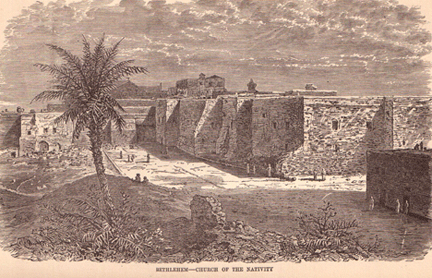
Situated on a fruitful ridge about six miles south of Jerusalem, overlooking the Valley of the Kedron on the north, and the deep chasm of the Dead Sea on the east, is Bethlehem of Judea, to the Christian the holiest place on earth.

It is one of the oldest villages in Palestine, and associated with some of the most stirring events in the religious history of the world. Here Ruth gleaned after the reapers of Boaz; here the youthful David kept his father’s flocks, and was annointed King of Israel; here, also, Jeremiah, after denouncing God’s terrible judgments upon the people, foretold the coming of “The Lord of Righteousness;” and here the shepherd’s who watched their flocks by night were startled by the angelic song announcing the Messiah’s birth, and proclaiming the evangel of “peace on earth, and good-will toward men.”

The name signifies the Hosue of Bread, and truly it may be said, Bethlehem has given to our perishing race the bread of eternal life. What countless millions have feasted on this heavenly loaf!

As we rode along the well-beaten path leading from Jerusalem, crowded with pilgrims from all lands going up to visit the place that gave birth to the Saviour of mankind, what old memories were awakened! Continue reading Buried Texts Recovered: An American Consul goes to Bethlehem, 1
Buried Texts Recovered: An American Consul in the Holy Land

“The author’s object in accepting an appointment under the United States Government was not the honor or emoluments of office, but a desire to visit the lands of the Bible, that he might see for himself how far the manners, customs, and traditions of the people and topography of those countries agreed with the inspired word.”

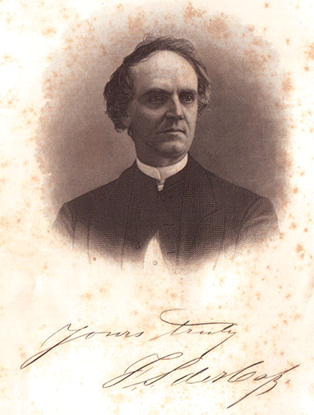
So begins one of the numerous 19th century Bible customs travel accounts by Christian enthusiasts able to travel to their “Holy Land.” The author is Frank S. DeHass, who served as the United States Consul in Palestine in the mid 19th century. His text is aptly entitled Buried Cities Recovered, or, Explorations in Bible Lands, giving the results of recent researches in the Orient, and recovery of many places in sacred and profane history long considered lost. My copy, handed down from my grandmother, was published in 1886 in Philadelphia by Bradley & Company; the tenth edition no less! This is a wonderful read and you can read the entire book online, thanks to Google Books.

Like so many other Bibliophiles of his generation, DeHass extols the virtue of actually visiting the land where Jesus was born and died. In his own words:

Recent explorations in the East have resulted in the recovery of many places in sacred and profane history long regarded as lost; and as the facts brought out by these researches are not accessible to the general reader, the author has compiled them in this concise form, and at the request of numerous friends gives them to the public, not as a scientific work for the antiquarian, but as a humble contribution to Biblical archaeology for the home circle, believing that such a volume will add greatly to the elucidation of the Scriptures, and serve to correct some of the errors which many travellers have fallen into by a too hasty or superficial view of the places visited. Continue reading Buried Texts Recovered: An American Consul in the Holy Land

THE STORY OF PRINCE AGIB


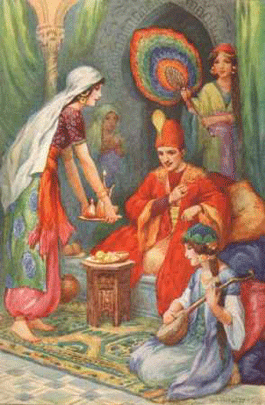
Illustration of Prince Agib by Harry G. Theaker from The Arabian Nights

THE STORY OF PRINCE AGIB

by W. S. Gilbert

STRIKE the concertina’s melancholy string!
Blow the spirit-stirring harp like any thing!
Let the piano’s martial blast
Rouse the Echoes of the Past,
For of Agib, Prince of Tartary, I sing!

Of Agib, who amid Tartaric scenes,
Wrote a lot of ballet-music in his teens
His gentle spirit rolls
In the melody of souls –
Which is pretty, but I don’t know what it means

Of Agib, who could readily, at sight,
Strum a march upon the loud Theodolite :
He would diligently play
On the Zoetrope all day,
And blow the gay Pantechnicon all night.

One winter -I am shaky in my dates-
Came two starving minstrels to his gates,
Oh, Allah be obeyed,
How infernally they played
I remember that they called themselves the” Oiiaits.” Continue reading THE STORY OF PRINCE AGIB

Shariah at the Kumback Café

By Roger Cohen, The New York Times, December 6, 2010

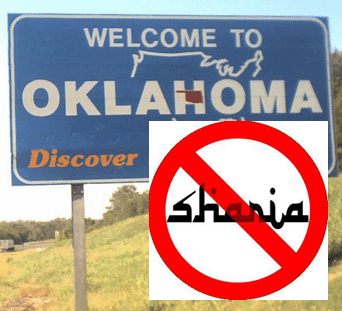
PERRY, OKLAHOMA — They call Oklahoma the buckle of the Bible Belt. It’s the state where all 77 counties voted Republican when Barack Obama was elected and where 70.8 percent of the electorate last month approved a “Save Our State Amendment” banning Islamic, or Shariah, law.

So I decided to check the pulse of a resurgent conservative America at the Kumback Café. The Kumback, established 1926, is a cozy, memorabilia-filled joint that sits opposite the courthouse in downtown Perry, population 5,230.

Things work like this at the Kumback: The guys, average age about 80, arrive around 8 a.m. and get talking on “the whole gamut of life”; the girls, average age too indelicate to print, gather later at a horse-shoe shaped table toward the back. Ken Sherman, 86 and spry, explained: “We’ve got to come here every day to find out what’s going on. And by the time we leave we forget.”

I asked Paul Morrow, a whippersnapper at 71, how things were going. “There’s just too much Muslim influence, all this Shariah law,” he said. “We’re conservative here, old and cantankerous.” Continue reading Shariah at the Kumback Café

Leaves from an old Bible Atlas #8


Hurlbutt’s Atlas, p. 16

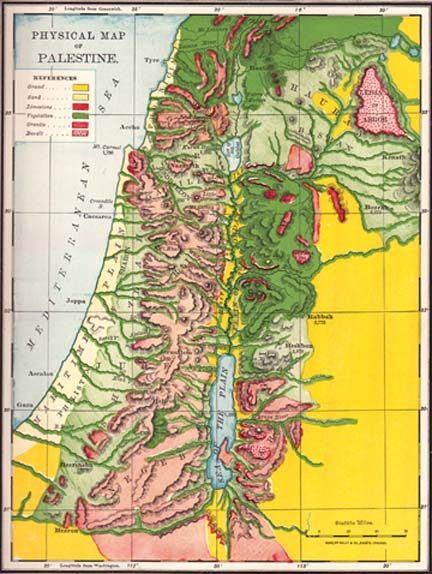
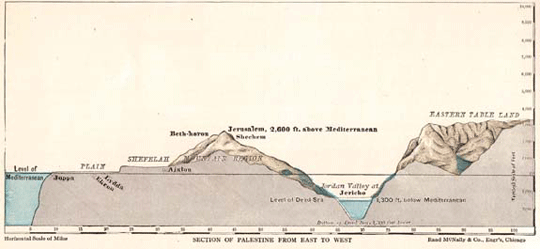
The Christian fascination with the Holy Land as a window into interpretation of the Bible has a long and indeed fascinating history of its own. Here I continue the thread on Jesse Lyman Hurlbutt’s A Bible Atlas (New York: Rand McNally & Company, 1947, first published in 1882). Hurlbutt includes two diagrams showing cross-sections across Palestine. That shown above is an east-west transect, showing the Dead Sea level at 1,300 feet below sea level. These were indeed better times, more than a century ago. Today the Dead Sea has dropped at least another 85 feet and continues at an alarming rate. The north-south transect is shown below. In order to be able to read it here, I have split it, but originally it was a single horizontal diagram. Continue reading Leaves from an old Bible Atlas #8

Of Dervishes, Fools and Prime Ministers


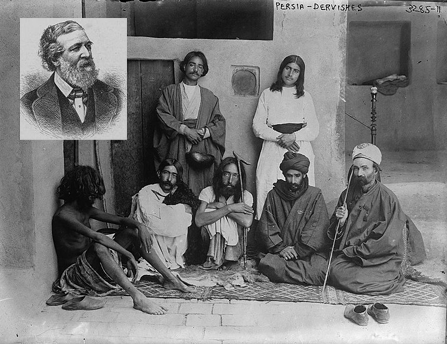
The poet Robert Browning left a large corpus, including his translation of Goethe’s masterful West-östlicher Diwan. One of his longer poems is an Oriental tale entitled Ferishtah’s Fancies. Recently in a used book shop I bought a copy of the 1885 edition published in Boston by Houghton, Mifflin and Company. There is an ironic epigraph for this Orientalist tale from Shakespeare’s King Lear (Act III, Scene 6) at the forefront:

You, Sir, I entertain you for one of my Hundred; only I do not like the fashion of your garments: you will say, they are Persian; but let them be changed.”

Browning’s verse is as antiquated today as the tale he spun, but still worth looking at if only for the nostalgia of Victorian English prose. Here is an excerpt from the encounter of Dervish Ferishtah with a former high official now beggared:

The Mellon-seller

Going his rounds one day in Ispahan, –
Half way on Dervishhood, not wholly there, –
Ferishtah, as he crossed a certain bridge,
Came startled on a well-remembered face.
“Can it be? What, turned melon-seller – thou?
Clad in such sordid garb, thy seat yon step
Where dogs brush by thee and express contempt? Continue reading Of Dervishes, Fools and Prime Ministers

Leaves from an old Bible Atlas #6


Hurlbutt’s Atlas, p. 118

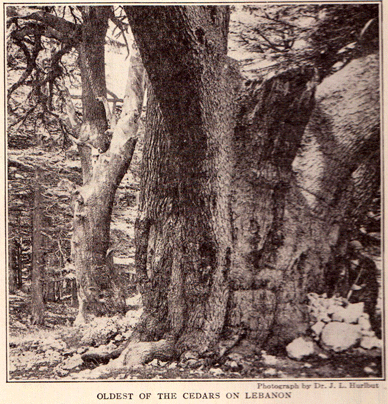
The Christian fascination with the Holy Land as a window into interpretation of the Bible has a long and indeed fascinating history of its own. Here I continue the thread on Jesse Lyman Hurlbutt’s A Bible Atlas (New York: Rand McNally & Company, 1947, first published in 1882). Ah, those cedars of Lebanon, hewn for Solomon’s temple but a few being left for the intrepid explorer, in this case Rev. Hurlbutt himself. Here is his sketch of that temple. Continue reading Leaves from an old Bible Atlas #6