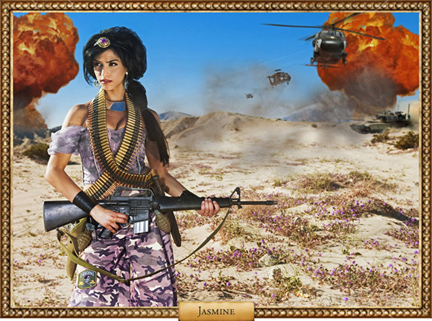
A website that features updates on 10 Disney princesses includes one of Jasmine from the Disney Aladdin film. Touché. [Note: This is the NRA approved version.]

A website that features updates on 10 Disney princesses includes one of Jasmine from the Disney Aladdin film. Touché. [Note: This is the NRA approved version.]
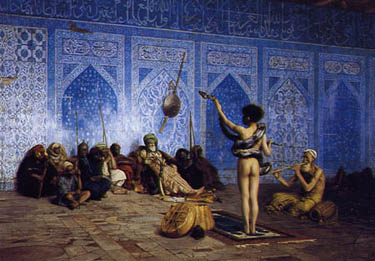
Jean-Léon Gérôme’s Le charmeur des serpentes, 1880
In 2007 I published Reading Orientalism: Said and the Unsaid with the University of Washington Press. The build-up to its publishing is a story that spans almost six years. Originally I had planned to include a chapter on Said’s Orientalism in a book I was writing called Islam Obscured: The Rhetoric of Anthropological Representation, which was published in the SAR series of Palgrave in 2005. But as I began to work on the chapter, it quickly took on a life of its own. I had first read Orientalism when returning from ethnographic fieldwork in Yemen in 1979. It sat on my bookshelf and I dutifully included the author’s “introduction†(the most readable part of the book for undergraduate students) in my course on Middle East anthropology. But as I delved back into Said’s book and started collecting the original reviews (which turned out to be more than 50) and the plethora of writings about Orientalism, I discovered that this dense book was fraught with errors of fact and methodological missteps.
While working on both books-to-be, I delivered a paper at the annual meeting of the American Anthropological Association in 2001 entitled “Dissing Orientalist Discourse: What Said Said and What Ethnographers Did,†followed by talks on my evolving text at the University of Pennsylvania, Harvard, the University of London and New York University. The AAA talk prompted a young employee of Routledge to ask if I was thinking of writing a book on the subject. Naively, I said yes and after another year had a draft ready to drop off in their New York office. Time went by and by and there was no word from Routledge. Eventually, after several months, I received a letter from the Sociology editor noting that Routledge at the time no longer had an Anthropology editor and my manuscript was not of interest to him. I thus learned that there were sociologists who seemed not to know much about Edward Said. But they did send the reviewer’s comments and these were well taken. In fact my first draft was in need of major revision.
So revise I did and then I accidentally stumbled across a website of a book agent inviting queries. Continue reading On the beauty of late medieval florilegium
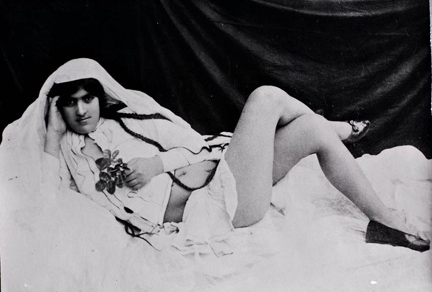
Portrait of a lying woman, Antoine Sevruguin, Iran, 1901 (geheugenvannederland.nl).
If a picture is worth a thousand words, then one like this century-old photograph taken in Iran will leave the reviewer with no loss for words. Here is the quintessential native Ottoman Era odalisque to ogle at. A number of enticing props are they as well: the flowers in hand, the shoes on the bed at the end of a curvaceous bottom in corso flowing down the exposed torso, the half-hidden belly button, long pigtails and dark kohl-laced eyes. Not only is this figure exposed to the viewer, but she engages with a direct gaze, using a hand to cradle her head. Here, visually presented, is the Orient represented: a luscious and willing consort for the taking.
The photograph above is part of a series of Ottoman Era images from the Ottoman History Podcast, a radio program and Facebook site based in The Netherlands. The site has a splendid selection of photographs from the Ottoman Era, the vast majority of which are not odalisque cheesecake, and it is well worth perusing.
Regarding the photograph above, here is how the Facebook site describes it: Continue reading Orientalist Cheesecake
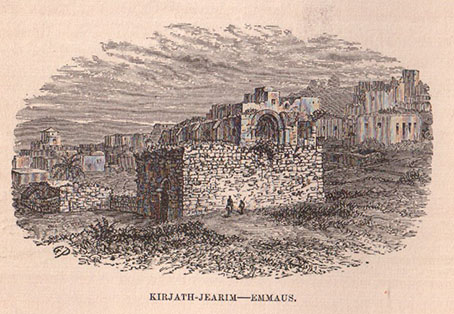
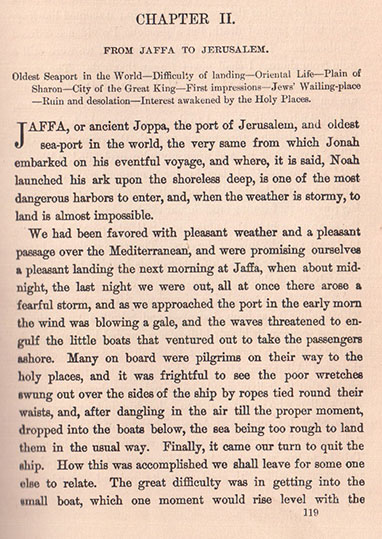
In a previous post I continued a thread on a 19th century Bible Lands text by Rev. Frank S. DeHaas. His account covers Egypt and Palestine. He entered Palestine at the port of Jaffa and discusses his disembarking, which he compares to the turmoil surrounding Jonah on the same sea, in the following passage. But it seems the crowded streets of Jaffa did not inspire the kind of reverence he wanted from traversing on holy ground. So he was quite glad to be out and out where the patriarchs trekked…
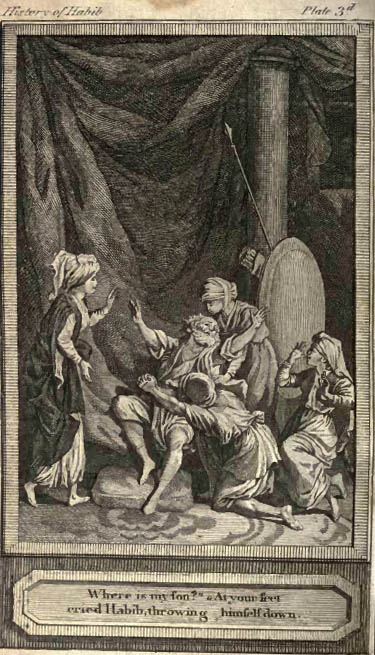
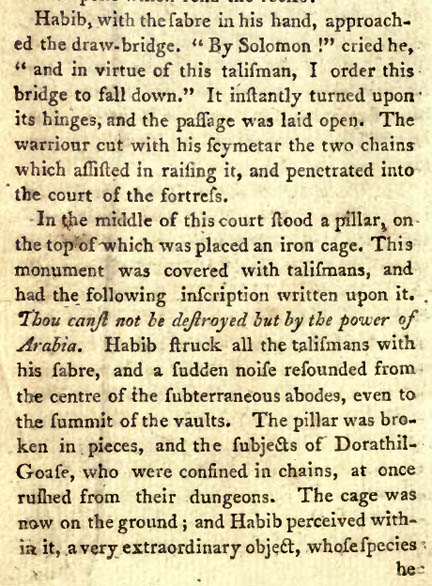
Here is the continuation of a previous post the story of Habib the knight from Jacques Cazotte’s Mille et une fadaises, Contes a dormir debout (The Thousand and One Follies, Tales to Sleep Upright), which was later translated into English. The English edition published in the year of his death is available in that magical resource for book lovers: archive.org. There are several volumes, but the excerpt here is from volume 3. Enjoy.
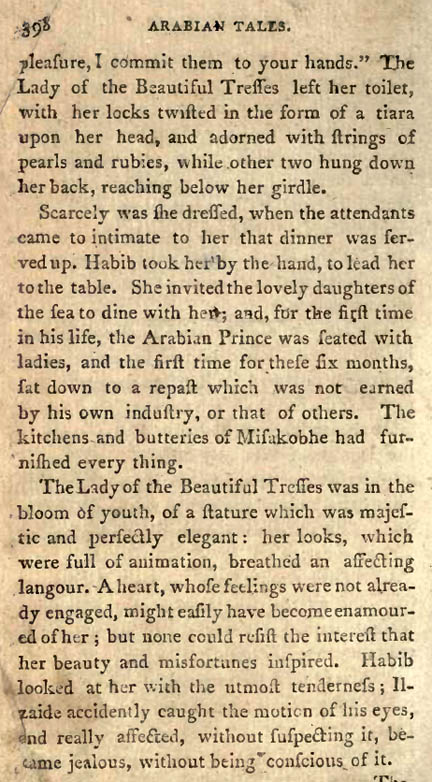
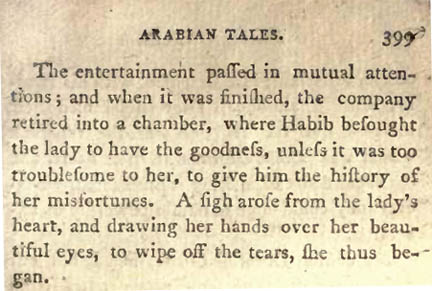
For the continuation of the story, you will need to consult volume 4 on the archive.org site.
Here is the continuation of a previous post the story of Habib the knight from Jacques Cazotte’s Mille et une fadaises, Contes a dormir debout (The Thousand and One Follies, Tales to Sleep Upright), which was later translated into English. The English edition published in the year of his death is available in that magical resource for book lovers: archive.org. There are several volumes, but the excerpt here is from volume 3. Enjoy.
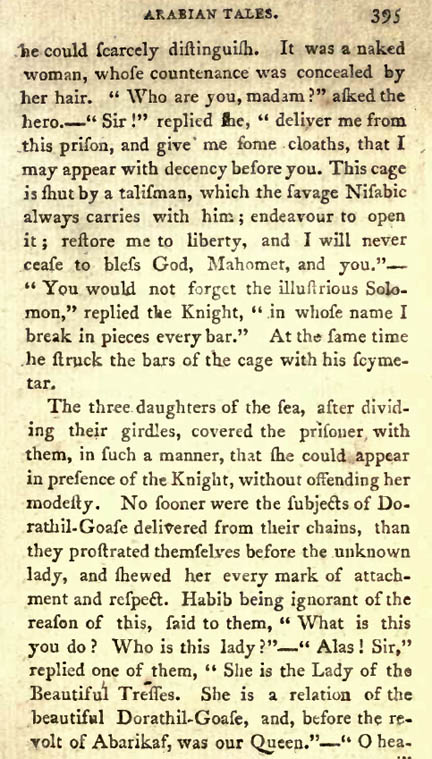
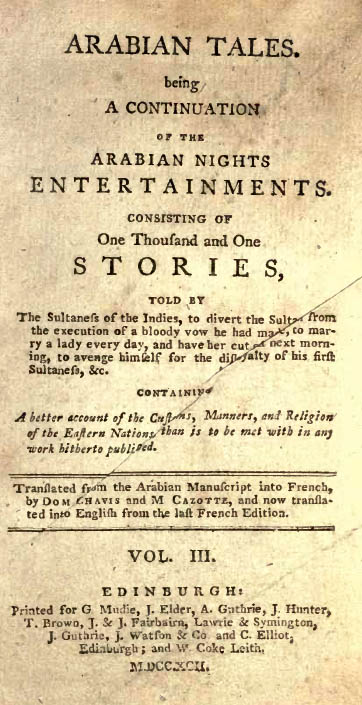
The name Jacques Cazotte may not ring many bells these days. After all, he died in 1792, a victim of the success of the French Revolution, but probably not because he was into the Illuminati… But fans of Oriental tales imitating the famous Arabian Nights may recognize his name. In 1742 he published Mille et une fadaises, Contes a dormir debout (The Thousand and One Follies, Tales to Sleep Upright), which was later translated into English. The English edition published in the year of his death is available in that magical resource for book lovers: archive.org. There are several volumes, but I have chosen an excerpt about Habib the knight from volume 3. Enjoy.
to be continued (just like the 1001 Nights…)
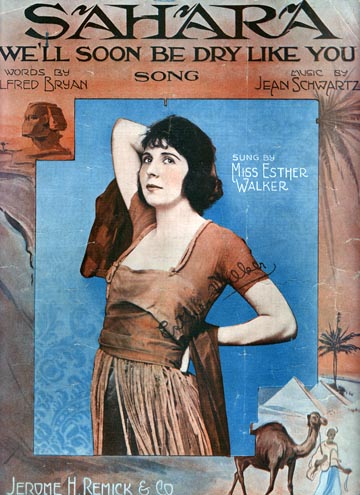
The Library of Congress has archived many of the Gramophone recordings from the early part of the last century. This includes several vaudeville songs about Arabs. One of these, about Egypt, is “Arab Love Song” sung by Harry Macdonough for Victor Records, made possibly as early as 1908. My personal favorite is “Sahara (we’ll soon be dry like you),” a prohibition era song recorded by Esther Walker in 1919. There are also comedy routines, like the schtick by Charles G. Widden on “Peterson at the Turkish Bath”. Then if you want a one-step from 1918, try “Arabian Nights” by the Waldorf Astoria Dance Orchestra or the fox trot “Oriental Love Dreams,” recorded in 1924 by Coon-Sanders Original Nighthawk Orchestra or “Harem Life” recorded in 1919 by the Paul Biese Novelty Orchestra.