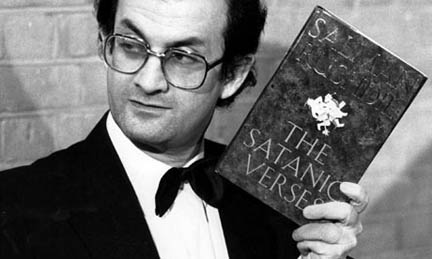
Salman Rushdie, author of The Satanic Verses
[The following is part five of a series on a lecture presented in the Hofstra Great Books Series on December 5, 1993. For part four, click here.].
The Struggling Believer’s Novel and the Text
I could easily continue this discussion of the views of Ibn al-‘Arabi for hours, days, or weeks (how long would it take to simply read 17,000 pages in his major work?) It is valuable to probe with a believer like this great scholar into the depths of his own meaning-rich search through the language of the Quran. But much has happened in the past 750 odd years in the Islamic World. Muslims, through no fault of their own, have been caught up in a broadening discourse defined in large part by the overtly Christian West, even though any distinctive Christianness may have largely eroded. In contrast, Ibn al-‘Arabi lived in a world in which the Quran’s detractors — those who did not grapple with this Arabic text as a revelation — were few and far away. To be sure there were debates over the form of the revelation, although these were tilted to orthodoxy rather early on. But in his day there was no viable reason in the Muslim context not to accept the Quran as revelation.
Muslims over the past couple of centuries have been compelled to defend the Quran against what they believe is a secular war aimed at the integrity of their religion. The heartland of Islam since the 16th century has been dominated by Ottoman Turks (Muslim converts, it must be remembered) up until this century, with European colonial powers nibbling away at the often frayed edges of the Sublime Porte. The more recent raw power politics of this century, be this the regimen of Western-trained military elite takeovers, the imposition of secular Israel in a predominantly Islamic Middle East, the cleric-driven drive for a militant, rejectionist radicalism in Iran and Afghanistan, the dirt-poor rage of simple Egyptian fundamentalists, the cold war Sadaamizing of Kuwait, the collective blinking as Bosnia bleeds non-Christian blood — these events have sharpened the frustration and anger of Muslims wherever they are. And at least three out of four Muslims are not in the Middle East. While we only rarely see these events on our evening news, for Muslims they are far more than ubiquitous sound bites; they are rather like pages torn without mercy, without compassion from their great book. Continue reading The Quran as a Great Book: Muslim Perspectives, 5