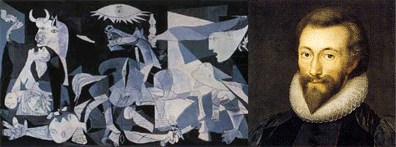
“Guernica†by Pablo Picasso, 1937, left; John Donne, right
In four weeks of fighting, since the Hizbollah raid of July 12 on an Israeli military outpost, what started out as an apparent effort to retrieve two captured Israeli soldiers has escalated into a nightmare for all involved. According to the BBC, as of August 8 the results are predictably ugly, with Lebanon taking the brunt but Israel also suffering greatly:
Deaths: 998 Lebanese, 102 Israeli
Injuries: 3,493 Lebanese, 690 Israeli
Displaced: 915,762 Lebanese, 500,000 Israeli
If this were a movie, it would be a smash hit, since it has killed more than twice as many in the nearby Iraq War during the past month. Of course, the death toll in the latest Israel-Lebanon war has a way to go until it reaches the estimated 40,000 plus Iraqi civilians who have died since the U.S. invasion. And there must be another 149,000 deaths to equal the Lebanese Civil War (1975-1990), which also had Israeli involvement. It is even a steeper climb to match the estimated 400,000 victims in Darfur.
So how should we read death tolls? What do such lists account for beyond the obvious fact of people not dying of natural causes (unless you think war is natural)? Here is an experiment you can try on your own. Check out the war death tolls posted at Wikipedia. What is your first reaction: to look for the largest losses or to count up the total losses? Of course I can’t find any information on the number of people who have died from peace, even on Google.
As John Donne told it awhile ago,
“Who casts not up his eye to the sun when it rises? but who takes off his eye from a comet when that breaks out? Who bends not his ear to any bell which upon any occasion rings? but who can remove it from that bell which is passing a piece of himself out of this world? No man is an island, entire of itself; every man is a piece of the continent, a part of the main.
If a clod be washed away by the sea, Europe is the less, as well as if a promontory were, as well as if a manor of thy friend’s or of thine own were: any man’s death diminishes me, because I am involved in mankind, and therefore never send to know for whom the bell tolls; it tolls for thee.â€
Daniel Martin Varisco