Category Archives: Literature

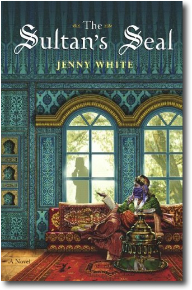
The Sultan’s Seal

“Your brush is the bowstring that brings the wild goose down.”

(Reviewed by Jana Kraus MAR 22, 2006)

Jenny White, an anthropologist and the author of numerous nonfiction works on Turkish society and politics, has written a real winner with her debut novel, The Sultan’s Seal. A historical mystery with a bit of romance thrown in, this book makes for an unputdownable read. Ms. White paints a remarkably vivid portrait of life in 19th century Turkey, from the luxurious sultan’s palaces to the most squalid slums of Istanbul, and writes intelligently of the political turmoil of the period. Continue reading The Sultan’s Seal

Ibn al-Farid’s “Khamriyya” – or “Ode on Wine”


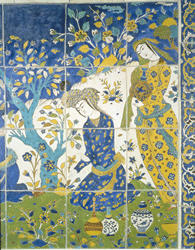
[Illustration: Tile panel with picnic scene (detail), Iran (Safavid), Isfahan, 17th century, fritware with colored glazes, Victoria and Albert Museum, London]

Ibn al-Farid’s “Khamriyya” – or “Ode on Wine”
A critical introduction, translation and analysis.

by George Nicolas El-Hage, P.h.D. Columbia University

Sufism has been defined as both “the apprehension of divine realities and as a universal message of love, brotherhood, and unity of man.” (1) Although R.A. Nicholson writes that Sufism is at once “the religious philosophy and the popular religion of Islam” (2), nevertheless it must not be understood that Sufism is a type of organized or conventional religion. It is not a religion, nor does it claim to create another sect, but it attempts to eliminate hatred and conflicts and to gather people in brotherhood. In his book, Sufism: Message of Brotherhood, Harmony, and Hope, Nasrolla S. Fatemi says that the elements common to Judaism, Buddhism, Christianity, and Islam can best be appreciated in Sufism. To the Sufi, only the moment of ecstasy can cleanse the soul of all its earthly concerns and elevate it to a joyful reunion with its creator. The soul, anxious to partake in divine love, will become ready to behold the truth and embrace the light and the beauty. Continue reading Ibn al-Farid’s “Khamriyya” – or “Ode on Wine”

Laughter that Lasts 12 Centuries

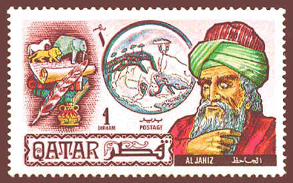
The honor of being the greatest writer in Arabic prose, at least in the eyes of numerous Arab literati for the last millennium, belongs to the Iraqi Abu ‘Uthman ‘Amr ibn Bahr al-Jahiz. Born in Basra in 776 C.E., a full millennium before our own nation was founded, Jahiz lived most of his life between the recently founded Baghdad and Samarra. He is the acknowledged master of Arabic adab literature, an eclectic form both entertaining and instructive. The elegance of his writing is matched by the grounding of his reflections on the ordinary and the lowest parts of the social order.

One of his most entertaining works that survives is a satirical look at misers and the nature of avarice. In a culture that idealized hospitality from the poor Bedouin’s goat-hair tent to the sumptuous silk cushions of the sultan’s palace, this is a telling admission that not everyone abides by the social norms. Continue reading Laughter that Lasts 12 Centuries

A Candid[e] View of an Honest Turk

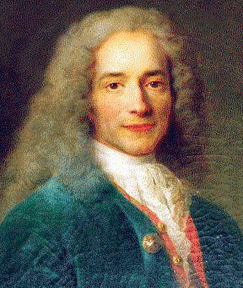
[One of the great moral tales of the 18th century is Voltaire’s (1759) Candide, a book well worth reading and rereading from time to time. Here is an excerpt from the end of the book, but it is not Orientalism in the Saidian sense of negative portrayal; indeed it is the honest Turk which stands in contrast to tyrants of all stripes.]

During this conversation, news was spread abroad that two viziers of the bench and the mufti had just been strangled at Constantinople, and several of their friends impaled. This catastrophe made a great noise for some hours. Pangloss, Candide, and Martin, as they were returning to the little farm, met with a good-looking old man, who was taking the air at his door, under an alcove formed of the boughs of orange trees. Pangloss, who was as inquisitive as he was disputative, asked him what was the name of the mufti who was lately strangled.

“I cannot tell,” answered the good old man; “I never knew the name of any mufti, or vizier breathing. I am entirely ignorant of the event you speak of; I presume that in general such as are concerned in public affairs sometimes come to a miserable end; and that they deserve it: but I never inquire what is doing at Constantinople; I am contented with sending thither the produce of my garden, which I cultivate with my own hands.” Continue reading A Candid[e] View of an Honest Turk

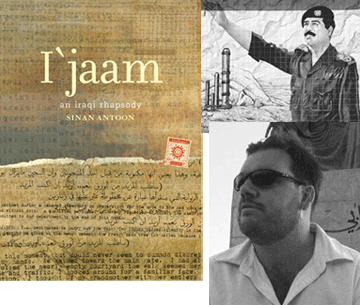
An Iraqi Rhapsody

[The following is an excerpt from Sinan Antoon’s recently published translation of his earlier Arabic novel about life in Saddam’s Iraq.]

Two clouds kissed silently in the Baghdad sky. I watched them flee westward, perhaps out of shyness, leaving me alone on the bench beneath the French palm tree (so called because it stood in the courtyard in front of the French department) to wait for Areej. I looked for something worth reading in that morning’s al-Jumhuriyya, and found a good translation of a Neruda poem in the culture section, besieged [beside?] on all sides by doggerel barking praises of the Party and the Revolution. The breeze nudged the palm fronds above my head to applaud. It was April, “the month of fecundity, the birth of the Ba’th and the Leader,” as one of the posters on the college walls announced. Continue reading An Iraqi Rhapsody

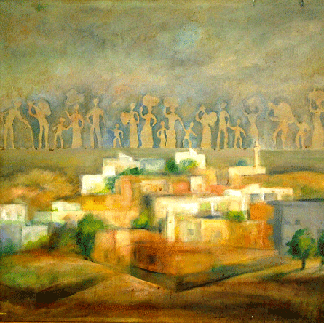
The Book Of Death #28


[Illustration: “Refugees” by Palestinian artisit Ibrahim Hijazy, 1996.]

by George El-Hage

Today, the seventh day of the month of Death, I decided to end our relationship. I decided to pack my suitcase and leave. Everything in our spring-like room I left for you: the velvet drapes, old books, notebooks of memories and red roses. All the silk pillows, and the ivory chairs, and the chandelier of carnations, the big bed in the other corner of the room remain for you. I took with me one bleeding suitcase which is my heart. It was so filled with surprise and sorrow that I did not have room for one little pencil. I left empty-handed except for an armful of ashes. I held dejection to my breast, the harvest of a full year of love. I embraced it with anguish and washed its forehead with dew from my eyes. Continue reading The Book Of Death #28

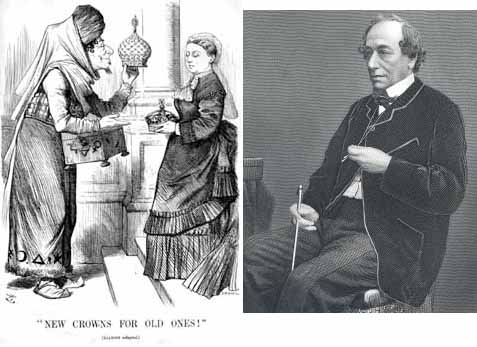
Tancred or the New Crusade


Benjamin Disraeli
(1804-1881) was one of the most colorful and literary of British Prime Ministers in the latter half of the 19th century. Among his novels was one about a young conservative English lord named Tancred who made a spiritual quest to the “Holy Land.” This is his Tancred, of The New Crusade, originally published in 1877. In the novel Tancred is disillusioned with the lack of morality in British politics. Instead of taking his inherited place in high society, he chooses instead to go on a quest for spiritual meaning to the land where his religion began. Disraeli, as novelist, uses the Levant as a backdrop for his psychological portrait of young Tancred, but it is as much about the foibles of the British political scene as it is an “Orientalist” rendering of the cradle of Judaism, Christianity and Islam. The novel is full of intrigue, as adventure stories should be. It has not made canonization as a “great” work, but it is still worth a read (if you can find a copy). Continue reading Tancred or the New Crusade

Alaa Al Aswany: Voice of Reason

This month’s National Geographic Magazine has an extended interview with the Egyptian author (and dentist) Alaa Al Aswany, whose recent Arabic novel, The Yacoubian Building, is a major bestseller.

“Just who is the Arab world listening to? Not only radical sheikhs and militant politicians. The man whose voice has captivated the Arab public is a Cairo dentist by day and a novelist by dawn. Alaa Al Aswany’s novel The Yacoubian Building is a phenomenon—the best-selling novel in the Middle East for two years and the inspiration for the biggest budget movie ever produced in Egypt. The novel paints a poignant and uncompromising picture of life in modern Cairo, as seen through the eyes of a carnival of characters—from the richest and most powerful to the poorest. An outspoken critic of the Mubarak regime and a friendly, self-effacing man, Dr. Al Aswany studied dentistry, and the American way of life, in the U.S. He has a humanist’s love of pondering what makes people do what they do.”

To read the interview online, click here.