Category Archives: Terrorism Issue

BBC Reporter Johnston Freed

BBC NEWS, 2007/07/04 08:37:02 GMT

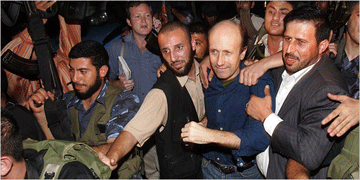
BBC correspondent Alan Johnston has been released after 114 days in captivity in the Gaza Strip. He describes the “appalling experience” at the hands of his captors, called the Army of Islam.

“I am hugely grateful to all the people – an amazing number of people that worked on the Palestinian side, the British government, the BBC from top to bottom, and a huge amount of support from BBC listeners and viewers.

I had a radio almost throughout, and was able to follow all the extraordinary level of support and interest in my case, and it was a huge psychological boost.

I am immensely grateful. It’s just the most fantastic thing to be free. Continue reading BBC Reporter Johnston Freed

The Little Rebellion that Was


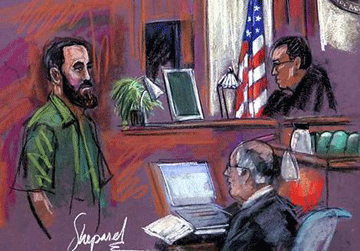
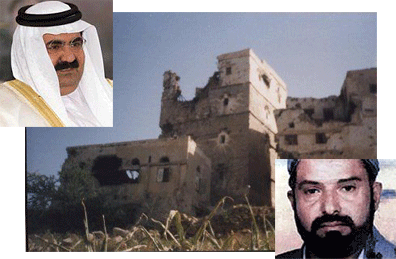
[Illustration: Emir Hamad Bin Khalifa al-Thani of Qatar, left; bombed out buildings in northern Yemeni town of Sa‘da in 2004 fighting, center; Husayn al-Houthi, right.]

In September, 2004, Yemen’s military captured and killed a Zaydi cleric in the northern part of their country. His name was Husayn al-Houthi and he is alleged to have started a rebellion with a strong anti-American thrust. Although claims were made that he was trying to revive the Zaydi imamate (which was toppled in 1962 in the revolution that formed a republic in North Yemen), such an al-Qaeda clone conspiracy theory are exaggerated. Nevertheless, his followers carried on a regional rebellion, lately under the leadership of his son Abd al-Malik, and as a result thousands of soldiers, rebels and civilians have died and tens of thousands of civilians have been displaced. It is not surprising that you may not have seen much about the fighting in the media. Indeed it has been a little rebellion compared to events in Iraq, Afghanistan or Gaza, and it certainly did not threaten the ruling government’s overall hold on the country. But it was certainly a big deal in Yemen. And now, with mediation by the Emir of Qatar, it appears that there will be an end to the armed conflict. Details are provided in today’s Yemen Observer.

Al-Houthi rebels descend the mountains, lay down their weapons

Written By: Nasser Arrabyee
Yemen Observer, Jun 30, 2007

Al-Houthi rebels have come down from the mountains of northern Yemen to put down their weapons and return home, as instructed by a Qatari-brokered agreement to end the five-month war between them and the government troops, said mediators Thursday. Continue reading The Little Rebellion that Was

A Voice in the Wilderness that is Gaza


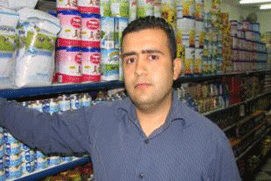
[Illustration: Khalil Yaziji found two bodies outside his shop, al-Jazeera.]

So what is today’s top story of violence in the Middle East? Take your pick: the Lebanese army vs. Fatah al-Islam in the camps of Tripoli, a Taliban-ignited bomb exploding in a market and killing civilians in Afghanistan, an assassination attempt on the mayor of Mogadishu, six U.S. soldiers and an interpretor killed in Diwaniya in southern Iraq, more deaths in Gaza. Reading the news (I almost made the anachronistic slip of “picking up” a newspaper) today is a time warp back to the revelationary isle John of Patmos and his prophetic vials of plagues. I am not referring to an incendiary end of the world scenario spun by the late Jerry Falwell (may he rest in Baptist solitude), but the continuing hell on earth. If you think this is about religion (or democracy), think again. Remove the politics (and American involvement or influence) from each of the stories above and the religion is reduced to a drizzle.

So here is my pick of the day, one from the little guy. Al-Jazeera, which has the resources and access that Western journalists can only dream about, published a piece by reporter Laila Haddad, who interviewed a variety of ordinary Palestinians living through the nightmare of Gaza these days. It is worthwhile looking at the violence from the ground-up, a welcome break from the bird’s-dropping view usually spun in the media. Here is what Khalil Yaziji, 26 years old, a shopkeeper and banker thinks of his present and future: Continue reading A Voice in the Wilderness that is Gaza

The Fort Dix Deep Six

Things can’t get worse; they can only get worse. No, this is not poor grammar or end-of-semester illogic but my first impression after listening to the hard-to-digest dollop of the morning news. Another suicide bomb killed and maimed scores in Iraq, this time in the Kurdish town of Irbil. The Bush administration suggests that things are getting better in Baghdad since the wall-less security crackdown, but that is debatable. What is not open to debate is that other parts of the country continue to spiral in insecurity, perhaps due in part to the targeted crackdown in one place. None of this seems to matter to Vice-President Cheney who has made a surprise visit to the Green Zone, mainly it seems to convince the Iraqi parliament not to take a summer vacation this year and be nice about dividing up the spoils of America’s, I mean Iraq’s, oil profits.

In this case it is not only the shit hitting the fan, but the gold as well. Gold as in Fort Dix (Fort Knox or whatever…) but I hope not a golden journalistic award to a local newspaper. Continue reading The Fort Dix Deep Six

Faces of the Fallen

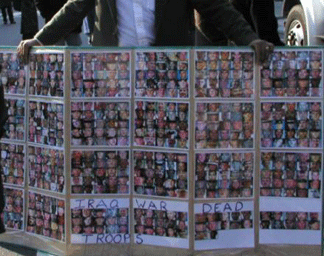
While Congress debates target dates for withdrawal and President Bush wields his veto bravado, the casualties from a no-longer-admired, quagmired war in Iraq continue to mount. For Operation Iraqi Freedom 3,345 American military personnel have lost their lives; for Operation Enduring Freedom in Afghanistan the number is a far more modest 381, yielding a total of 3,726 total fatalities overall. Then there are the Iraqi civilians and insurgents who have died, usually in bloody and terror-damned ways, reaching between 63,000 and 69,000 according to Iraq Body Count, but with estimates well above 100,000. Figures for Afghanistan are harder to come by. The initial bombing campaign four years ago took an estimated 3000-3400 civilian lives, with more every passing year. The sheer numbers, although not catastrophic when compared to big bloody wars of the past, are still numbing. But listing names is the easy way out; looking at the faces of the fallen takes more courage. Continue reading Faces of the Fallen

An Iraqi Rhapsody

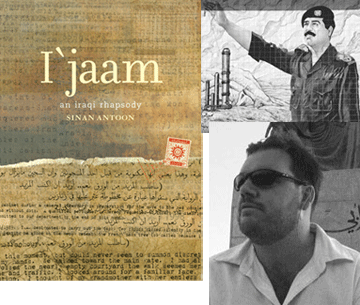
[The following is an excerpt from Sinan Antoon’s recently published translation of his earlier Arabic novel about life in Saddam’s Iraq.]

Two clouds kissed silently in the Baghdad sky. I watched them flee westward, perhaps out of shyness, leaving me alone on the bench beneath the French palm tree (so called because it stood in the courtyard in front of the French department) to wait for Areej. I looked for something worth reading in that morning’s al-Jumhuriyya, and found a good translation of a Neruda poem in the culture section, besieged [beside?] on all sides by doggerel barking praises of the Party and the Revolution. The breeze nudged the palm fronds above my head to applaud. It was April, “the month of fecundity, the birth of the Ba’th and the Leader,” as one of the posters on the college walls announced. Continue reading An Iraqi Rhapsody

May Day, May Day

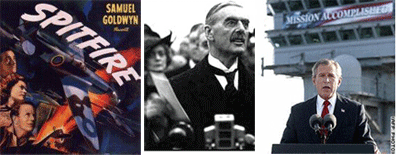
“May day, may day.” You can take this in two ways. First, this is the day in which many working people in the world celebrate being workers. This is not the way it will be commemorated on the front lawn of the White House today. Then there is the military version of a Spitfire on fire and a pilot knowing it is time to bail out. The pilot currently occupying the White House is wielding his veto power today in order to stay the course. Since he is not yet convicted that the war is lost, he sees no need to bail out.

But let’s flash back four years to the banner day “Mission Accomplished” speech of a boastful George Bush on the deck of USS Abraham Lincoln. Continue reading May Day, May Day

Delta Farce: Jihad in Somalia?


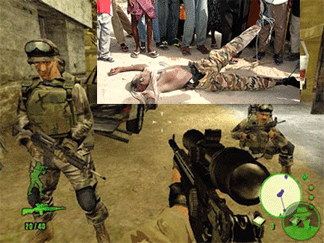
[Illustration: Delta Force video game; insert, Somali soldier killed in heavy fighting in Mogadishu is dragged through the city’s streets in late March. Photograph: Mustafa Abdi/AFP/Getty]

The impoverished East African country of Somalia is continually in the news. Minority Rights Group (MRG) International announced a month ago that Somalia is now the least safe country in the world for minorities, edging out Iraq and Sudan for this dubious distinction. Nor can it be said that Somalia is safe for majorities, given its recent, bloody history. In the past month more than 1,000 people have died, rivaling the surging toll in Iraq.

In 1993, a decade before Saddam Hussein’s Iraq was shocked and awed into anarchic free fall, a team of U.S. commandos parachuted into Mogadishu, the capital of this strife-torn East African country. Two Blackhawk helicopters were downed and the warlord escaped. Hollywood’s cinematic version hit the screen eight years later with the same bad ending. Then came the video game, Delta Force Black Hawk Down. Now a savvy teenager, armed with cheats, could rewrite history and let the good guys win. But in Somalia today it is hard to figure out just who the good guys are. Continue reading Delta Farce: Jihad in Somalia?