Category Archives: Terrorism Issue

Iraq: The Hidden Human Costs

[Note: The following excerpt is from a book review published in the latest New York Review of Books by Michael Massing. The full article is available free online and describes two compelling memoirs of the invasion of Iraq, one by a Marine and one by a reporter embedded with the Marine’s unit. It is well worth reading for a side of the fighting usually sanitized out of reports.]

by Michael Massing, New York Review of Books, December 20, 2007

As the Marines fall back, some are clearly exhilarated at this first exposure to battle; others express remorse. “Before we crossed into Iraq, I fucking hated Arabs,” says Antonio Espera, a thirty-year-old sergeant from California. “I don’t know why…. But as soon as we got here, it’s just gone. I just feel sorry for them. I miss my little girl. Dog, I don’t want to kill nobody’s children.” Coming under heavy fire for the first time, Wright is surprised to find himself calm, but he is astonished at the fierceness of the barrage being directed at Nasiriyah. It includes high-explosive rounds that can blast through steel and concrete as well as DPICMs (Dual-Purpose Improved Conventional Munitions), cluster shells that burst overhead, dispersing dozens of bomblets designed to shred people. Continue reading Iraq: The Hidden Human Costs
Mass-Mediated Violence in Morocco and the US: Suicide Bombing and Shooting Sprees


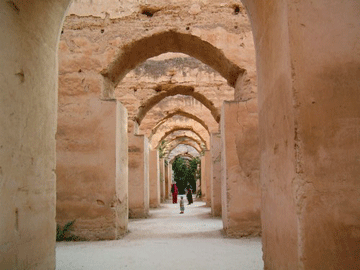
Scene in Meknes, Morocco

by Emilio Spadola
Colgate University
Dept of Sociology and Anthropology

Recently, my efforts to think on Moroccans’ quality of modern (i.e., mass-mediated) life have turned on violence both there and in the US, and, especially, to two forms of youth violence: suicide bombings and suicide shootings. In 2007 Moroccans witnessed separate bombings in Casablanca and Meknes; in separate cases Moroccan state intelligence traced other accused suicide bombers to one neighborhood in Tetouan. In the US in December an Omaha teenager with an automatic weapon shot and killed eight mall goers, then himself; four deaths shortly after in Colorado added to the long year of suicide sprees by young men: six deaths in a Utah mall in February, 33 deaths on the Virginia Tech campus in April.

Emphasizing putative differences, cultural pundits habitually link suicide bombings to the Middle East, and, specifically, to an Islamic culture of violence. And shooting sprees seem typically, if pathologically, American. They are nonetheless strikingly redolent. Yet to compare them, that is, to abstract them from their separate contexts, takes special care. In so doing one faces what Benedict Anderson calls the “specter of comparisons,” that is, the distinctly modern moment in which persons appear, like commodities and print, as serial copies. Yet it is precisely this imagined quality of commensurability—when “anyone” rather than a specific someone can be a target (of mass-mediated messages)—that marks as contemporary suicide bombing and suicide shooting. Continue reading Mass-Mediated Violence in Morocco and the US: Suicide Bombing and Shooting Sprees

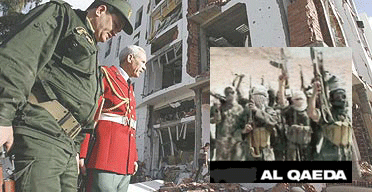
You’ve Gotta Be Al-Qaiding Me

Pick up your morning newspaper or log on to an online news source and chances are there will be reports of suicide bombings somewhere in the Middle East (or Sri Lanka). The latest example, reported only a few hours ago, is from Algeria, as published in The Guardian:

At least 47 people, including a member of UN staff, were killed in two car bomb attacks in the Algerian capital today.

A car packed with explosives rammed into the offices of the UN’s refugee agency (UNHCR) in Algiers, and another was detonated outside the constitutional court.

Official estimates put the death toll at 47, but the BBC reported that the figure was over 60. A further 43 people have been injured.

The US president, George Bush, condemned the attacks as “senseless act of violence”.

The two car bombs, in upmarket areas of the capital, happened 10 minutes apart.

The first car bomb was driven into the constitutional court building in the Ben Aknoun district, killing at least 30 people. The official Algerian news agency reported that several of the victims were students who had been travelling on a school bus.

Ten minutes later, the second car bomb was driven into the UNHCR, in the Hydra district, killing at least 15.

Farhan Haq, a UN spokesman, said the member of staff who died had been working in the office of the UN development programme, which is across the road from the UNHCR building and was also damaged in the blast.

More of the same, you might think. The story could as easily have been about Iraq or Afghanistan or Israel or fill in the increasing number of blanks. So why is all this happening, as if the pragmatic reasons are not painfully obvious? More of the same again. The media, echoing the Bush administration, has a suspect. Continue reading You’ve Gotta Be Al-Qaiding Me

MPAC and the Bad News Bear Story

I am a Canadian Muslim who has been living and teaching in Los Angeles for the past decade. My recent book, Oil and Water: Two Faiths, One God is an introduction to Islam for a North American audience. As a Muslim, I am deeply concerned about violence committed by Muslims, especially when it is done in the name of Islam. Muslims around the world have condemned the recent cases in Sudan and Saudi Arabia. For example, the Muslim Public Affairs Council (MPAC) wrote this in response to the jailing of the teacher in Sudan: “‘Jailing Ms. Gibbons is the real insult to Islam in this case,’ said MPAC Communications Director Edina Lekovic. ‘Invoking Islamic law to jail and deport her for this insignificant class project is absurd and appalling.'” Their full response can be found on their web page and is reproduced here:

MPAC Appalled by Sudanese Jailing of Teacher for Naming Teddy Bear
November 30, 2007

The Muslim Public Affairs Council today expressed its disgust with the Sudanese court decision to jail and beat a British teacher who allowed her students to name a class teddy bear “Muhammad.”

SEE: “Calls in Sudan for Execution of British Teacher” (New York Times, 11/30/07)

The hundreds of protesters, some waving ceremonial swords, outside the presidential palace denouncing the teacher and calling for her execution are falling into a pathetic trap by making a story out of nothing. The leaflets condemned Gibbons as an “infidel” and accused her of “the pollution of children’s mentality” by her actions.

“Jailing Ms. Gibbons is the real insult to Islam in this case,” said MPAC Communications Director Edina Lekovic. “Invoking Islamic law to jail and deport her for this insignificant class project is absurd and appalling.” Continue reading MPAC and the Bad News Bear Story

Secrecy and Anthropology

by Elizabeth Redden, Inside Higher Ed, December 3

With debate over the role of anthropologists in aiding the military machine a theme threading through their annual meeting, scholars voted Friday to demand that the American Anthropological Association reinstate strict language from its 1971 code of ethics prohibiting secret research. Members at the meeting – who, for the second time in about 30 years and the second year in a row constituted a quorum in excess of the required 250 — also voted overwhelmingly to oppose “any covert or overt U.S. military action against Iran.”

The language anthropologists want reinstated on secrecy – which, the resolution’s sponsor affirmed would apply to anthropologists doing work for corporations too – stipulates that “no reports should be provided to sponsors that are not also available to the general public and, where practicable, to the population studied.” Like every item of business discussed Friday other than the resolution on Iran, the resolution on secrecy was not filed for consideration 30 days in advance, as is required under association rules, and so will be submitted to the association’s executive board on an advisory basis only.

But Friday’s vote only strengthens a recommendation contained in a new report from the AAA Commission on the Engagement of Anthropology with the U.S. Security and Intelligence Communities, which suggests that the membership or ethics committee “should consider” reinstating those same sections (1.g, 2.a, 3.a, and 6) of the 1971 code. The report centers on whether the association’s ethical standards bar ties to the military or intelligence agencies. The commission’s short answer: Not necessarily, although more scrutiny is needed. Stressing the diversity of roles anthropologists can play in military and intelligence apparatuses, the panel determined that while certain interactions would violate the ethical code, members also “see circumstances in which engagement can be preferable to detachment or opposition.” On issues of secrecy, for instance, the commission offered one particularly complex dilemma as illustration: “Some situations might be counterintuitive for most of us: consider a situation in which a research project is kept secret from the scholarly community, but not from the local population or community under study – as when an anthropologist employed by a government agency helps a special operation to get medical supplies to a remote town in northern Afghanistan.” Continue reading Secrecy and Anthropology

Al Qaeda’s generational split

by Gregory D. Johnsen
The Boston Globe, November 9, 2007

RECENT CONFUSION over the status of Jamal al-Badawi, one the masterminds of the attack on the USS Cole in Yemen in 2000, illustrates the difficulties of containing an increasingly fractured jihadist movement. Badawi, who escaped from prison early last year, had surrendered to the Yemeni government in early October, only to be released as part of a plea deal. These events have sparked confusion and anger in the United States.

In Yemen, meanwhile, authorities have continued to make misleading and ambiguous statements about his whereabouts. It would be easy to assume, as many have done, that the country’s reaction was that of a reluctant ally eager to shirk its responsibility in the war against Al Qaeda. This reading, as Rudy Giuliani suggested, demands that the United States threaten Yemen with a reduction in aid.

But what to the United States is a cohesive organization bound together by a common hatred is to Yemen a fragmented movement that is rife with infighting and dissension. Continue reading Al Qaeda’s generational split

Darkness Falls on the Middle East

by Robert Fisk
The Independent, 24 November 2007

In Beirut, people are moving out of their homes, just as they have in Baghdad.

So where do we go from here? I am talking into blackness because there is no electricity in Beirut. And everyone, of course, is frightened. A president was supposed to be elected today. He was not elected. The corniche outside my home is empty. No one wants to walk beside the sea.

When I went to get my usual breakfast cheese manouche there were no other guests in the café. We are all afraid. My driver, Abed, who has loyally travelled with me across all the war zones of Lebanon, is frightened to drive by night. I was supposed to go to Rome yesterday. I spared him the journey to the airport.

It’s difficult to describe what it’s like to be in a country that sits on plate glass. It is impossible to be certain if the glass will break. When a constitution breaks – as it is beginning to break in Lebanon – you never know when the glass will give way. Continue reading Darkness Falls on the Middle East

Pakistan’s tribal chieftains exploit state collapse to assert local power

[Editor’s Note: there is an interesting new post by Hamid Hussain on Saudi Debate about the current strife in Pakistan and its relation to the situation in Afghanistan. Here is an excerpt from the end of his commentary, the full version available at http://www.saudidebate.com/index.php?option=com_content&task=view&id=952&Itemid=181.]

In general, Pakistani society is in a state of denial refusing to acknowledge the looming threat to the very national fabric of the society. Majority see current conflict only through the prism of anti-Americanism. In the absence of reliable information, opinions are being formed on the basis of rumors, suspicions and conspiracy theories. On one end of the spectrum is the opinion of use of overwhelming force to crush the challenge to government authority and on the other end some are advocating that government simply abandon its primary responsibility and pull out all security forces. Everyone is mute about what will happen next; i.e. after large scale destruction from a sledgehammer approach or after pulling security forces out without any mechanism in place and giving free hand to militants. Average citizen wakes up every morning to see another horrific case of brutality and wanton violence. Continue reading Pakistan’s tribal chieftains exploit state collapse to assert local power