Category Archives: Terrorism Issue

Playing Games with Iran


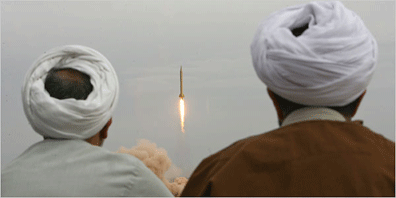
Clergymen watched a missile during war games Thursday near Qum, Iran. The exercise was conducted by Iran’s Revolutionary Guards. Fars News Agency, via Agence France-Presse

by William O. Beeman, Foreign Policy In Focus, July 21, 2008

By now the structure of the U.S. game with Iran is clear. In the first move, the United States and Iran make some small progress toward improved relations. In the counter move, hardliners in the United States and Israel launch attacks against Iran in order to sabotage these improving relations.

In the latest iteration of this game, the U.S. State Department has made an interesting gambit. It announced that Undersecretary of State William Burns would sit at the table on July 20 as members of the European Union entered into talks with Iran over its nuclear program. At the same time, the United States has been reported to be considering opening a formal American Interests Section in Tehran. These two actions will be the first serious public diplomatic activities between the two nations in nearly three decades. (Three earlier meetings in Baghdad between U.S. Iraqi Envoy Ryan Crocker and Iranian Ambassador to Iraq Hassan Kazemi-Qomi focused on security in Iraq). Continue reading Playing Games with Iran
Virtual Vengeance

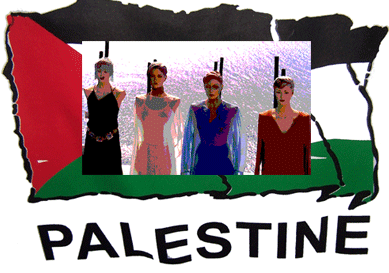
There are more online shoot-em-up games than a person can shake an MK-37 at. The enemies are always the ‘bad guys,’ including Muslim terrorists, who might as well be Nazi or Japanese kamakazi pilots. Of course, video gaming (unlike duck hunting) is all fantasy, I am told. Isn’t it better to shoot fake bullets and rip apart digital bodies online than harm real people (or ducks)? Surely it is. So, if you are interested in seeing the tables turned and are concerned about the usual representation of Palestinians as terrorists, you may find the following video of interest. And remember, it is of course only fantasy.

A Course on the Collision Course

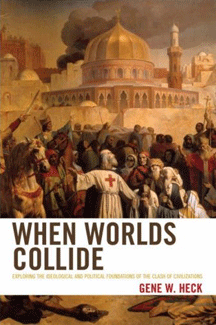
[The aftermath of 9/11 has yielded a stream of books on Islam and violence, so much so that it is rare to find a book about Islam that does not tackle the issue one way or the other. Part of this is due to media promotion of books like Bernard Lewis’s What Went Wrong? and the neocon mantra borrowed from Samuel Huntington’s Clash of Civilizations thesis. A refreshing rejoinder to all this clash talk is provided by Gene Heck in his recent When Worlds Collide: Exploring the Ideological and Political Foundations of the Clash of Civilizations. Here is an excerpt from his Introduction. Webshaykh]

What are the Causes of Modern Middle East Terror?

5. That the so-called Wahhabi movement is often unjustly maligned for alleged doctrines and precepts that do not comport with the actual teachings of the movement’s eighteenth-century founder, Muhammad ibn ‘Abd al-Wahhab, who advocated jihad by peaceful, not militant, means. Continue reading A Course on the Collision Course

Buns and Guns in Beirut

‘Buns and Guns’ Fast Food Eatery Opens in Beirut

Asharq Alawsat, 27/06/2008

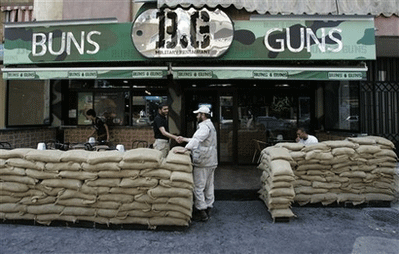
BEIRUT, Lebanon, (AP) – At the “Buns and Guns,” the chefs wear military helmets, the food is wrapped in camouflage paper and the advertising slogan is “a sandwich can kill you.”

The fast food eatery with a tongue-in-cheek military theme opened three weeks ago in Beirut’s Hezbollah-dominated southern suburbs and is drawing in residents proud of the Shiite militant group’s battlefield successes.

Done up like a military outpost, the restaurant is located in the heart of a neighborhood heavily pounded by Israel during its 2006 war with Hezbollah, which fought the Israeli military to a standstill.

Neatly stacked sandbags cover the exterior, while the inside is festooned with camouflage nets, defused mortar shells and live ammunition. Employees in military uniforms serve meals to the taped sounds of gunfire as “background music.” Continue reading Buns and Guns in Beirut

Dancing with Snakes

For Yemen’s Leader, a Balancing Act Gets Harder

By ROBERT F. WORTH, The New York Times, Saturday, June 21, 2008.
SANA, Yemen

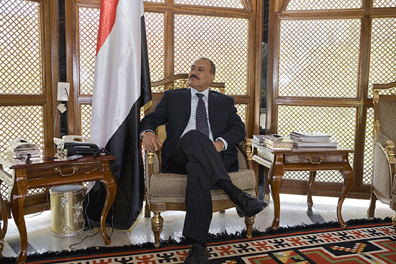
PRESIDENT Ali Abdullah Saleh’s face is everywhere in Yemen. He stares out from billboards, shop windows and living room walls, always with the same proud expression: eyes glinting, chest thrust out as if to confront a challenger. After 30 years in power, Mr. Saleh has become almost synonymous with the state in this arid, desperately poor corner of southern Arabia.

But lately the president, 66, known for his wicked sense of humor, has been uncharacteristically dour. A war with northern Shiite rebels has spread to the outskirts of the capital. Terrorist attacks have led embassies and foreign companies to evacuate their employees. With an insurrection rising in the south as well, the turmoil has renewed fears that this conservative Muslim country of 23 million, a longtime haven for jihadists, could collapse into another Afghanistan.

Mr. Saleh, his gruff voice tinged with anger, dismissed the rebels as “racists” who want to return to Yemen’s ancient system of religious rule. They have won popular support by associating his government with the United States, he said during an hourlong interview inside the sprawling, high-walled presidential palace compound. Continue reading Dancing with Snakes

All in the name of War on Terror

by Fahad Faruqui, Yemen Times

Detainee number 063, Mohamed Al-Kahtani, was one of the many hundreds housed in the Guantanamo (known as “Gitmo”) Bay detention camps who was subjected to 20 hours of interrogation on only four hours of sleep.

The Haynes memo, which approved controversial and harmful interrogation techniques, was signed by Donald Rumsfeld, the former United States Secretary of Defense, in early December of 2002. Entitled, “Counter-Resistance Techniques,” this was the memo that opened the door for partial drowning (called water boarding), along with humiliation, mental destabilization and other illegal methods of obtaining information from detainees.

Al-Kahtani, a citizen of Saudi Arabia, is the alleged 20th hijacker, but the U.S. Military Commissions dropped key 9/11 suspect charges against him on May 11 this year. Continue reading All in the name of War on Terror

Keith Ellison’s Iran Forum

Keith Ellison’s Iran Forum and the June 10 Call-In to Congress

By Lydia Howell, Engage Minnesota, June 6, 2008

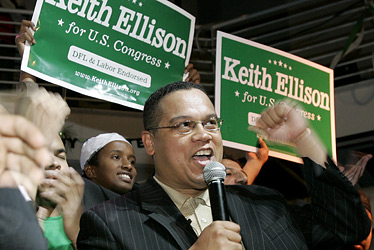
On May 28, U.S. Rep. Keith Ellison, D-Minn., hosted Iran scholars for a community forum in a packed hall at the First Unitarian Society church in Minneapolis. The focus was on the U.S.-Iran relationship, estranged for over 30 years, which many fear may become the next chapter in the Bush administration’s “war on terrorism.”

“Nary a day goes by that someone isn’t saying something abut Iran in the media. Part of my responsibility as a U.S. congressman is to be a forum to discuss the critical issues we face and to promote dialog about the most pressing issues,” said Ellison. “To quote [African-American writer] James Baldwin: Anything that cannot be faced cannot be fixed.”

In the first half of 2008, newspaper front pages and television news have begun repeating a message about a Middle Eastern country that has not attacked the United States but which allegedly “poses a grave threat,” “may build nuclear weapons” and “must be prevented from making war on its neighbors.” In 2002-3, such stories were about Iraq; now, Iran is being described in similar ways. No actual evidence is given for the frightening allegations about Iran—which are too often made by unnamed “Pentagon officials” or the same members of right-wing think tanks that previously pushed the disastrous attack on Iraq. Continue reading Keith Ellison’s Iran Forum