Category Archives: Terrorism Issue

People in Muslim Nations Conflicted About UN

People in Muslim Nations Conflicted About UN

Favor More Active UN With Broader Powers, But See US Domination and Failure to Deal With Israel-Palestinian Conflict

Press Release, WorldPublicOpinion.org, December 3, 2008

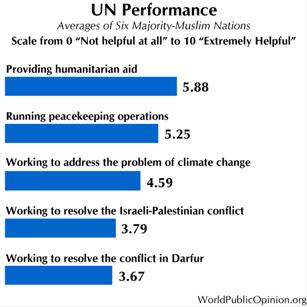
College Park, MD—A poll of seven majority Muslim nations finds people conflicted about the United Nations. On one hand there is widespread support for a more active UN with much broader powers than it has today. On the other hand, there is a perception that the UN is dominated by the US and there is dissatisfaction with UN performance on several fronts, particularly in dealing with the Israeli-Palestinian conflict.

These are the findings from a WorldPublicOpinion.org survey in Egypt, Turkey, Jordan, Iran, Indonesia, the Palestinian Territories, and Azerbaijan. Muslims in Nigeria (50% of the general population) were also polled. The survey was conducted in two waves in 2008. Overall, 6,175 respondents were interviewed in the first wave and 5,363 in the second; a total of 11,538 respondents participated in the study. The first wave was conducted January 12-February 18, 2008 though in two nations it was completed in late 2006. The second wave for all nations was completed July 21-August 31, 2008. Margins of error range from +/-2 to 5 percent. Not all questions were asked in all countries. Continue reading People in Muslim Nations Conflicted About UN
Enough is Enough

Enough is Enough
Says who to whom?

By Badri Raina, ZNet, November 30, 2008

Epigraph:

The Light of the body is the eye: if therefore thine eye be single, thy whole body shall be full of light.(Gospel, Matthew, 6:22)

I

My skimpy acquaintance with the Taj hotel in what was then Bombay goes back to 1962.

I had been selected as a rookie sales executive by the then world’s largest corporate house, Standard Oil, whose Asia division was called ESSO.

Our offices, also then the only air-conditioned building in Bombay, was at Nariman point.

Such was the nature of my job that on two or three occasions I had to be inside the Taj, full of smiles and business.

Some three years later I decided I wasn’t going to sell oil for the next forty years, and I quit cold turkey to return happily to an academic life, liberally enlivened with activist involvements.

In short, the Taj hotel is truly a magnificent structure, although those days it made me happier to look at its magnificence from the outside than wheeling-dealing inside.

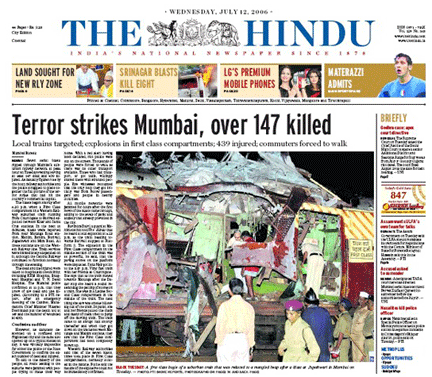
Like every other Indian, therefore, I am deeply saddened both by the insane loss of life, notable and ordinary, and by the damage done to this edifice. Especially when I recall that the Taj was the result of a laudable anti-colonial impulse, since Jamshedji had been refused entrance to another hotel reserved exclusively for the British. Continue reading Enough is Enough

Terrorism That’s Personal


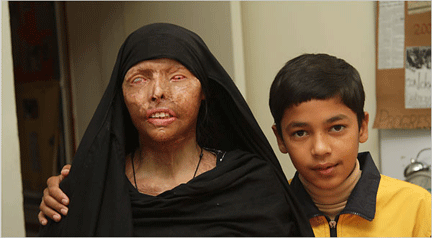
Acid attacks and wife burnings are common in parts of Asia because the victims are the most voiceless in these societies. Naeema Azar, above, was attacked by her husband after they divorced. Her 12-year-old son, Ahmed Shah, looks after her.

Terrorism That’s Personal

By NICHOLAS D. KRISTOF, The New York Times, November 30, 2008

ISLAMABAD, Pakistan

Terrorism in this part of the world usually means bombs exploding or hotels burning, as the latest horrific scenes from Mumbai attest. Yet alongside the brutal public terrorism that fills the television screens, there is an equally cruel form of terrorism that gets almost no attention and thrives as a result: flinging acid on a woman’s face to leave her hideously deformed.

Here in Pakistan, I’ve been investigating such acid attacks, which are commonly used to terrorize and subjugate women and girls in a swath of Asia from Afghanistan through Cambodia (men are almost never attacked with acid). Because women usually don’t matter in this part of the world, their attackers are rarely prosecuted and acid sales are usually not controlled. It’s a kind of terrorism that becomes accepted as part of the background noise in the region. Continue reading Terrorism That’s Personal

Mumbai and the Blame Game

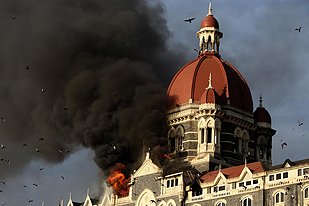
Must every country have its 9/11 moment and must these tragedies continue to be the work of extremists who attack and kill as if they were commanded by Allah? This is a rhetorical question, of course. The latest events in Mumbai have trumped the economic slump in the news. Once again billowing smoke from a famous building clouds the sky; again Islam is tainted as the religion that fosters terrorists. And the blame game begins anew.

The sheer audacity of the attack, more like a Rambo commando raid than the hijacking scenario that felled the Twin Towers, is staggering. How could such landmarks have been targeted in tandem? Where was the security? These are the questions inevitably asked after the fact. As reported in Al-Jazeera, here is the unfolding of the drama: Continue reading Mumbai and the Blame Game

An Internationalist President


Professor John Esposito


An internationalist president

by John Esposito, The Immanent Frame, SSRC Blogs, November 7, 2008

Barack Obama’s campaign victory was epic-making in America and across the Muslim world. On November 4, as soon as the election was called for Barack Obama, I began to receive congratulatory emails from friends in the Middle East, South and Southeast Asia, and Europe. Some had stayed up through the night to hear the final results. Of course, I wasn’t surprised at the global interest and support, which had been evident on recent visits to Europe, the Middle East and Southeast Asia. Wherever I spoke, regardless of the topic, someone in the audience would ask me a question about Obama and his prospects. Privately, it was the topic of conversation. So what will all this mean?

In the Muslim world, as in Europe and much of the world, Obama is welcomed as an internationalist president. His Kenyan father, early schooling in Indonesia, race and name symbolize for many a unique internationalist presidential profile, one that contrasts sharply with his predecessor. Indeed, he is seen as the antithesis of George W. Bush-internationally informed, experienced, aware and sensitive, a measured and articulate statesman-not, as Bush is often regarded, as a swaggering Texas cowboy. Continue reading An Internationalist President

Sex and the Islamic City

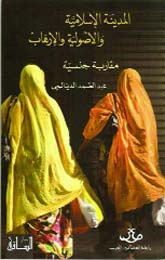
[The following is a review by Omar El Kouch of Al-Madina al-Islami wal-Ouçoulya wal-Irhab: Muqaraba Jinsya, (Islamic City, Fundamentalism and Terrorism: a Sexual Approach), Beirut, Arab Rationalist League, Dar Es Saqi, 2008, 208 pages, ISBN 978-1-85516-287-7 by Abdessamad Dialmy. The review is translated here from Arabic into English by Said Allibou and Imad Mahhou (Mohamed V University, Rabat, Morocco).]

The new book of Prof. Dr. Abdessamad Dialmy holds a new treatment and handling, where the author attaches a particular importance to the sexual factor in the composition and the reasoning of a fundamentalist, radical and terrorist personality. This is a factor which is absent in the various studies on fundamentalist and radical movements in the Kingdom of Morocco and witnessed in the rise of radical movements and incidents of violence and bombings, fields of study and research. Continue reading Sex and the Islamic City

Pay Dirt for the RNC


Where the RNC found Joe the Plumber

Yesterday the RNC (also to be known as Really Nasty Condemnations) slid out yet more mud trying to fearmonger Senator Obama yet again as a terrorist. Since they cannot find any smoking guns from Obama’s record, the exit strategy has come down to throwing smoke-filled room stink bombs around Obama’s Chicago neighborhood. The latest mudpie comes at the expense of Professor Rashid Khalidi, who holds the Edward Said Chair of History at Columbia University. When Obama taught at the University of Chicago he was a colleague, neighbor and friend of Khalidi. For the RNC all it takes to be labeled terrorist these days is to be Palestinian. But they have chosen an individual who is a recognized international scholar and who is admired across a broad spectrum of the academy. His most recent book, The Iron Cage, attacks the excesses of Zionism on the Palestinian quest for statehood, but is also critical of the PLO and Palestinian violence. He writes as a historian, not a polemicist only interested in political spin. Continue reading Pay Dirt for the RNC

Rethinking Jihad conference

International Conference
“Rethinking Jihad: Ideas, Politics and Conflict In the Arab World and Beyond”

The University of Edinburgh, 7-9 September 2009

Especially since 11 September 2001, the notion of ‘jihad’ has assumed
centre-stage in public and academic discourses on Islam, Muslims, and the
Arab world, particularly as a byword for terrorism and violence. But
clearly jihad has meant different things to different people at different
times, whether as theory, as action or as metaphor. As a timely exploration
of this diversity, the Centre for the Advanced Study of the Arab World
(CASAW) is convening a major international conference on the subject of
jihad in its multiple dimensions. The conference has three overarching
goals. The first is to bring together academics and others from a variety
of disciplines and specialisations to generate an in-depth discussion of
jihad in its practical, theoretical, historical, juridical and symbolic
dimensions. It is hoped that by drawing on a diversity of perspectives
(methodological, historical and geographical) the conference will contribute
to a deeper and more critical understanding of jihad. The second goal is to
reflect critically on the importance of jihad, however defined, to the study
of the Arab and Islamic worlds: to what extent is jihad a useful analytical
concept? Have students of Islam and the Arab world minimised or overstated
its importance? How should jihad be located in future research agendas?
Finally, the conference will seek to engage with the broader knowledge
community and explore current understandings and representations of jihad
within policy and media circles internationally. It will critique these
representations, as well as explore ways in which academics might contribute
to an improved understanding and contextualisation of jihad in public
discourse. Continue reading Rethinking Jihad conference