Category Archives: Terrorism Issue

Interrogating Interrogation in Iraq


Interrogation Results Prompt Scrutiny Of Methods

by Dina Temple-Raston, NPR, Morning Edition, April 30, 2009

This is a story about two interrogation programs — one run by the U.S. military, the other run by the CIA. The military program was focused on getting important al-Qaida suspects in Iraq to talk. The CIA operation zeroed in on important al-Qaida suspects from around the world. Both programs had similar goals, but they operated under very difficult rules.

Earlier this month, former CIA Director Michael Hayden was on Fox News defending the CIA’s enhanced interrogation program.

“The use of these techniques against these terrorists made us safer,” he said emphatically. “It really did work.” As Hayden and others see it, the U.S. had to use tough techniques — some called it torture — to battle al-Qaida.

Matthew Alexander is an advocate of a different kind of interrogation — one that builds rapport, like the kind of technique you see on television cop shows. Alexander was a military interrogator in Iraq and doesn’t see the need for rough questioning. Continue reading Interrogating Interrogation in Iraq

10 Conceptual Sins

“10 Conceptual Sins” in Analyzing Middle East Politics

by Eric Davis, from The New Middle East, January 28, 2009. For an Arabic translation of this post, click here.

Sin # 1: “Presentism.” Unfortunately, many of those who analyze Middle East politics, whether journalists, policy analysts, or academics, do not take history seriously. That is, they fail to situate Middle East politics in a historical context. If they did, they would gain many more insights into the political dynamics of the region.

Analysts would have realized why, for example, Iraqis showed little enthusiasm when American troops toppled Saddam Husayn’s regime in April 2003. This response did not indicate that Iraqis were ungrateful as the vast majority were relieved to see the end of Saddam’s regime. Rather, many Iraqis, who did have a historical consciousness, knew that the US had supported Saddam Husayn during the Iran Iraq War. Iraqis also remembered that, when President George Bush senior called upon them to rise up against Saddam Husayn in 1990, many took him at his word. However, not only did the US not intervene to help the rebels during the February-March 1991 uprising (Intifada), it gave permission for Iraqi helicopter gun ships to enter the fray which turned out to be critical in suppressing it. Continue reading 10 Conceptual Sins

Islamophobia and MisIslamothropes


Geert Wilders, the right-wing Dutch politician. Photograph: Jerry Lampen/Reuters

“Islamophobia” is a relatively new word, perhaps only from the late 1980s. What it signifies, however, dates back to the very beginning of the Islamic faith. Indeed, the initial response of the Meccan elite to the monotheistic preaching of Muhammad was so fearful of the economic fallout and political challenge of the message brought by this new prophet that the first Muslims were forced to flee to a safe haven in Madina. After Islam was established as a community and expanded, it came into conflict with the Christian enclaves in Syria and Egypt, as well as the Sassanian Persian empire to the east. By the time Muslims had briefly made forays into southern France in the 9th century, the Venerable Bede villified them as a “very sore plague.” Whether seen as Arabs, Moors or Turks, the many ethnicities represented by the growing religion understandably struck fear among those who saw the faith as a political or religious threat.

Fear is understandable; anything new is prone to be misunderstood, especially when the issue is about how to believe in God. Christians and Jews came to fear Islam because it was a rival, one with powerful political muscle through the 16th century. Fear, however, is not the problem. The major stumbling block for peaceful coexistence between rival faiths or ideologies of any kind is hatred. Continue reading Islamophobia and MisIslamothropes

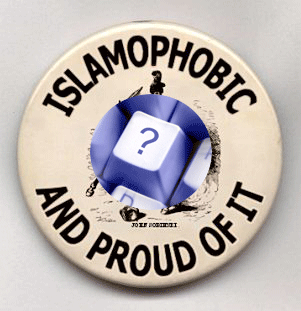
Islamophobia 101, A call to analyse

[Webshaykh’s Note: This is the start of a new blog thread dedicated to energizing scholarly and pedagogical attempts to combat, or at least mitigate, the ongoing volume of Islamophobia in the media, especially on the Internet. The question is simple: what can be done to respond to Islamophobia in the media by our efforts in the blogosphere, formal media outlets, classroom, community and scholarly forums? I invite fellow scholars, professors and teachers and anyone concerned with this issue to contribute to the discussion here at Tabsir.]

People of any particular religious faith are understandably offended when someone or something they hold to be sacred is dragged through the media-made mud of ridicule. There is no way to completely stop desecration, even when hate crime laws are in place. As long as there are synagogues with walls and anti-Semites with paint, swatstikas will be painted. As long as there are artists who stretch their creative energies to the limit of tolerance, animal dung will adorn the body of the Madonna. And as long as so many individuals in Western societies fear Islam through the veil of their own ignorance and historically constructed disdain, the Prophet Muhammad will be pictured as a profligate. The Danish cartoon controversy was only the tip of the iceberg, one that created a titanic rift in the Muslim community worldwide. The irony is that portraying Muhammad in any form is considered wrong in Islam, so that placing a stud missile in the turban of a caricatured Mahound (to drop a literary motif of the same controversial dimension) glosses over the level of misunderstanding motivating those who made and appreciated the cartoon images.

So what is the proper response to the volume of prophet bashing out there, not only in the case of Islam. Here are a few suggestions to jumpstart the process of analysis so that we as scholars can mitigate the paralysis created by an Islamophobia that is only a mouse click away.

• Identify resources (books, relevant articles, websites, speakers) which provide a scholarly and objective-as-possible perspective on Islamophobia
• Discuss the merits of whether or not to provide examples of Islamophobic writing, art and videos that are admittedly offensive to many Muslims
• Provide lesson and project ideas to encourage students to critically assess the Islamophobia in specific examples they are likely to find in the media and on the Internet
• Engage with fellow scholars and concerned Muslims about the most effective and least offensive ways to combat and mitigate Islamophobic writing and art
• Link examples of Islamophobia to other forms of verbal and artistic ridicule of sacred materials.
• Expose Islamophobic rhetoric by politicians, celebrities and other people in the news.

Having set out the goals, I invite colleagues contribute comments, commentaries and examples for and against Islamophobia for this series, please email the webshakh at daniel.m.varisco@hofstra.edu. I will post the first commentary tomorrow.

Daniel Martin Varisco

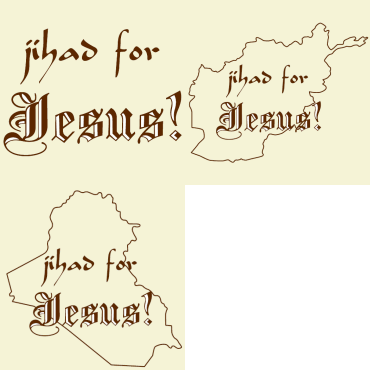
Jihad for Jesus

Forget “Jews for Jesus.” Bill Maher missed the t-shirt gospel in his Religulous. If the War on Terror is the message; a t-shirt may be the best medium. Just check out the one-size-does-not-fit-all humor at smarttorso.com.

The site even comes with a disclaimer:

This site is not suggesting that the Global War on Terror is a front for spreading western Christianity to Afghanistan, Iraq, and the rest of the middle east.

That sure would be sweet, though.

(Reminder to our heroes overseas: any SmartTorso order shipping to an APO or FPO address will automatically recieve $5 off. Thanks for your service. Just don’t wear this shirt in formation, unless you have enormous balls and can get away with it.)

Who is the Enemy?

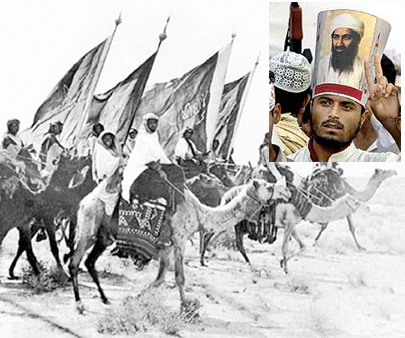
Wahhabism, Salafism and Islamism: Who Is The Enemy?

by Ahmad Moussalli, Conflicts Forum, January, 2009

This essay constructs and deconstructs three main discourses created by different and opposing trends in modern Islamic thought that are normally and mistakenly lumped together as Islamism, fundamentalism, salafism, neo-salafism, Wahhabism, jihadism, political Islam, Islamic radicalism and others. I will compare and contrast between them by developing a typology of major ideologies of active Islamic trends that centers specifically on Wahhabism and neo-Wahhabism, salafism and neo-salafism, and Islamism, both moderate and radical. Understanding these trends and their discourses will allow world powers, policymakers, academicians, intellectuals, terrorism experts, journalists, and many others to distinguish between and understand the logic of the radical and the moderate, the active and the inactive, the jihadi and the peaceful, the takfiri and the tolerant, the modern and the traditional, and the rational and irrational. This essay will also clarify the terminology used chaotically by different policy-makers, analysts, journalists, academicians, and intellectuals. Although all Islamic trends use similar literal doctrines and concepts such as jihad, Islamic state, al-shari‘a or prophetic traditions, their connotations and discourses differ importantly from one trend to another. This makes their implications serious in action, massive in repercussions, and fundamental for understanding. Continue reading Who is the Enemy?

Reflections on Gaza


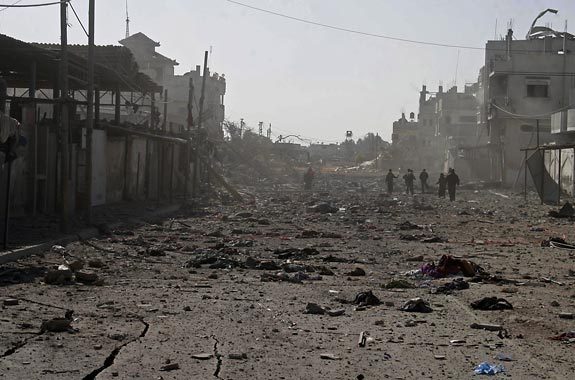
Palestinians walk in the rubble following an Israeli airstrike Wednesday in Rafah refugee camp in the southern Gaza Strip. Photo by Khaled Omar, The Associated Press.

Why did Israel start this War?
by Amr al-Azm, Brigham Young University

There are several answers to this question depending on which angle you look at it from.

The facts on the ground (Time Line) run as follows:

June 19 – An Egyptian brokered truce begins between Hamas and Israel. It calls for Hamas to stop cross-border rocket fire and for Israel to gradually ease its embargo on Gaza.

July 27: Israel kills Shihab al-Natsheh, a senior Hamas fighter, in his house in the West Bank city of Al-Khalil. Hamas protests action and Israel claims that the West Bank is not covered by the ceasefire.

November 5: Israel raids supposed smuggling tunnels in the Hamas-controlled region. Six Palestinians killed in the attack. Hamas responds by firing several dozen rockets and mortar shells at western Negev in Israel in retaliation. No casualties or property damage is caused, but three women are treated for shock. Continue reading Reflections on Gaza

Occupying more than our minds

American minds these days are occupied with the financial crisis. The increasingly distant Iraq War, ever expanding military muscle in Afghanistan and recent loss of life and massive destruction in Gaza have been knocked off the front page and main story of daily newscasts. Problematic as the economy worldwide is, we will survive. It is not wealth that has disappeared, nor the ability to make money, but confidence in a system that by its very nature rewards with one hand and takes away with the other. As in economics, so in politics, it seems. And “occupation” is the main problem. In a short interview on FORA TV, Dr. Abdul Mawgoud Dardery (Assistant Professor of Cultural Studies and Critical Discourse at South Valley University, Egypt) brings this point into focus. Of course occupation has been the rule of history with “to the victor go the spoils” a mantra of civilization’s domination of those not considered sufficiently civilized. But unless the occupier empties the land of those already occupying it, as all the American continents’ countries have attempted to do, problems necessarily remain. In fancy we think of getting along with others as a melting pot; for much of the Middle East it has been more of a smelting and pelting pot … and the beating goes on.

Daniel Martin Varisco