Category Archives: Terrorism Issue

Islam and the Power of Kindness

[Note: The following excerpt by a Muslim intellectual is perhaps the best antidote for the ongoing violence of mosque bombings, Taliban and Basij brutality towards Muslim women and vitriolic sermons.]

Islamic Perspectives of Inter-Community Relations

by Maulvi Yahya Nomani (Translated from Urdu by Yoginder Sikand) TwoCircles.net

The issue of what Islam has to say about inter-community relations is one about which much misunderstanding exists. Anti-Muslim propagandists claim that Islam preaches hatred for non-Muslims, and that the Quran is a menace to world peace. They go so far as to argue that world peace is simply impossible as long as the Quran exists. In order to back their propaganda, they have deliberately twisted and misinterpreted certain verses of the Quran. Many people with little knowledge have fallen prey to this poisonous propaganda, which has been aggressively spread on an enormous scale through the media. Continue reading Islam and the Power of Kindness
Iran Twitters at the Brink


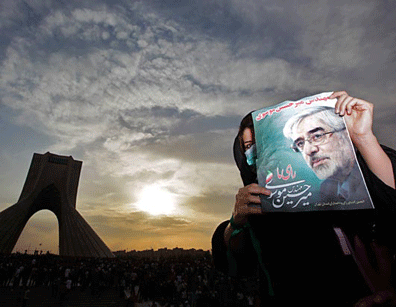
A female demonstrator holds up a poster of leading opposition presidential candidate Mir Hossein Mousavi, who claims there was voting fraud in Friday’s election, as she and hundreds of thousands of others turn out to protest the result of the election at a mass rally in Azadi (Freedom) square in Tehran, Iran, Monday, June 15, 2009.
(Ben Curtis/AP Photo)

Extraordinary scenes: Robert Fisk in Iran

ABC News, June 16, 2009

The long-standing Middle East correspondent for The Independent, Robert Fisk, is defying the government crackdown on foreign media reporting in Iran.

As he explains, he has been travelling around the streets of Tehran all day and most of the night and things are far from quiet:

I’ve just been witnessing a confrontation, in dusk and into the night, between about 15,000 supporters of Ahmadinejad – supposedly the president of Iran – who are desperate to down the supporters of Mr Mousavi, who thinks he should be the president of Iran.

There were about 10,000 Mousavi men and women on the streets, with approximately 500 Iranian special forces, trying to keep them apart. Continue reading Iran Twitters at the Brink

No Honor among Election thieves

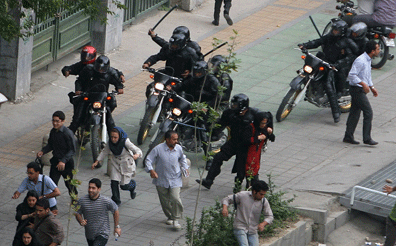
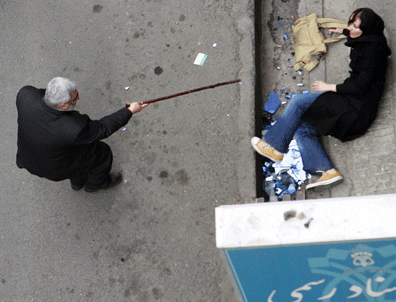
The instant forms of communication that cyberspace creates may spell the demise of rule by dictatorship. Had there been no email, youtube or twitter, the events unfolding in Iran after the rigged election of Ahmadinejad would largely go unnoticed. But instead the brutality of the police and armed vigilantes against ordinary Iranians are being seen around the world. There is a gallery of images, some quite graphic, compiled by the Boston Herald. Whatever the ruling mullahs decide, the deep divisions within Iranian society are exposed to the world. The Islamic Republic is now more clearly seen as an Islamic Dictatorship, increasingly out of touch with the youth and educated members of the society.

Consider the two pictures here of men taunting and manhandling Iranian women. It goes to show that in Iran there is no honor among election thieves. Has anyone stopped to ask: WWMD (What would Muhammad do?)

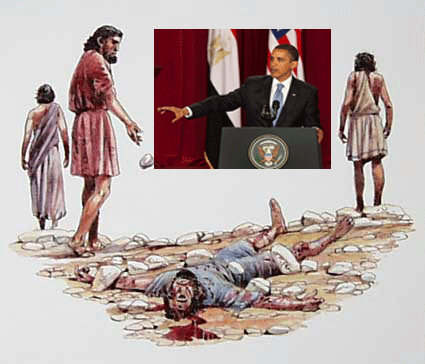
On God and Obama: When Wright is Wrong

A new book with the promising but pathetically journalistic title The Evolution of God has just appeared with media fanfare. The fanfare I have seen thus far is an op ed piece and a Time Magazine article by the author, Robert Wright. In both the author’s lack of knowledge brands the work fiction from the start. Let’s start with the Time Magazine article, which is entitled “Decoding God’s Changing Moods.” As a veteran journalist, Wright knows that Bible codes sell well, even though there is nothing to decode in his supposed code. Continue reading On God and Obama: When Wright is Wrong

AhmadineBush

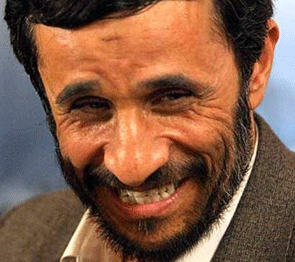
Color Iran today in black; it is not yet ready for a greening. The smiling face of Mahmoud Ahmadinejad is in victory mode. What was thought would be a close election turned out to be a seeming mandate for the man who would make Iran a nuclear power. The people have spoken or have they? Critics contend that the voting was rigged, that counting was being done before the polls closed (they had been extended up to six hours in some places), that there were not enough ballots and that Ahmadinajad even beat his main challenger Moussavi in the latter’s home town of Tabriz, an unlikely scenario. No matter, the Supreme Cleric has spoken, and in Iran that is the true nature of democracy, a theocracy that tolerates a parliament.

So do not expect the recent friendly overtures of President Obama to go very far in the second term of Ahmadinejad, whose tainted victory brings to mind the Florida recount that promoted George Bush into the White House in 2000. Indeed, there is a case for renaming the returning President AhmadineBush. Continue reading AhmadineBush

Re-Writing Muslim Political History

Based in New Delhi, Maulana Waris Mazhari is a leading Indian Deobandi scholar. He is a graduate of the Dar ul-Uloom at Deoband, and is the editor of Tarjuman Dar ul-Uloom, the official organ of the Deoband Madrasa’s Graduates’ Association.

In this interview with Yoginder Sikand, Maulana Mazhari talks about his views on Islam, historiography and politics.

Q: Muslim history has generally been written in the form of a series of battles and a succession of rulers and military generals. This, in turn, has had a deep impact on the way Muslims imagine their past and their identity and on the way they relate to people of other faiths. What do you feel about this way of presenting Muslim history?

A: I have major problems with the traditional approach, including the traditional way of presenting the sirat, the history of the Prophet Muhammad, who Muslims consider as the model for all humankind. Typically, sirat-writing has taken the form of a narration of events that focus mainly on the maghazis or military confrontations and victories of the Prophet. This tradition goes back to early times. In fact, one of the first available sirat texts that we have, by Ibn Ishaq, is also known as Maghazi Ibn Ishaq. This is a reflection of how Ibn Ishaq portrayed the Prophet’s life. Ibn Ishaq was by no means an isolated case. In fact, many other sirat writers followed in that mode, and still continue to do so. Continue reading Re-Writing Muslim Political History

Islam and Contemporary Issues

By Asghar Ali Engineer, April, 2009

A few days ago I was invited to speak in a Prophet Day’s function. There were other speakers as well. As usual the speakers before me indulged in rhetoric ‘Islam is the solution’ and also said the world economy has failed and slowed down as it is based on gambling and interest. Another person said Islam declared human rights 14 hundred years ago whereas UNO declared it only sixty years ago. Yet another speaker said Islam has given equal rights to women and made it obligatory for them to seek education. Also it was emphasized that Islam is religion of peace.

All this provoked me to say all this is true and I can add much more to it but have we ever seriously reflected why Islamic world is in such turmoil today. Why Muslims have totally failed to adopt these teachings in practice. I said if one caste a critical glance at Islamic world today one finds exactly opposite of what Qur’an teaches. If Qur’an lays great emphasis on knowledge, Islamic world from Indonesia to Algeria has more illiterates than any other community. Continue reading Islam and Contemporary Issues

God, the Devil and Pakistan


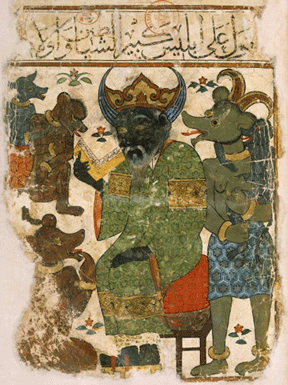
Iblis (the Devil) from The Book of Nativities (Kitâb al-Mawalid) by Abû Ma’shar, 15th Century.

by Suroosh Irfani, Daily Times (Pakistan), May 7, 2009

Jewish denial during the war is perilously instructive for Pakistan today: a country where the founding spirit of justice and democracy is blighted by falsehood and fear. Small wonder that last month, Prime Minister Gilani virtually ignored the seditious speech of Sufi Muhammad.

Noted Saudi novelist Turki al Hamad’s novel, Kharadib, has sold over 20,000 copies in the Arab world since publication in 1999. Al Hamad continues to live in the Saudi capital Riyadh, despite fatwas of Saudi clerics against him, and Al Qaeda branding him an apostate.

The reason? Hamad’s teenaged protagonist in the controversial novel dares to ponder the question of God and the devil.

King Abdullah, then the Crown Prince, reportedly offered Hamad bodyguards for his protection, while reputed Saudi scholar Sheikh Ali al Khudair, who initially censured Hamad, withdrew his fatwa in 2003.

The retraction suggests that the musings of Hamad’s protagonist on “religion, sex and politics, the three taboos in Saudi society” had triggered a rethink on an issue that Muslim luminaries like Jalaluddin Rumi (d.1273) had addressed, long before German writer Goethe cast the devil in new light in his epic poem Faust in the 19th century.

However, it remained for Allama Iqbal’s genius to bring together Goethe and Rumi in a discourse on the devil, burnishing wisdom of the past with his own insights on evil. The upshot of it all is a realisation that “evil is not mere darkness that vanishes when light arrives. This darkness has as positive an existence as light,” as Javed Iqbal, former Chief Justice of Lahore High Court, notes in “Devil in the triangle of Rumi, Iqbal and Goethe” in Iqbal Review. Continue reading God, the Devil and Pakistan