Category Archives: Terrorism Issue

Mr. Peabody and Sherman Rewrite Middle East Policy

For those of us who grew up on the Rocky and Bullwinkle show, Mr. Peabody and his not-so-bright sidekick Sherman taught us the “real” story behind history. Mr Peabody has long since retired and I suspect Sherman is still working on his B.A. somewhere, but a new episode has appeared that explains how we got into the mess in Iraq. If, as Napoleon is credited with saying, history is a pack of lies agreed upon, one might as well agree with this as with the multiple official versions.

Check it out on Youtube.

More than just (a) war


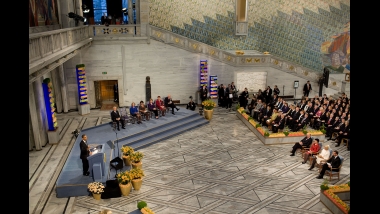
President Obama speaking to the Nobel Prize Committee

As the season has arrived in which “Peace on Earth” fills the airwaves and resonates from church choirs, the recent choice of President Obama for the Nobel Peace Prize becomes ironic as well as iconic. The icon is obvious, as no president since John F. Kennedy has elicited such fanfare at his entry into office. As the chairman of the Nobel committee, Thorbjorn Jagland, introduced President Obama, it was clear that in part the real choice was the man who pledged to reverse the isolationist and publicly entrenched private sectoring of George W. Bush. Had our previous president not been the bearer of two made-for-Hollywood wars in the guise of a nebulous “War on Terror,” Obama would have had to wait his turn. The irony is manifold. American dissatisfaction with the costly war in Iraq led to a political surge for the Democrats for a change; the man who pledged to end the war mongering is still saddled with the two wars he did not start. On the home front, the financial tsunami he inherited now tarnishes virtually every attempt to pull the economy out of its cross-the-boards harm from the combustable engine of Wall Street to the reckless drivers on Main Street.

The liberals and centrists who voted to give hope a chance have all too soon decided not to give it much of a chance. Those who actually prefer to call themselves liberals no doubt hoped that Obama was just politicking when he touted centrist positions to secure some of those Red State votes. But the man from Illinois, who kicked off his run with the symbolic capital of an earlier president-to-be from Illinois, is decidedly centrist, the mad ravings of vanity pouting Glenn Beck and publicity whoring Sarah Palin notwithstanding. If you want to probe the postmodern meaning of irony, just listen to what President Obama said about war in being honored as a man of peace: Continue reading More than just (a) war

Swiss Minaretxia


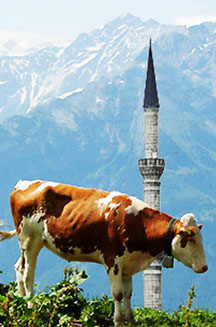
Cows will no longer give milk in Switzerland if minarets are allowed to stand.

The rightwing political parties in Switzerland are up in arms, preparing for a vote on Sunday to save their alpine paradise from the dreaded cultural eyesore of mosque minarets. This proposed ban on minarets comes from the same friendly yodelers in the nationalist Swiss People’s Party that has previously campaigned against foreigners, including a proposal to kick out entire families of foreigners if one of their children breaks a law and a bid to subject citizenship applications to a popular vote. But they have the pure white chocolate science to back up their campaign this time. It is now evident from a pretentious hypothetical analysis that purebred Swiss cows refuse to give milk, even 1 percent, when they see a minaret. This spells the end of Swiss milk chocolate, a loss that would udderly ruin the Swiss economy, not to mention the sense of shame the bovine residents of the country would feel.

Save Switzerland for the pure Swiss, those wily Swiss Bankers who for decades have allowed brutal dictators to launder their money in untouchable Swiss bank accounts. Continue reading Swiss Minaretxia

Going (after) Muslim


A picture making the news rounds of Major Hasan on the day of the shootings.

[Note: I have just published a commentary on a commentary in Forbes Magazine in which Major Nidal Hasan is said to have “gone postal” in his frenzy. This is published on Religion Dispatches. I excerpt the first couple of paragraphs here, but please go to the Religion Dispatches site, where you can post comments as well.]

If the media frenzy over the Fort Hood killings is any gauge, the ugly specter of 9/11 has again taken its psychological toll. This time, instead of the “bad Muslim” being a bearded terrorist called bin Laden, there is a US Army psychologist who was trained to be a healer of military personnel. He happens to have an Arabic ancestry and is Muslim.

Prominent American Muslim organizations issued statements right away condemning the murders. Debate in the media is now focused on his motivation. Was he a fifth-columnist wolf in military dress? Did his sympathies for innocent victims in our ongoing wars in Iraq and Afghanistan overwhelm his common sense of decency? Should the FBI and security arms of the US military have pounced on him when they uncovered his initial links to a radical imam?

One result that I have noticed among those who study Islam, especially my Muslim colleagues, is a growing fault line over the dubious “good Muslim/bad Muslim” binary. As Mahmood Mamdani has eloquently argued, the choice is not between good and bad individuals or citizens, but about being Muslim. Major Hasan is a man who looked very much like a “good Muslim”: a military officer providing therapy to returning veterans. But, now, it seems that at some tipping point he became the “bad Muslim,” the kind who places mosque above state.

For the rest of this commentary, click here.

Daniel Martin Varisco

Contesting Islamism

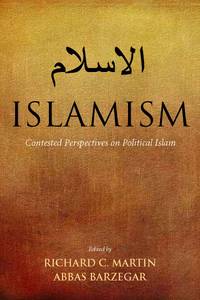
Stanford University Press has just published Islamism: Contested Perspectives on Political Islam, edited by Richard C. Martin and Abbas Barzegar. In this book Political Scientist Donald Emmerson argues for an inclusive use of the term “Islamism” in order to rescue the term from its misappropriation in the media. This is followed by my essay, in which I argue that the term “Islamism” is as tainted as “Mohammedanism” and should be avoided as a replacement for fundamentalist and political Islam. Our two essays are followed by twelve short responses from a variety of perspectives, Muslim and non-Muslim. The contributors include Feisal Abdul Rauf, Syed Farid Alatas, Hillel Fradkin, Graham Fuller, Hasan Hanafi, Amir Hussain, Ziba Mir-Hosseini and Richard Tapper, M. Zuhdi Jasser, Bruce Lawrence, Anouar Majid, Angel Rebasa and Nadia Yassine. Given the range of perspectives on one of the hot topics of the day, this volume will be a great addition to courses on Islam or the Middle East.

The publisher’s description is presented below: Continue reading Contesting Islamism

The Sixth War

by Gregory D Johnsen, The National, November 12, 2009

Last week, the sporadic five-year long war between the Yemeni government and Houthi fighters in the country’s north finally spilled over the border into Saudi Arabia. The conflict has been steadily escalating since the Yemeni government resumed fighting in August after more than a year of fragile calm. Leaving no doubt as to its intentions, the government calls the present campaign “Operation Scorched Earth”: the fighting has already produced thousands of internal refugees and spread outward from the northern governorate of Sadaa, where the Houthi rebels are based.

Like much of the conflict, the clashes that began on November 4 are clouded by conflicting and contradictory reports. The Houthis claim that they were responding to repeated strikes by the Yemeni military, which was using Saudi territory as a rear base to launch flanking manoeuvres into Sadaa. Saudi Arabia contends that it was responding to incursions by the Yemeni rebels, and both sides insist that the other fired the first shots.

But whatever the sequence of events, the skirmishes mark a major escalation in the messy and murky guerrilla war that has only become more intense – and drawn in an increasing number of players – since its start in 2004. The Saudis deployed troops to their southern border, where they launched air and ground assaults on pockets of Houthi fighters, purportedly to drive them back into Yemen. The intervention was meant to be a limited one – and the Saudis claim they only attacked positions on their side of the border – but it is doubtful, having joined the fray, that they will be able to extricate themselves easily. Continue reading The Sixth War

Tarim Journal


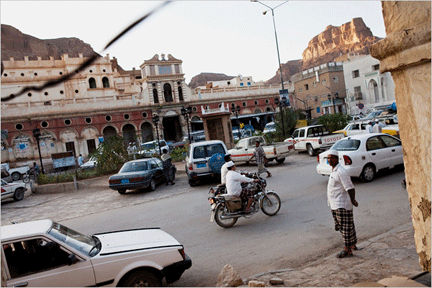
Tarim, a remote desert valley in Yemen with towering bluffs and ancient mud-brick houses, is probably best known to outsiders as the birthplace of Osama bin Laden’s father. Photo: Bryan Denton

Tarim Journal
Crossroads of Islam, Past and Present

By ROBERT F. WORTH, The New York Times, October 15, 2009

TARIM, Yemen — This remote desert valley, with its towering bluffs and ancient mud-brick houses, is probably best known to outsiders as the birthplace of Osama bin Laden’s father. Most accounts about Yemen in the Western news media refer ominously to it as “the ancestral homeland” of the leader of Al Qaeda, as though his murderous ideology had somehow been shaped here.

But in fact, Tarim and its environs are a historic center of Sufism, a mystical strand within Islam. The local religious school, Dar al-Mustafa, is a multicultural place full of students from Indonesia and California who stroll around its tiny campus wearing white skullcaps and colorful shawls.

“The reality is that Osama bin Laden has never been to Yemen,” said Habib Omar, the revered director of Dar al-Mustafa, as he sat on the floor in his home eating dinner with a group of students. “His thinking has nothing to do with this place.”

Lately, Al Qaeda has found a new sanctuary here and carried out a number of attacks. But the group’s inspiration, Mr. Omar said, did not originate here. Most of the group’s adherents have lived in Saudi Arabia — as has Mr. bin Laden — and it was there, or in Afghanistan or Pakistan, that they adopted a jihadist mind-set. Continue reading Tarim Journal

Picturing the Displaced in Yemen


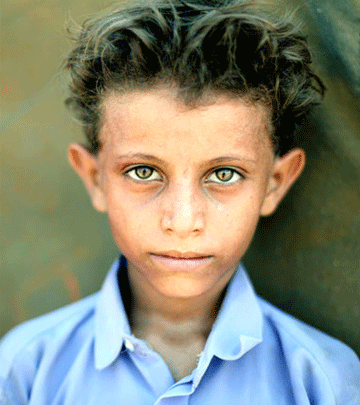
A boy who fled fighting between militants and government forces in a refugee camp near the town of Hadja, north west Yemen. Photo by David Bebber, The Times

Photographer David Bebber has produced a superb slide show in The Times on Yemenis, especially children, displaced by recent fighting in the north of Yemen between government forces and the al-Huthi rebels. To see a slide show of the 19 images, click here.


Photo by David Bebber, The Times