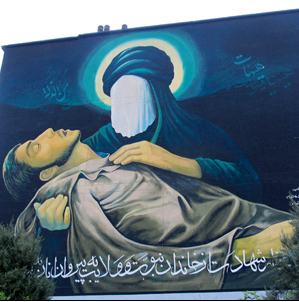
Martyrdom is the inheritance of the Prophet and his family to their followers (translated title). Three-storey high mural located on Mudarris Freeway, Abbas-Abad, Tehran, Iran, Fotini Christia, photographer.
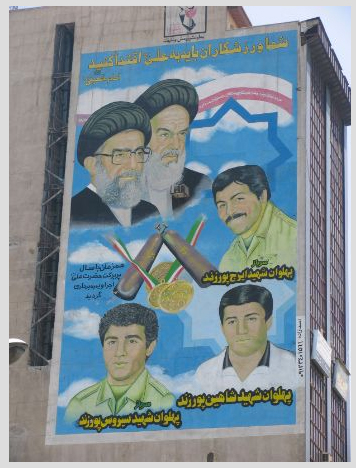
“You athletes should follow Ali (peace be upon him)”, Fotini Christia, photographer,
Death at the mosque
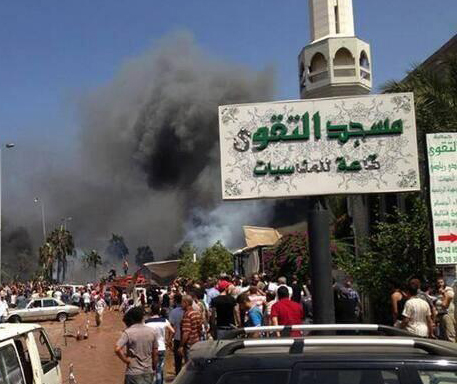
Blast at al-Taqwa Mosque in Tripoli, Lebanon
The mosque in Islam is known as a place of prayer. Since the very inception of Islam it has also been a place of death, indeed murder. It is reported that Ali, the cousin and son-in-law of Muhammad, was killed as he was praying in the Great Mosque of Kufa in Iraq by a fellow Muslim. Today in Tripoli, Lebanon, explosions at two mosques killed at least 27 people and injured hundreds. One of the blasts occurred near the al-Taqwa Mosque, where a Salafi preacher was praying, in the Abu Ali Square as those attending were leaving following Friday afternoon prayers. Another blast hit the al-Salam Mosque in the center of Tripoli. The reason? Yet another repeat of the intra-Islamophobia of one group of Muslims politically opposed to another group of Muslims.
When Ali was hit with a poisonous sword blade, he urged his sons and followers not to seek revenge on the Kharijites, the group to which the man who attacked him belonged, but to the man himself. But Ali was a better man than his followers. It seems that the attack on the Sunni mosque was tit-for-tat for the blast earlier this month in southern Beirut in the stronghold of Hezbullah. And the cycle continues, not only here, but in Iraq where it is almost a daily occurrence this summer.
There is a twisted logic here, the notion that someone who is clearly of the same religion is also someone that can be mercilessly slaughtered at prayer. Is there no one who will pray for peace and who will set aside political partisanship to work for peace? Continue reading Death at the mosque
Hezbullies
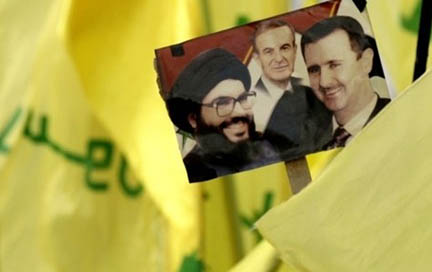
ebanese Hezbollah supporters hold a picture of Hezbollah leader Hassan Nasrallah (L), Syrian President Bashar al-Assad (R) and his late father President Hafez al-Assad (C) in Bint Jbeil on September 22, 2012 (AFP)
[This post was first written a month ago and recently published in Middle East Muddle on Anthropology News.]
The bullet and bomb-blast battle of the bullies is raging in Syria. The biggest bully is Bashar al-Asad, son of Hafez al-Asad who in February, 1982, sent his troops into the city of Homs and slaughtered between 10,000-40,000 civilians who dared to oppose his dictatorial rule. Hafez has slain his thousands, Bashar his tens of thousands. One estimate, reported by Reuters, estimates that between 94,000 and 120,000 Syrians have died in the wake of the Arab Spring that toppled other long-standing dictator regimes. Over a million and half Syrians are refugees who have fled the fighting to neighboring countries, where many do not find even the most basic humanitarian aid. Millions within Syria are in desperate shape, victimized by all sides. But the bully of Damascus hangs on, with Russian backing and Iranian duplicity.
There are other bullies in this fight, from a small faction of radical Muslims intent on reinstalling a caliphate where the Umayyads once ruled to seemingly secular-minded opponents of Asad’s brutal policies. And recently a new bully has arrived, the Hezbollah Hezbullies who control southern Lebanon and thrive as a thorn in the side of Israel. Israel, thus far, has mainly watched from the sidelines, no doubt content to see a bloodbath not directed at them. There was a sharp military response a couple of weeks ago to what appeared to be stockpiles of weapons from Iran on the Damascus road to Hezbollah. Continue reading Hezbullies
Hezbollah and Bashar: Another Unholy Alliance
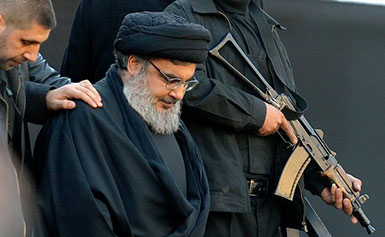
Hezbollah leader Hassan Nasrallah; Photograph by Wael Hamzeh/European Pressphoto Agency
My friend Omid Safi has created a provocative blog entitled What Would Muhammad do? Today I would like to ratchet up the commentary game to an approach which may, at first glance, seem sacrilegious. Given that the Lebanese “Party of God” (Hezbollah) is now known to be sending its fighters to support the Syrian dictator Bashar al-Asad, it is time to ask “What Would Allah do?” As much as I admire the spiritual sentiment of the crucified mystic al-Hallaj, I am not advocating oneness with the Supreme Being. But if I were to try and imagine what Allah would say about the current trials besetting his umma, I think I might begin by insisting that those who spread messages of hate and turn jihad into an excuse for political gain stop using my name. The Shi’a at least had the common decency to call themselves shi’at Ali, rather than presume from the start that they exclusively spoke for me. If these partisans of the hundreds of sects that have evolved since the Prophet Muhammad received the Quran want to hear me, they should stop selecting isolated verses from my message for their own agendas. Submission to Allah is the message of Islam, not submission to any party claiming to be Allah’s party.
Muslims should remember the history not only of their faith, but also the religions founded by other of my prophets. Jews and Christians are not infidels; their lives are as precious to Allah as those of Muslims. Muhammad was sent as the “seal” of the prophets, not to brag that he was superior to my other prophets. Each prophet was sent for a specific purpose, to guide people at different times in history. Muhammad received the Quran not so everyone after that could stop time and live as though it was still 7th century Mecca and Medina. Look at his life and you will see that he was a mediator, who preached salam and knew full well that the greater jihad took place within the individual. Jews and Christians heard from their prophets that humans are not divine, not perfect, and easily seduced to go astray. But Moses gave commandments to run society, Jesus showed the power of love to conquer hatred and Muhammad was a living example of how to live, but not an icon to follow blindly because of the recorded faulty memories of his companions. Continue reading Hezbollah and Bashar: Another Unholy Alliance
Tom Friedman (not Tom Sawyer) Abroad in Yemen
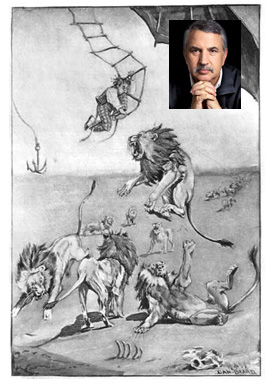
Background image is Daniel Beard illustration for the 1899 edition of Mark Twain’s Tom Sawyer Abroad
The well traveled journalist Thomas Friedman has popped up in Yemen, but apparently he has yet to find out that no one in Yemen drives a Lexus and Yemenis do not grow olive trees. Friedman has won many awards for his hot-air balloon reporting of events in the Middle East. He reminds me of Mark Twain’s Tom Sawyer Abroad, where the American boy hero gets a birds-eye view of Egypt and Palestine without ever escaping being mere “innocents abroad.”
Still, a postcard from Yemen via the New York Times op-ed page, by such a renowned journalist deserves a reading. As usual the journalist himself is one of the main attractions, including starting the very first sentence with an “I” to his own presence. I am not a fan of Friedman’s reportage, even when he claims some kind of inside knowledge about a place in the Middle East, but I do appreciate that two very important points are highlighted in his article: Yemen’s water crisis is a greater threat to instability than any political act and Yemen is poised to “have the best chance to start over – now – if they seize it.” I would only add this: if Saudi Arabia, the Gulf States and the U.S. do not keep the Yemenis from seizing and sustaining control of their own future.
Like Friedman, I have long known that Yemen is “a country of breathtaking beauty, with wonderful people” and, yes, it has become a “human development disaster.” But I would not explain this disaster away as simply due to “political mismanagement” by a string of military dictators. The United Nations, the World Bank, the United States, Britain, France, The Netherlands, Japan, China and a rather long list of foreign aid donors have pumped millions upon millions of dollars into a system without achieving any sustainable results. Saudi money has bankrolled the Ministry of Education, introducing a conservative Salafi brand of Islam that is overtly political. Yemeni workers have been treated like slum bums by the Saudis and Gulfies who hire and fire them at will. While Friedman is right to stress that the environmental and economic crisis created by the critical shortage of water, especially for domestic use in cities, is the major problem being faced, it is not “just about water” by any means. The heavens and fountains of the deep could open tomorrow and the mix of old and new ideologies (most coming from outside Yemen) would blossom like spring flowers after a desert rain. Continue reading Tom Friedman (not Tom Sawyer) Abroad in Yemen
Sanaa Book Republished
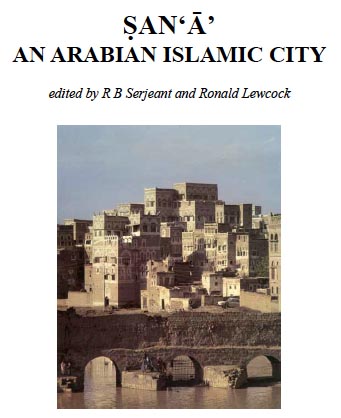
One of the most important volumes for anyone interested in Yemen is San’a’ An Arabian Islamic City, edited by R. B. Serjeant and R. Lewcock for the World of Islam Festival Trust in 1983. Long out-of-print, it is now being brought back into print. And there is a discount, if ordered before April 30, 2013.
The published price is £85.00 but the book is being offered at a pre-publication price of £50.00 until 30th of April 2013, quote SP13 to receive this offer.
For details, contact:
Vicki Coombs
Melisende UK Ltd
G8 Allen House
The Maltings, Station Road
Sawbridgeworth
Herts. CM21 9JX
+44 (0)1279 721398
www.melisende.com
The Cost of the Syrian Uprising: Shaykh Al-Bouti
For an interesting article on the death of the Syrian religious scholar Muhammad Sa’id Ramadan al-Bouti, see the article by by H.A. Hellyer at Tahrir Squared.
To kiss or not to kiss: Iranian style
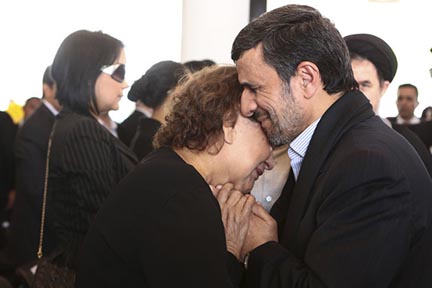
A controversial tempest in a samovar erupted last week when Iran’s President Ahmadenijad appeared to kiss the grieving mother of Hugo Chavez at the state funeral for the Venezuelan leader. The lips do touch the face of Chavez’s mother, but the context suggests an embrace of consolation rather than anything untoward. To the extent this innate human reaction of sympathy is something to be forbidden as unIslamic, religion becomes a mockery. The Muhammad presented in the Sira was a man of compassion. I suspect he would not approve of those who take the charge of modesty to such an extreme as to deny the most basic of positive human instincts.
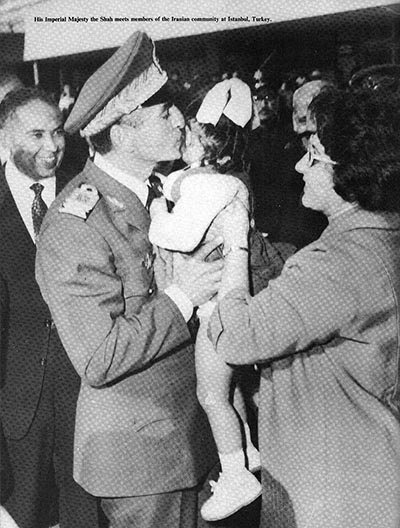
But the controversy over this alleged “kiss” reminded me of an image from a different time in Iran. I have a booklet (Iran Today) issued by the Imperial Iranian Government in the early 1960s, when Lyndon Johnson was still vice-president. This is pure propaganda for the then-young Shah’s Iran. Opposite the Table of Contents, and thus the first image in the booklet, is a full-page spread with the caption: “His Imperial Majesty the Shah meets members of the Iranian community in Istanbul, Turkey.” You will note that this image is the classic politician baby kissing. Obviously, this was seen as a positive side of the ruler who loves his people. What a difference half a century makes in the interpretation of a kiss.
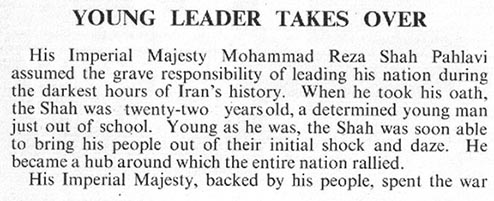
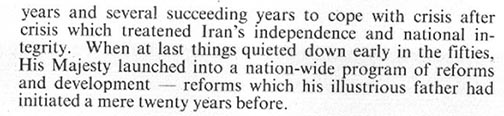
The propaganda aspect of the booklet is most evident in the unflinching praise for the Shah, as can be seen below:
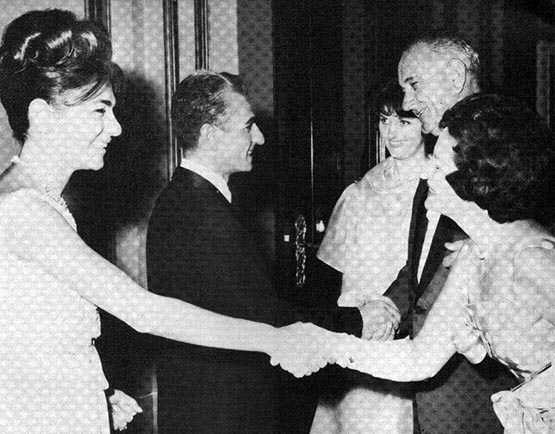 “Their Imperial Majesties the Shah and Queen Farah greet distinguished guests from the United States: Vice President and Mrs. Lyndon Johnson and their daughter, who visited Iran last summer.