Category Archives: Islamic Sects

Yemen: Fighting in North Hampers Humanitarian Work


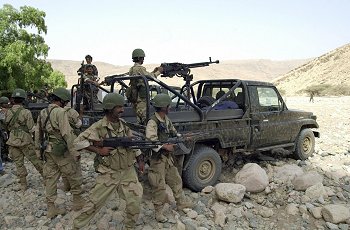
Yemeni soldiers patrolling in Saada, 150 miles north of the capital, Sana’a. A Yemeni Member of Parliament accused of being a leader of a deadly three-year uprising by the Zaidi minority in the northern mountains warned in remarks published on Feb. 25 that rebels might widen their campaign. (Photo: Khaled Fazaa / AFP-Getty Images)

Integrated Regional Information Networks, United Nations, May 6, 2007

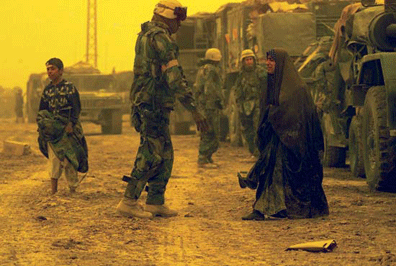
The I.C.R.C. and Red Crescent came under attack in the Saada region of northern Yemen. (Photo: Afif Sarhan / IRIN)

A humanitarian aid convoy of the International Committee of the Red Cross (I.C.R.C.) and the Yemen Red Crescent Society came under heavy gunfire on May 2 in the governorate of Saada, north Yemen, the I.C.R.C. has reported.

The incident took place in al-Saifi area, 18 kilometers north of Saada city.

Fighting between government forces and followers of rebel leader Abdul-Malik al-Houthi in Saada governorate is still going on, causing thousands of people to leave their homes, said aid workers. Continue reading Yemen: Fighting in North Hampers Humanitarian Work
Sanaa’s Grand Mosque stands for 1400 years

by Mohammed al-Qiri, Yemen Observer, April 8, 2008

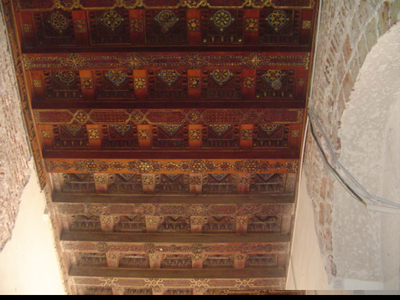
The Grand Mosque of Sana’a is considered to be the oldest in the Islamic world. It was built by order of the Prophet Mohamed (PBUH) in the sixth Hijri year, corresponding to 627 C.E.. It is located in the Bathan garden, between Ghamdan palace and the Malmlamah rock.

Over the course of history, there have been many additions made to the original building. The mosque was extended in the eighth century by the Amawi Khalif al-Walid ibn Abdulmalik (705- 715 C.E.) and at the beginning of the Abasi dynasty in the eighth century C.E., doors were added by Governor Omar ibn Abdulmajeed al-A’dawi, in addition to other overhauls in 745 C.E under his watch. Continue reading Sanaa’s Grand Mosque stands for 1400 years

Open season on Egypt’s opposition, but Islam is not the solution

By Andrea Teti, Department of Politics and International Relations, University of Aberdeen

Following a wave of strikes and an equally spectacular tsunami of price increases in a range of essential goods over recent months, the April 8th local elections seemed for a brief moment to have become a focus for Egypt’s diverse opposition. A few days before a general strike proclaimed for April 6th, the coalition for democratic change Kifaya! (Enough!) published a statement saying it expected the Muslim Brotherhood’s active support. In the event, the Brotherhood defended Kifaya!’s right to strike, but did not participate in it. Then, following a wave of pre-election arrests and dirty tricks by the ruling National Democratic Party – resulting in a mere 21 MB candidates making it onto ballots out of the 5,754 put forward – the MB declared the elections beyond repair, and boycotted them. The NDP’s electoral victory (97% of posts) was as striking as the estimated 5% voter participation rate. Continue reading Open season on Egypt’s opposition, but Islam is not the solution

Tolerance takes a hit in Indonesia

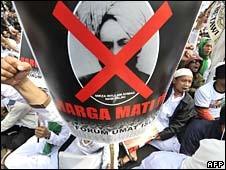
Among Muslim majority states, Indonesia has a reputation for being one of the more tolerant, given the variety of religious persuasions in this multi-island nation. But recently there has been a flare up against the Ahmadiyya order. As reported on the BBC, the government of Indonesia is considering a ban on the Ahmadiyya:

About 2,000 people have gathered in the Indonesian capital, Jakarta, to protest against a minority Muslim sect, the Ahmadiyya community.

Speakers outside the presidential palace demanded the group be banned.

That was what a government panel recommended last week, saying the Ahmadiyya’s beliefs went against Islam as practised in Indonesia.

But the Ahmadiyya argue that, like other minorities, they are protected under the Indonesian constitution.

The Ahmadis believe their own founder, Mirza Ghulam Ahmad, who died in 1908 in India, was a prophet.

That contradicts the belief of most Muslims, who think the Prophet Muhammad was the last prophet.

The Ahmadiyya face persecution in many countries.

Less than a month ago, an Ahmadiyya mosque was destroyed by protesters, as can be seen in video. This is not a new situation, as persecution of Ahmadiyya has previously been reported for Indonesia.

Human Rights Watch has called on the Indonesia government not to issue the ban on the Ahmadiyya, a ban which would contradict the state’s constitution on religious liberty. For a pro-Ahmadiyya view of the situation, click here.

Human rights violations in the name of religion

by Wazhma Frogh, from Persian Mirror

As the world is witness of Afghanistan stepping into development and rehabilitation phase, but experiences have revealed that no country can ever develop without a sound base for human rights issues. Afghans are suffering from a very harsh situation and human values are worthless in many parts of the region. As I am a researcher on women issues in Afghanistan and I travel frequently to different parts of the region to find out the living circumstances of women.

Some three months before I has a visit to an eastern south province of Afghanistan and observed the situation of women and children, their rights have been massacred entirely under the shadow of ignorance those who call themselves Muslims. In this province, in every 10 families , 9 of them have sold their daughters at a value equivalent to 300 US $. Continue reading Human rights violations in the name of religion

Who’s a Muslim Heretic?


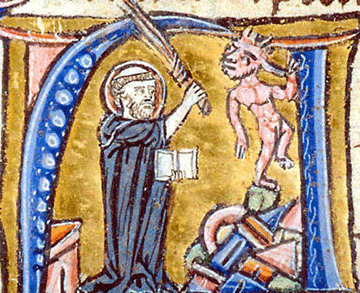
“Augustine of Hippo Refuting Heretic,” (Illuminated manuscript, thirteenth century, from Morgan Library, New York, M. 92, ©Morgan Library)

The history of Islam, like that of any religion, is littered with heretics. When you start with a divine revelation, revealed only in an Arabic dialect understandable to a seventh century illiterate Prophet alone in a cave with an archangel, add a cult of personality adoration for this Prophet and then acknowledge a cycle of violence and assassinations within the emerging Muslim community, heresy is inevitable. So who were the heretics over the fourteen centuries of the Islamic ummah? In a sense, everybody. Certainly every single sect calling itself Muslim has been attacked by some other sect. It is not just the majority Sunni vs. the marginalized Shi’a, nor the rational Mutazilites vs. the hardline literalists, nor the Arabs vs. the non-Arab converts, nor the trained clerics vs. the itinerant dervishes, nor simply the women-can’t drive Wahhabis of Saudi Arabia, the Buddha-bashing Taliban or those brave souls who pursue Queer Jihad. Simply put, the heretic is the person who does not take your truth as his or her own. Continue reading Who’s a Muslim Heretic?

Ahmadinejad and the Twelfth Imam

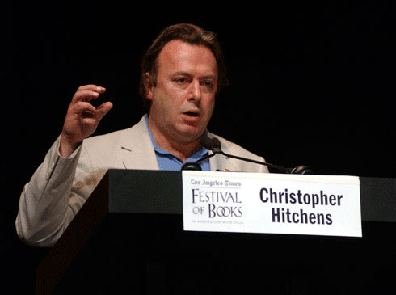
by Christopher Hitchens

[Excerpt from Christopher Hitchens, god is not Great (New York: Hachette, 2007), pp. 278-280.]

On a certain day in the spring of 2006, President Ahmadinejad of Iran, accompanied by his cabinet, made a procession to the site of a well between the capital city of Tehran and the holy city of Qum. This is said to be the cistern where the Twelfth or “occulted” or “hidden” Imam took refuge in the year 873, at the age of five, never to be seen again until his long-awaited and beseeched reappearance will astonish and redeem the world. On arrival, Ahmadinejad took a scroll of paper and thrust it down the aperture, so as to update the occulted one on Iran’s progress in thermonuclear fission and the enrichment of uranium. One might have thought that the imam could keep abreast of these developments wherever he was, but it had in some way to be the well that acted as his dead-letter box. One might ad that President Ahmadinejad had recently returned from the United Nations, where he had given a speech that was much covered on both radio and television as well as viewed by a large “live” audience. On his return to Iran, however, he told his supporters that he had been suffused with a clear green light — green being the preferred color of Islam — all through his remarks, and that the emanations of this divine light had kept everybody in the General Assembly quite silent and still. Private to him as this phenomenon was — it appears to have been felt by him alone — he took it as a further sign of the immanent return of the Twelfth Imam, not to say a further endorsement of his ambition to see the Islamic Republic of Iran, sunk as it was in beggary and repression and stagnation and corruption, as nonetheless a nuclear power. But like Aquinas, he did not trust the Twelfth or “hidden” Imam to be able to scan a document unless it was put, as it were, right in front of him. Continue reading Ahmadinejad and the Twelfth Imam

The Iraq experience has laid bare the limits of raw military power

by Max Hastings, The Guardian, Monday, March 17 2008

[This article appeared in The Guardian on Monday March 17 2008 on p32 of the Comment & debate section. It was last updated at 00:05 on March 17 2008].

The Iraq war has shown how high is the pain threshold of the west. Five years after the 2003 invasion, the daily roll call of Iraqi suicide bombings, murders, firefights and body-bags has become as familiar a part of our landscape as traffic jams on the M1 and Los Angeles freeway.

The media class on both sides of the Atlantic is deeply engaged, indeed impassioned. The war is much discussed in the US presidential election campaign. But most Americans and Europeans display vastly less interest in the Middle East than in troubles closer to home – the global banking crisis foremost among them.

They have grown used to Iraq in the way they do to a chronic personal ailment. It is there. It is nasty. They wish that it would go away. But it does not inflict the sort of agonising pain that causes democracies to force urgent action upon their governments. Continue reading The Iraq experience has laid bare the limits of raw military power