Category Archives: Islamic Sects

Poster Martyrs


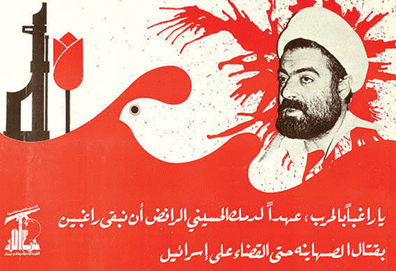
A poster commemorating the second anniversary of the assassination of Sheikh Ragheb Harb, by Merhi Merhi, 1986 (Hizballah Media Office)

by Hicham Safieddine, The Electronic Intifada, July 6

Author Christopher Hitchens might have saved himself a beating had he read Zeina Maasri’s book Off the Wall: Political Posters of the Lebanese Civil War. Hitchens, a self-proclaimed expert on all matters theological and Middle Eastern, was attacked in the streets of Beirut last February after defacing a political poster. The power of posters apparently touched Hitchens himself, who felt compelled to express his vindictiveness by attacking an image. But in a war-ravaged place like Lebanon, images can be a lot more than mere symbols. As Fawwaz Traboulsi explains in Off the Wall’s forward, they can serve as weapons, and Hitchens’ attackers must have understood that quite well.

The power of posters, as not merely symbolic weapons but also sites of hegemonic struggle during Lebanon’s civil war, is a central theme of Maasri’s book. A mix of text and image, the book is a rich and visually engaging work that tackles a dimension of war long-neglected by Lebanese historians. A sample of 150 posters (out of 700 the author has examined) in full color and printed on laminated paper occupies the center of the book and it is hard to begin reading before going through them: portraits of “heroic” leaders of all factions, clenched fists facing enemy guns, silhouettes of martyrs and landscapes of religious and nationalist symbols overlooked by dominant war figures, many marked with slogans that range from the racist to the revolutionary. But the book is a lot more than a slideshow of images summing up defining moments of the war or a straightforward critical review of the posters. Maasri delves into questions of theory, representation and meaning that shaped and defined the art of poster-making and the politics of their interpretation during times of conflict.

For the rest of this article, click here
.

God, the Devil and Pakistan


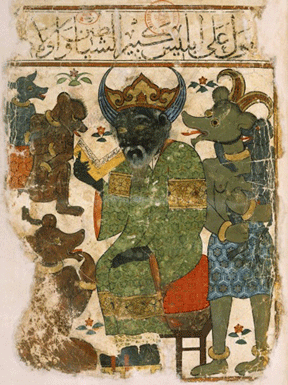
Iblis (the Devil) from The Book of Nativities (Kitâb al-Mawalid) by Abû Ma’shar, 15th Century.

by Suroosh Irfani, Daily Times (Pakistan), May 7, 2009

Jewish denial during the war is perilously instructive for Pakistan today: a country where the founding spirit of justice and democracy is blighted by falsehood and fear. Small wonder that last month, Prime Minister Gilani virtually ignored the seditious speech of Sufi Muhammad.

Noted Saudi novelist Turki al Hamad’s novel, Kharadib, has sold over 20,000 copies in the Arab world since publication in 1999. Al Hamad continues to live in the Saudi capital Riyadh, despite fatwas of Saudi clerics against him, and Al Qaeda branding him an apostate.

The reason? Hamad’s teenaged protagonist in the controversial novel dares to ponder the question of God and the devil.

King Abdullah, then the Crown Prince, reportedly offered Hamad bodyguards for his protection, while reputed Saudi scholar Sheikh Ali al Khudair, who initially censured Hamad, withdrew his fatwa in 2003.

The retraction suggests that the musings of Hamad’s protagonist on “religion, sex and politics, the three taboos in Saudi society” had triggered a rethink on an issue that Muslim luminaries like Jalaluddin Rumi (d.1273) had addressed, long before German writer Goethe cast the devil in new light in his epic poem Faust in the 19th century.

However, it remained for Allama Iqbal’s genius to bring together Goethe and Rumi in a discourse on the devil, burnishing wisdom of the past with his own insights on evil. The upshot of it all is a realisation that “evil is not mere darkness that vanishes when light arrives. This darkness has as positive an existence as light,” as Javed Iqbal, former Chief Justice of Lahore High Court, notes in “Devil in the triangle of Rumi, Iqbal and Goethe” in Iqbal Review. Continue reading God, the Devil and Pakistan

Who is the Enemy?

Wahhabism, Salafism and Islamism: Who Is The Enemy?

by Ahmad Moussalli, Conflicts Forum, January, 2009

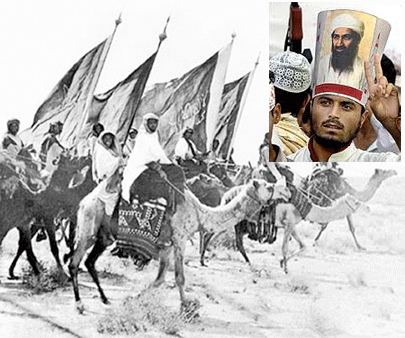
This essay constructs and deconstructs three main discourses created by different and opposing trends in modern Islamic thought that are normally and mistakenly lumped together as Islamism, fundamentalism, salafism, neo-salafism, Wahhabism, jihadism, political Islam, Islamic radicalism and others. I will compare and contrast between them by developing a typology of major ideologies of active Islamic trends that centers specifically on Wahhabism and neo-Wahhabism, salafism and neo-salafism, and Islamism, both moderate and radical. Understanding these trends and their discourses will allow world powers, policymakers, academicians, intellectuals, terrorism experts, journalists, and many others to distinguish between and understand the logic of the radical and the moderate, the active and the inactive, the jihadi and the peaceful, the takfiri and the tolerant, the modern and the traditional, and the rational and irrational. This essay will also clarify the terminology used chaotically by different policy-makers, analysts, journalists, academicians, and intellectuals. Although all Islamic trends use similar literal doctrines and concepts such as jihad, Islamic state, al-shari‘a or prophetic traditions, their connotations and discourses differ importantly from one trend to another. This makes their implications serious in action, massive in repercussions, and fundamental for understanding. Continue reading Who is the Enemy?

Blood money for Killing Yemeni Jew


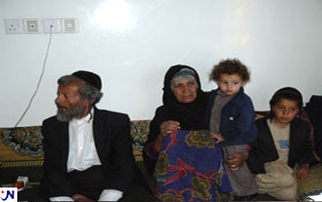
Yemeni Jews: source: Yemen Observer

by Nasser Arrabyee, Yemen Observer, March 3, 2009

A Yemeni primary court in Amran, north of the country, ruled on Monday a payment to be made of 5.5 million YR (US$ 27,500) in blood money for the murder of a Jewish man by Yemeni, Abdul Azeez al-Abdi, last December.

The court, chaired by Judge Abdul Bari Aqaba, also ordered that the convict should be placed in a psychotic sanatorium. The father of the Jew refused the sentence and asked for an appeal to be made to demand the death penalty against the convict.

“As long as there is no justice for us, then (they should) deport us to Israel, it’s better for us.” Continue reading Blood money for Killing Yemeni Jew

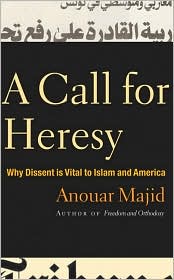
A Call for Heresy

[Note: The following excerpt is from Anouar Majid’s “A Call for Heresy: Why Dissent is Vital to Islam and America” (Minneapolis: University of Minnesota Press, 2007), pp. 1-2, 47]

by Anouar Majid, University of New England.

“A Virtuous heretic shall be saved before a wicked Christian.” Benjamin Franklin

“The atheist from his attic window is often nearer to God than the believer caught up in his own false image of God.” Martin Buber

This book is both an attempt to treat Islam over and above the confines of the familiar extremist/moderate dichotomy and an extension of my reflections on ways to divert Muslim and other cultures toward more progressive formulations. In the past I called for a progressive interpretation of Islam and its canons, urged both Muslims and Westerners to question their orthodoxies, and argued for a polycentric world of ‘neoprovincials’ questioning dogmas at home, reaching out to progressive elements in other cultures, and forging global alliances in the building of a genuinely multicultural human civilization, one in which economics are integrated into the broader aspirations of nations, not ruling over them like ruthless, insatiable deities. Here I am taking the discussion to its outer limits, calling on both Muslims (who consider their religion to be God’s final word in history) and Americans (who often think of themselves of having received a special dispensation from the Creator) to embrace heretical thought, or freethinking, as the only life-saving measure left to avoid an apocalyptic future. Continue reading A Call for Heresy

Iranian Authorities Destroy Sufi Holy Site In Isfahan

By Golnaz Esfandiari, Radio Liberty Website, February 18, 2009

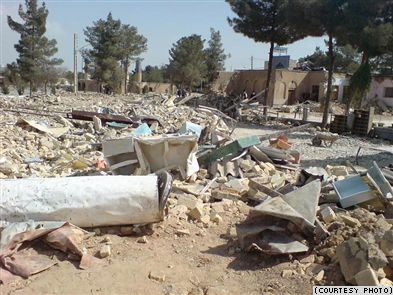
A house of worship of the Gonabadi dervishes in Isfahan has reportedly been destroyed by the Iranian authorities.

The reason for the destruction — which reportedly took place shortly after midnight on February 18 — is not clear, but it comes amid growing pressure on dervishes, who practice the Sufi tradition of Islam, and other religious minorities in Iran.

The dervish house of worship, or hosseinieh, was located next to the tomb of the great poet and dervish Naser Ali at the historical Takht-e Foulad cemetery, where a number of respected Iranian figures are buried. Continue reading Iranian Authorities Destroy Sufi Holy Site In Isfahan

Memoirs Recount Limitations Of Life In Modern Iran


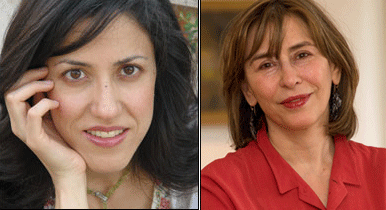
Azadeh Moaveni, left; Azar Nafisi, right

Memoirs Recount Limitations Of Life In Modern Iran

NPR, Morning Edition, February 10, 2009
Two new memoirs chronicle life in pre- and post-revolution Iran and offer a glimpse of a people struggling to find pockets of freedom within a repressive regime.

Azadeh Moaveni, a California-born journalist who lived in Iran from 1999 until 2002 and again from 2005 until 2007, is the author of Honeymoon in Tehran, in which she recounts the complexities of moving in with her boyfriend and becoming pregnant — before getting married — in a restrictive Islamic regime.

Moaveni describes modern Iran as an “as if” society, where young Iranians avoid the rules by acting as if they don’t exist and where what people do in private tends to be very different from the way they are forced to behave in public.

“For example, you have a middle class of young people who has premarital sex, drinks alcohol — behaves as young people around the world, and this is something the regime can’t do anything about because, for the most part, it all takes place behind closed doors,” Moaveni tells Morning Edition’s Rene Montaigne. Continue reading Memoirs Recount Limitations Of Life In Modern Iran

Tariq Ali, Pashtun Nationalism, and Taliban


By Naeem Wardag, Indus Asia Online Journal, December 3, 2008

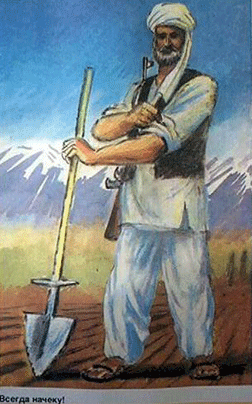
Since the Afghan War, important power quarters in Pakistan have been propagating a particular interpretation of the security situation in Afghanistan through a variety of means ranging from the vociferous propaganda of the religious right to the more subtle works and ways of the allied experts strategically deployed here and there. Joined the campaign lately have also some ideologues of the liberal left-in particular from Punjab – whose paradigm of the class-struggle fully converge with the “cosmic struggle metaphysics” of the extreme religious right at this point of time as far as their analysis of the problem is concerned. Continue reading Tariq Ali, Pashtun Nationalism, and Taliban