Category Archives: Islamic Sects

Yosef Tobi at Hofstra

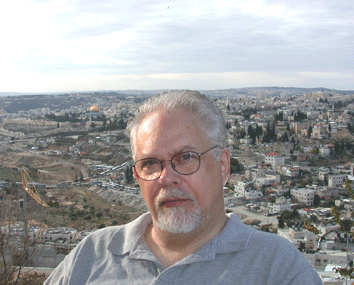
Professor Yosef Tobi of Haifa University will be presenting a talk entitled “The Legal Status of the Jews in Muslim Yemen, 897-1948” at Hofstra University on Tuesday, April 27 at 9:35 am in 201 Barnard Hall. This lecture is sponsored by the Middle Eastern and Central Asian Studies Program and the program in Jewish Studies at Hofstra. Dr. Tobi is one of the leading experts on the history of Yemenite Jews and has written several important books on the topic, including The Jews of Yemen: Studies in their History and Culture (1999).

For a review of Dr. Tobi’s The Jews of Yemen, click here.

For an article by Dr. Tobi entitled “THE CONTRIBUTION OF YEMENITE
JEWISH WRITINGS TO YEMENITE HISTORY” click here.

Ibn Taymiyya on Snake Oil

[Webshaykh’s Note: The Muslim World has made some of their articles available, perhaps only for a limited time, to non-subscribers. In the latest issue (Volume 99, Issue 1, Pages 1-20, 2009) there is an interesting article by Yahya Michot (“Between Entertainment and Religion: Ibn Taymiyya’s Views on Superstition”). I attach here a brief excerpt from the article.]

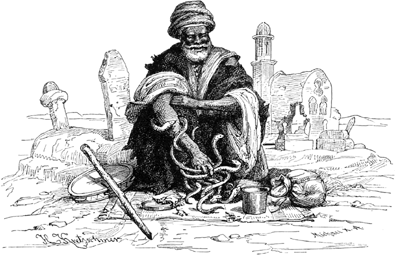
One day, Ibn Taymiyya was asked to answer the following questions in a fetwa: “Are there, in this community, virtuous persons whom God keeps absent to people’s eyes? They are only seen by those by who they want to be seen. Even if they are among people, they are, in the state which is theirs, veiled to these people’s eyes. And also, are there, on Mount Lebanon, forty men absent to the eyes of those who look there? Every time one of them dies, they take somebody else among the people, who absents himself with them just as they are absent. All those, the earth hides them. They perform the pilgrimage. They accomplish in an hour distant trips that would normally take a month or a year. There are some among them who fly like birds, speak of hidden things before they happen, eat bones and clay and find this nourishing and sweet, etc.”27 Continue reading Ibn Taymiyya on Snake Oil

Grand Ayatollah Hossein Ali Montazeri Dies


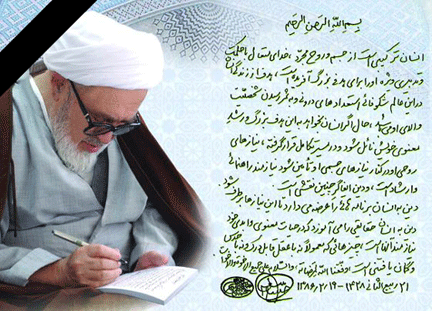
Image of the Ayatollah from his Persian website

One of the most vocal opponents of the hardliners in the Islamic Revolution and of the recent election fixing by President Ahmadinejad was the Grand Ayatollah Hossein Ali Montazeri, who has died at the age of 87. Reports of the funeral in Qum are based on eyewitnesses, since the government of Iran has forbidden journalists to cover the burial. The New York Times has a lengthy article by Robert Wirth with the following general information:

Ayatollah Montazeri was widely regarded as the most knowledgeable religious scholar in Iran, and that gave his criticisms special potency, analysts say. His religious credentials also prevented the authorities from silencing or jailing him. Last month, he stunned many in Iran and abroad by apologizing for his role in the 1979 takeover of the American Embassy in Tehran, which he called a mistake. Iran’s leaders celebrate the takeover every year as a foundational event of the Islamic revolution. Continue reading Grand Ayatollah Hossein Ali Montazeri Dies

Broken Taboos in Post-Election Iran

by Ziba Mir-Hosseini, Middle East Report Online, December 17, 2009

The on-camera martyrdom of Neda Agha-Soltan, the 26-year old philosophy student shot dead during the protests after the fraudulent presidential election in Iran in June, caught the imagination of the world. But the post-election crackdown has two other victims whose fates better capture the radical shift in the country’s political culture. One victim was the protester Taraneh Mousavi, detained, reportedly raped and murdered in prison, and her body burned and discarded. The other is Majid Tavakoli, the student leader arrested on December 8, after a fiery speech denouncing dictatorship during the demonstrations on National Student Day.

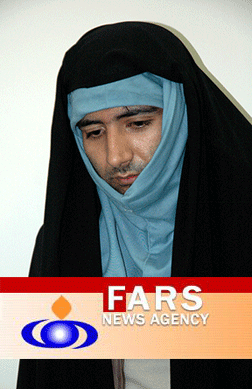
Following his arrest, pro-government news agencies claimed Tavakoli had been caught trying to escape dressed as a woman and published a series of photographs showing him wearing a headscarf and chador — a common version of the “modest” garb (hejab) mandated for women by the Islamic Republic. Attempts at flight in such gender-bending disguises are a classic trope in Iranian political history. The best-known instance was when the first president of the Islamic Republic, Abol-Hasan Bani-Sadr, after his deposition in 1981, allegedly fled the country in women’s dress — the Fars News Agency put a photo of him in a scarf next to that of Tavakoli. But in pre-revolutionary Iran clerics, too, such as Ayatollah Bayat, are said to have evaded the Shah’s authorities by concealing themselves beneath chadors, which pro-government media outlets now choose to ignore. Continue reading Broken Taboos in Post-Election Iran

Bringing al-Zabîdî to Light and to Life


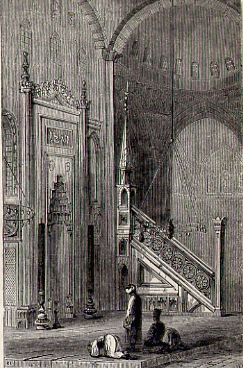
19th century Cairo mosque illustration from Henry Van-Lennep’s Bible Customs.

Those of us who spend hours using Arabic lexicons would be at a loss without the massive Tâj al-‘Arûs min jawâhir al-qâmûs of Muhammad Murtadâ al-Zabîdî. Completed by this consummate Muslim scholar in 1188/1774 after fourteen years of diligent research, the recent Kuwait edition comprises 40 volumes. Ironically, what took al-Zabîdî fourteen years to write and dictate seems a rapid turn-around, given that the Kuwait edition began in 1960 and was not completed until 2002 [There is a copy available for only £2,463 from Abe Books…, but I suggest you go to Lebanon, where the 40 volume set is only $325 from Fadak Books I am not aware of any online version of Tâj, although Lisân al-‘Arab is available online in searchable format.] Those of us who could never afford to house the 40 volume edition have managed to get by with reprints of the 19th century Cairo edition, funky font presence that it sheds. I remember buying my copy of the thick black-cover volumes in 1981, filling a suitcase with the hefty weight, paying the porter a handsome bakshish for his back-breaking effort at Cairo airport, and then having the suitcase implode from the weight as I crossed the threshhold of my home back in New York. I like to think that my own account would have made its way into al-Zabîdî’s inquisitive notes. Continue reading Bringing al-Zabîdî to Light and to Life

The Sixth War

by Gregory D Johnsen, The National, November 12, 2009

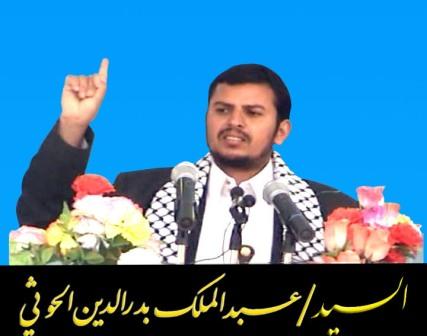
Last week, the sporadic five-year long war between the Yemeni government and Houthi fighters in the country’s north finally spilled over the border into Saudi Arabia. The conflict has been steadily escalating since the Yemeni government resumed fighting in August after more than a year of fragile calm. Leaving no doubt as to its intentions, the government calls the present campaign “Operation Scorched Earth”: the fighting has already produced thousands of internal refugees and spread outward from the northern governorate of Sadaa, where the Houthi rebels are based.

Like much of the conflict, the clashes that began on November 4 are clouded by conflicting and contradictory reports. The Houthis claim that they were responding to repeated strikes by the Yemeni military, which was using Saudi territory as a rear base to launch flanking manoeuvres into Sadaa. Saudi Arabia contends that it was responding to incursions by the Yemeni rebels, and both sides insist that the other fired the first shots.

But whatever the sequence of events, the skirmishes mark a major escalation in the messy and murky guerrilla war that has only become more intense – and drawn in an increasing number of players – since its start in 2004. The Saudis deployed troops to their southern border, where they launched air and ground assaults on pockets of Houthi fighters, purportedly to drive them back into Yemen. The intervention was meant to be a limited one – and the Saudis claim they only attacked positions on their side of the border – but it is doubtful, having joined the fray, that they will be able to extricate themselves easily. Continue reading The Sixth War

The End of Middle East History

by Richard Bulliet, Agence Global, September 28, 2009

Iran’s Arab adventure had ostensibly grown from three separate roots, Islamic revolution, Shi‘ite solidarity, and sympathy for the Palestinians. But underlying each of these was a dream dating back to the overthrow of Prime Minister Mossadegh in 1953 — the dream of confronting and confounding American imperial arrogance. Now each of the three roots withered, and confrontation with the Great Satan faded from significance along with them.

The idea of an Islamic revolution leading to an Islamic republic that would reinvigorate the faith and reveal the viciousness of Western stereotypes of Islam had lost steam before the IRI was a decade old. Internal progress had been stifled by eight years of war with Iraq and by factional infighting that sapped governmental innovation and efficiency. Though public discourse of unprecedented vitality flourished after the revolution, other intellectual and philosophical trends superseded the concept of Islamic revolution per se. However, the death knell of constructive Islamic revolution was rung on September 11, 2001 when the terrorist attacks on the World Trade Center and the Pentagon elevated nihilistic violence in the name of (Sunni) Islam above the dream of creating a model religious state in (Shi‘ite) Iran. Instead of an Islamic republic, the ideologues of the new terrorism called for an autocratic Islamic emirate or an atavistic return to a universal caliphate that had not wielded significant political power for over a thousand years. In response, Islamic political parties everywhere put behind them the idea of an Islamic republic, and with it the Iranian model, and called instead for pluralistic electoral systems in which Islamist parties would be free to run for office, but not free to disempower rival non-religious parties. Continue reading The End of Middle East History