Category Archives: Islamic Sects

On Mahometanism, 1833 style


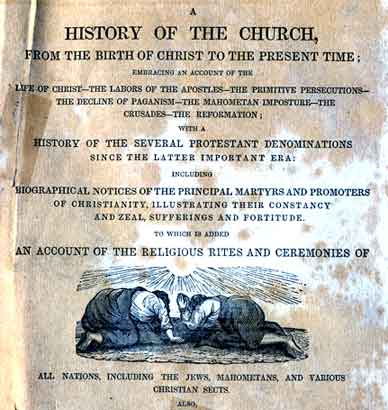
One of the books owned by a great, great aunt of mine in Cleveland was A History of the Church, etc., published in 1833. The bottom of the frontispiece is torn, so I do not know the publisher, although I suspect it was printed in Boston. It is a general history of Christianity with extended comments on other religions, including “Mahometanism.” The author is a certain C. A. Goodrich, who is decidedly Protestant and as unfriendly to Roman Catholicism as he is to Islam and Hinduism. Several parts of the text, which stretches a robust 504 pages, deal with Islam and are interesting for the biased perspective of the time. The history of the Church is according to periods, and Period V is labeled “The Rise of Mahometanism” (at the top of the pages of the chapter); the longer title is “The Period of the Rise of the Mahometan Imposture will extend from the establishment of the supremacy of the Roman Pontiffs, A.D. 606, to the first Crusade, A. D. 1095.” Period VI covers the Crusades, followed by the Reformation and then a very long chapter on the Puritans.

At the start of the section is a small lithograph of Muhammad, mounted on a steed with a sword in hand. Some of the information is descriptive; some even praises Muhammad, but it is clear that the author despises Islam as the excerpts below well show:
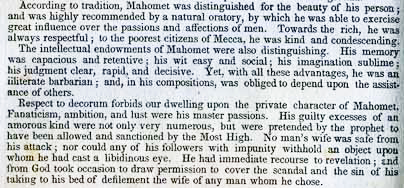

A History of the Church, 1833, p. 96
Continue reading On Mahometanism, 1833 style

New Orientalism at a German University?

By Andreas Neumann, Erlangen Center for Islam & Law in Europe (EZIRE)

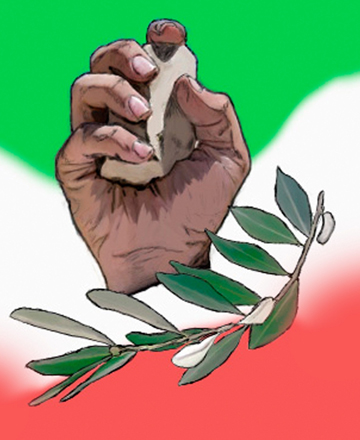
Recently, at one of the many German universities of excellence (names do not matter), students and other citizens were invited to a lecture with the title: “Stoning: a Non-Islamic tradition.” The hosts were the Seminar for Arab and Islamic Studies and the Institute of Criminal Sciences. The picture represented here is taken from the poster hanging all over the campus and also in the city. At its center, you see a huge hand on the point of casting a crude edged stone in the direction of the observer. In the foreground, there is an olive branch. The colors in the background evoke the national flag of Iran flying in wind. A short analysis might be fruitful. The picture is an example of contemporaneous stereotyped thinking and also transports a message contrary to the requirements of reason.

The hand, disambiguated by the context, symbolizes the gruesome act. It is combined with the enlarged olive branch. The olive branch was a symbol of peace in Greek and Roman antiquity, when it also was worn as an adornment by brides. Retrospectively, it was associated with Noah who sent out a dove which returned with an olive leaf in its beak (which became a branch in the Vulgate). This sign indicated that the water was receding. There might exist an older model of this image, since the association of the dove, the olive branch or even the rainbow with peace does not follow conclusively from the text. The Quran has not taken it over in its frequent references to the Genesis version of the story of the Flood (also see the account by Heinrich Speyer, Die biblischen Erzählungen im Qoran, Gräfenhainichen 1931, pp. 89-115). Nevertheless, the olive tree (by the way, in German more often called “Ölbaum”, oil tree) is cited several times in the Quran, especially in the beautiful verse of the light, Q 24:35, where the blessed olive tree in question is characterized as neither Eastern nor Western (cf. Zechariah 4:3-11). The olive branch has become an international symbol of peace and is represented on the emblem of the United Nations, where two of them symmetrically embrace a map of the world. Continue reading New Orientalism at a German University?

If Salih read the Qur’an


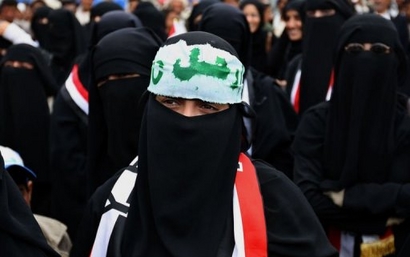
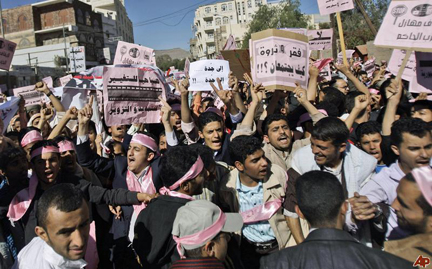
The rhetorical standoff in Yemen continues with only a limited amount of violence even while hundreds of thousands of people have been protesting, mostly against the decades-old regime of President Ali Abdullah Salih. Yesterday the New York Times commented that the protests in Yemen remain remarkably peaceful, with isolated cases of individual violence (mainly by those who support Salih) but no major clashes with the army or between tribal groups. President Salih holds a weekly rally of his supporters (some of whom have clearly been paid to come to the rally, as reporters note) as a counterpart to the far greater numbers protesting all over the country against his continued rule. He is holding on to power with a very thin string; indeed it is hardly even ‘power” any more given that much of the country is basically ignoring him and he is diplomatically isolated.

The only thing more incongruous than dictators (a military man installed in a coup after an assassination of the previous leader and who has remained in power for over three decades is at least an honorary dictator) talking about democracy is when dictators start talking about religion. Unlike Yemen’s Zaydi imams, whose millennium long rule was abolished in 1962, none of the military leaders of Yemen are noted as Quranic scholars; some could barely read and write when they came into office. Continue reading If Salih read the Qur’an

Talk on Yemen


Abdullah Hamiddaddin will be providing a lecture entitle “Whither Yemen” on Thursday, March 31, 2011 at Columbia University in 208 Knox Hall from 12:30-2:00 pm. the discussion will be about how to frame the current struggle in Yemen, the importance of tribal politics, and the overrated threat of al-Qaeda in the Arabian Peninsula. This is sponsored by Columbia’s Middle East Institute.

For more details, click here:

Sunni-Shi’a Relations in Mamluk and Ottoman Contexts


by Stefan Winter

There is a wealth of literature on Sunni-Shi’a relations relating to many periods and places of Islamic history. I attach a brief list of titles on the Mamluk and Ottoman cases with which I am familiar below.

Beyond that, however, there is probably a good reason why “this confrontation” and “its new relevance in today’s politics” is dealt more with in journalistic analyses than scholarly works. To link all instances of conflict or contact between given Sunni and Shi’a actors throughout Islamic time and space, from Pakistan to Lebanon, from Siffin to Doha, to a single ongoing confrontation, as modern observers often do, is reductionist at best.

Of course there is a fundamental theological dispute between Sunnism and Shiism and there has been no shortage of wars and communal disturbancesthat expressed themselves along sectarian lines. But such events invariably also had political and economic causes that must be investigated in their own specific context, and they should not mask the far more numerous instances when the supposed Sunni-Shii dichotomy explains absolutely nothing of, or is downright contradicted by, political events, from the Ayyubids’ tactical alliances with the Ismailis, to the Ottomans’ commercial relations with the Safavids and recourse to Shii tax farmers, to Iran’s intermittent support of Gülbuddin Hekmatiyar to the posters of Hasan Nasrallah you see all over the (conservative Sunni) suq in Aleppo today. Continue reading Sunni-Shi’a Relations in Mamluk and Ottoman Contexts

El-Aswad on Bahraini Shi’a


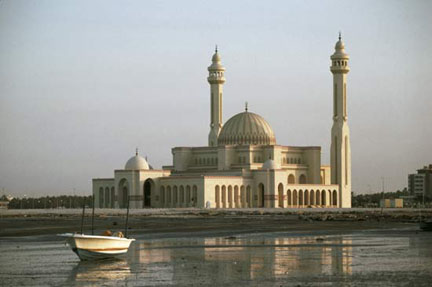
Grand Mosque in Bahrain

Tabsir contributor El-Sayed el-Aswad recently published an article entitled “The Perceptibility of the Invisible Cosmology: Religious Rituals and Embodied Spirituality among the Bahraini Shi’a” in Anthropology of the Middle East, Volume 5, Number 2, Winter 2010 , pp. 59-76. The article is available to subscribers of the journal or for purchase. The abstract is cited here:

This article analyses the relationship between the seen and the unseen in the cosmology and practices of Bahraini Shi’a. Rather than contrasting the visible and the invisible, the study delineates the hierarchical relations between them, within a whole or cosmology, as reflected in various discursive and non-discursive actions that are supported by the religious beliefs of Bahraini Shi’a. Issues of the Hidden Imam, concealment, dissimulation and other unseen dimensions of the cosmos are discussed. The article finds that the Shi’a construct the invisible in their social world by using visible ways of creatively enacting their hidden thoughts and beliefs, as represented in their religious discourses, rituals and body symbolism. Their belief in a divine higher power provides a source of emotional, spiritual and socio-political empowerment.