Category Archives: Islamic Sects

Behold the Huthis


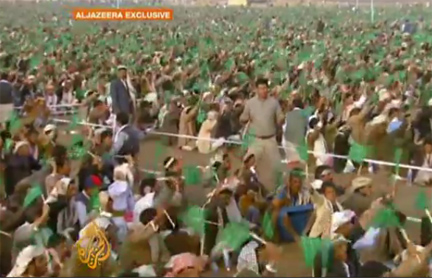
Huthi political rally near Sa’da this week

The ongoing political turmoil in Yemen has been overshadowed, and understandably so, by the increasing bloodshed in Syria, soccer riots in Egypt and lingering resistance by a few Qaddafi supporters in Libya. The past year of protests and revolution, unprophecied by political pundits, reminds me of a giant tire with so many holes that it is impossible to stop the air from escaping, even when one hole seems to be plugged. Meanwhile the road gets bumpier and bumpier in Yemen. Now for the latest recap… about-to-be-former President Ali Abdullah Salih is still in New York receiving medical treatment. He is in principle immune from prosecution, but certainly not immune from the continuing opposition to the excesses of his long rule in Yemen. A recently infused political form of Islam, known as Ansar al-Shari’a (with its own Facebook page) has all but replaced the infamous name Al-Qaida, in the south. The upcoming election, with one emerging compromise candidate for President, hardly seems headed for a democratic exercise apart from name only. Several aid workers were captured earlier this week and then released. And, behold the Huthis…

Al-Jazeera posts a video of a celebration of the Prophet Muhammad’s birthday in a remote area outside of the northern city of Sa’da. There on a platform etched against a barren landscape, a region less vibrant after almost eight years of conflict with the government that has left the ancient town of Sa’da in tatters, stood Abd al-Malik al-Huthi, the leader of the rebellion. Reports of his death at the hands of a government raid in 2009 are, as Mark Twain once noted about a premature obituary for himself, greatly exaggerated. While I do not doubt the sincerity of those present who celebrated the birth of the Prophet, the political flavor of the event certainly dominated the scenes shown on al-Jazeera.
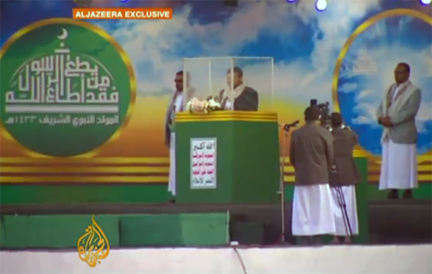

Abd al-Malik al-Huthi speaking near Sa’da this week
Continue reading Behold the Huthis

The Zaydi manuscripts of Northern Yemen


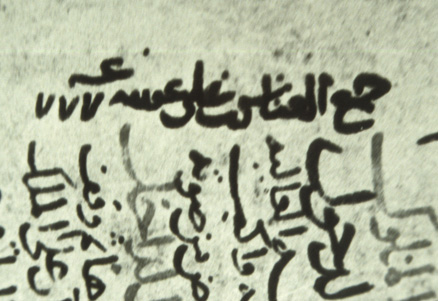
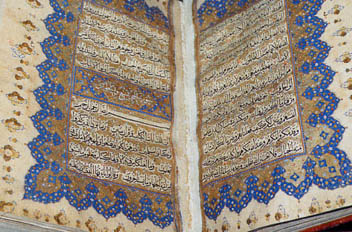
Qu’ran manuscript in Western Library of the Great Mosque, Sanaa

by Arie Amaya-Akkermans, bikyamasr, 13 December 13, 2011

In recent articles on Bikyamasr.com, it was reported at length on the diversity of cultural sites, part of Yemen’s vast cultural heritage, that were threatened with neglect and destruction, partly because of the inability of the Yemeni authorities to preserve them and partly because of the state of unrest caused by the Yemeni uprising – namely the ancient cities of Sana’a, Shibam and Zabid, in which thousands of years of rich history are likely to become yet another casualty in Yemen’s struggle for freedom from the 33-years old dictatorial rule of Ali Abdullah Saleh.

It is fortunate however that these three ancient cities are considered UNESCO world heritage sites, due to the fact that they have received attention from international organizations – most prominently the government of Germany – and some degree of action has been taken in order to minimize the damage, or at least, that was the case until the beginning of the Yemeni uprising. The extent of the real damage done to the sites in the course of 2011 remains yet to be properly assessed in a post-revolutionary scenario.

More unfortunate is the fate not only of other sites but of something much more intangible but equally valuable: The rich intellectual Islamic heritage of the country embodied in over 50000 manuscripts held in many libraries and private holdings. The astounding numbers and the nature of the manuscripts make Yemen one of the most important archival collections in the world, easily rivaling similar holdings of Islamic manuscripts in the national libraries of Cairo, Istanbul and Teheran. Continue reading The Zaydi manuscripts of Northern Yemen

Will Saudi Women Lose Their Virginity En Masse If They Start Driving?


by Melody Moezzi, MS.blog Online, December 3, 2011

My first thought is “no,” followed by a swift “none of your business.” But that wasn’t the conclusion of a recent report prepared for Saudi Arabia’s legislative assembly by a well-known academic. He predicted that if Saudi women were given the right to drive, those who had never had sex would quickly start losing their virginity as easily as they might their car keys.

Let’s start with the basics here: It’s a hell of a lot harder to lose your virginity in the front seat, as opposed to the back. Especially while driving. I mean, it’s difficult enough to text and drive.

But if that isn’t enough to sway the Saudi government, I recently polled several of my female friends, and I’ve come up with a report of my own. I submit the following report to the Saudi legislative assembly, which I suspect is far more scientific than the aforementioned prominent academic’s: NONE of the friends I polled, a large number of whom happen to be Muslim women originally from the Middle East, has lost her virginity while driving. Nor did a single one of them lose her virginity immediately after obtaining a driver’s license. Shocking, I know. Continue reading Will Saudi Women Lose Their Virginity En Masse If They Start Driving?

The Politics of Ramadan


Religion and politics have always been intertwined, even though some rituals would seem to be above the fray. Consider the fasting month of Ramadan, which has just ended. The Islamic hijra calendar is lunar with arbitrary 30-day months for a lunation which is not exactly 30 days. So determining when a month begins is linked to the sight of the new moon. Before the age of mechanical clocks it was also necessary to fix dawn by observation of the sunrise and decide at what point it was possible to say the sun had risen. In the early days of Islam the timing of Ramadan and the prayer times was based on visible signs. Scholars devised scientific and folk scientific means of telling time, but the basic premise is that a pious individual must make the call.

The Fiqh Council of North America advocates a fixed date based on modern astronomical calculation. Here is how Dr. Zulfiqar Ali Shah states it:

People have landed upon the Moon and Muslims are still fighting about the moon sighting. Islamic Shari’ah is not static. It responds to people of all times and differing circumstances. Actual moon sighting is a mean to determine Ramadan and not an objective in itself. Islam requires certainty regarding the sacred timings. During Prophetic era this certainty was achieved either through physical moon sighting or through estimation or completion of thirty days. Currently the astronomical calculations about the birth of new moon are so accurate that astronomers can determine moon birth dates years in advance. The Qur’an in Surah Yunus authenticates calendar based upon such precise astronomical calculations. “It is He Who made the sun to be a shining glory and the moon to be a light, and measured out stages for it (moon); that you might know the number of years and the calculations. (10:5) There is absolutely nothing in the Qur’an which categorically mandates actual moon sighting for confirmation or negation of Ramadan. The Qura’nic exegetes universally agree that the verse of Surah al-Baqarah (2:185) “So whosoever witnesses the month among you should fast in it” does not require physical moon sighting but mandates residential presence and knowledge of Ramadan as the legal cause of fasting. The original linguistic meanings of the word hilal revolve around announcement with loud voice, cry of joy and sharing news publicly by raising voices. The new moon was metaphorically called al-hilal because the Arabs at its first sight used to express joy and publicly announce coming of the new month. Therefore, there is absolutely nothing in the Qur’an that requires actual moon sighting as the only means of determining Ramadan. The supposed Prophetic supplications (Dua’s) at first glance of the new moon are based upon weak Ahadith. Moreover these supplications can be recited at any time the person sees the new moon first time.

A nice idea, but one that depoliticizes the timing and thus is bound to run into opposition. A case in point is Yemen. Continue reading The Politics of Ramadan

Brother, can you spare a revolution


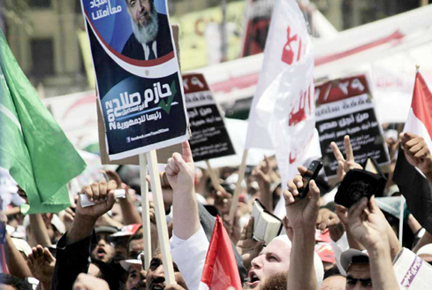
An Egyptian shouts slogans during a protest of Islamist groups at Tahrir Square, the focal point of Egyptian uprising, in Cairo, Egypt, Friday, July 29. (AP Photo/Amr Nabil)

Egypt rally not harbinger of Islamic state: analysts

By Jailan Zayan / Agence France-Presse, thedailynewsegypt.com July 31, 2011

CAIRO: A massive show of force by Islamist groups at a rally in the Egyptian capital on Friday may have showcased their organizational skills, but their actual political clout remains limited, analysts say.

Hundreds of thousands of Islamists from across the country packed Cairo’s Tahrir Square to defend what they called “Egypt’s Islamic identity” in the country’s largest protest since a revolt ousted president Hosni Mubarak in February.

But while the protest may have been visually dramatic, divisions within the Islamist groups and their lack of nationwide support are bound to restrain their strength, analysts said.

Chants calling for Egypt to “implement the law of God” rang across Tahrir in an impressive display of religious banners and slogans, dotted with Saudi flags.

Hardline Salafis (fundamentalist Muslims) in coordination with the Muslim Brotherhood have been organizing the rally for weeks, sparking fears of clashes with secular protesters who have been camped out in the square since July 8.

The sheer size of the protest appeared to have angered, and in some cases intimidated, secular activists.

But analysts say that while Friday’s rally showcased the Islamist groups’ organizational skills and their ability to mobilize members efficiently, its political impact remains limited. Continue reading Brother, can you spare a revolution

Digitalizing Yemeni Manuscripts


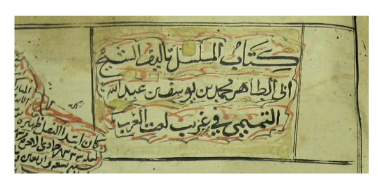
Detail from the title page of MS Glaser 20, Staatsbibliothek zu Berlin

Given the current unrest and economic turmoil in Yemen, little thought is being given to Yemen’s vast cultural heritage. But there is hope, at least for preservation of manuscripts. The German Archaeological Institute in Sanaa has recently released a report in English and Arabic entitled Preserving Yemens’ Cultural Heritage: The Yemen Manuscript Digitization Project and written by Sabine Schmidtke and Jan Thiele. This is available for reading online or as a pdf download.