Category Archives: Islamic Rituals

Veiled Voices


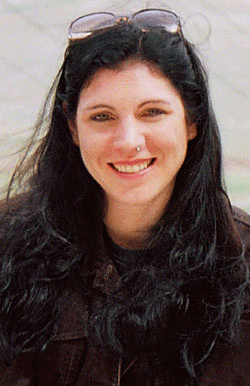
Brigid Maher, Director of “Veiled Voices”

Veiled Voices is a one-hour documentary that investigates the grassroots movement of Muslim women in the Middle East who act as religious leaders. It introduces the viewer to a world rarely seen by outsiders: the world of devout Arab Muslim women leading other women in prayers and lessons. Veiled Voices concentrates primarily on Ghina Hammoud, a divorced mother separated from her children, who has a television program and a charitable foundation in Lebanon, and Huda al-Habash, who has a loving and supportive husband and children, and runs lessons and programs in a mosque in Syria. Veiled Voices also travels to Egypt, where women struggle for public recognition in roles of authority over men; this is contrasted with Syria, where some male religious authorities, such as the Grand Mufti, are encouraging of women in leadership roles. The film shows women empowered, while exploring the struggles they face on both a personal and a public level. Continue reading Veiled Voices

The Kaaba’s New Kiswah


[Note: For a Youtube documentary on the Saudi Kiswah Factory, click here.]

By Manal Homeidan, Asharq Alawsat, December 17, 2007

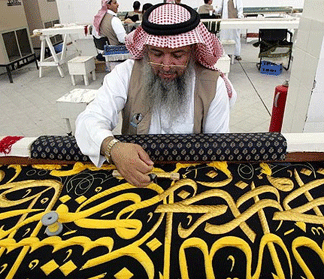
Jeddah, Asharq Al-Awsat – Following their departure from Mecca, millions of pilgrims have started to make their way to Mount Arafat. Coinciding with this unchanged ritual is the tradition of changing of the Kaaba’s ‘kiswah’, the cloth that adorns the Kaaba made of black silk and embroidered with gold calligraphy.

This event is customarily attended by the gate-keepers of the Kaaba and technicians from the Kiswah Factory, which has been manufacturing the fabric that adorns the Kaaba for the past six decades. These technicians employ a special mobile escalator so as to remove the old cloth and cover it with the new kiswah, one day before the first day of Eid ul-Adha. Continue reading The Kaaba’s New Kiswah

Keeping Mecca Flu Free

Bird Flu Measures in Place

by Faleh Al-Thibyani, The Saudi Gazette, Sunday, 25 November 2007

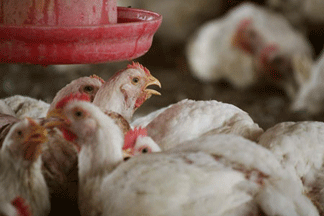
RIYADH – Measures will be in place to prevent an outbreak of avian flu in Makkah and Madina during the upcoming Haj season, a Ministry of Health spokesperson said.
Pilgrims coming from the Central Region, where the disease broke out last week, will undergo stringent medical checks, the spokesperson said.

Health Minister Dr. Hamad Al-Manie is due to attend a meeting of the Haj Preparation Committee in this regard Sunday.

Minister of Agriculture Dr. Fahd Balghunaim, meanwhile, said the public would be promptly informed about ongoing efforts to prevent the disease from spreading further.

So far, 3.5 million chickens and other birds have been culled since the disease was detected at a farm in Al-Kharj, and the ministry would not hesitate to eliminate all chickens in the Kingdom in order to protect its citizens and residents, Dr. Balghunaim said. Continue reading Keeping Mecca Flu Free

Sacrilege and Pilgrimage

One of the most odious acts for a non-Muslim to do is enter Mecca. The swash-buckling Captain Richard Burton (1821-1890) disguised himself as an Afghan (pre-Taliban, of course) Muslim and in 1853 joined pilgrims to Mecca. While not the first Westerner to sneak into the holy city, his account is the most notorious. Here is how Burton describes his participation:

“”Alhamdu Lillah!” Thanks be to God! we were now at length to gaze upon the Kiblah, to which every Mussulman has turned in prayer since before the days of Muhammed, and which, for long ages before the birth of Christianity was reverenced by the Patriarchs of the East. Soon after dawn arose from our midst the shout of ‘Labbaik! Labbaik!’ and passing between the rocks, we found ourselves in the main street of Mecca, and approached the ‘Gateway of Salvation,’ one of the thirty-nine portals of the ‘Temple of Salvation.’ Continue reading Sacrilege and Pilgrimage

Exiting Through the ‘Alley Gate’

[Note: Numerous excerpts of this popular Syrian Ramadan serial can be found on Youtube, starting with episode 1. The following is a commentary in Asharq Alawsat.]

by Mshari Al-Zaydi, Asharq Alawsat, Saturday 20 October 2007

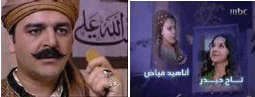
I will admit to watching the Bab al Hara (Alley Gate) series with the same fervor normally reserved for football finals. Moving from one café to another on Jeddah’s al Tahlia Street, I watched this session’s last episode. The young crowd present, dressed in t-shirts and baggy jeans, burst into a warm round of applause at the end of the show – which is quite a rare reaction among Saudi viewers.

This second-part sequel to the Syrian television series is, in fact, an undeniable phenomenon; some in Saudi even exchanged Eid ul-Fitr felicitations that were inspired by stories in the series.

But this phenomenon has reached farther and wider than just Saudi alone, many viewers in various Arab states; even Arabs living abroad, regularly tuned in and set their alarm clocks to the show’s airing time.

Perhaps this huge success is what prompted the show’s producers to make a third series for next year. Such was its popularity that even some clerics were involved in this commotion; among them was Sheikh Salah Kuftaro, son of the former late Syrian Grand Mufti Ahmad Kuftaro and the Director-General of the Sheikh Ahmad Kuftaro Academy, who publicly acclaimed the show and invited its cast to a Ramadan Iftar held in their honor. Likewise, Kuwaiti Islamist MP Walid al Tabtabai also praised the series. Continue reading Exiting Through the ‘Alley Gate’

A Qibla Query: Facing Mecca and Fasting in Outer Space


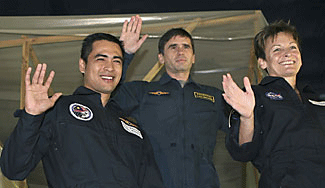
(left to right) Sheikh Muszaphar Shukor of Malaysia, Yury Malen¬chenko of Russia, and Peggy Whitson of the US will fly on a Russian rocket.

How does an Islamic astronaut face Mecca in orbit?

Decisions by a conference of Muslim leaders and scientists will help a Malaysian doctor stay observant in outer space.

By Bettina Gartner | Contributor to The Christian Science Monitor

Allah is watching – even in outer space. And that poses a problem for a devout Muslim astronaut who is scheduled to fly to the International Space Station (ISS) aboard a Russian rocket this week.

Imagine trying to pray five times a day in zero gravity while having to face an ever-shifting Mecca hundreds of miles below. How do you ritually wash yourself without water? And, now that it’s Ramadan, how do you fast from sunrise to sunset when you see a sunrise and a sunset every 90 minutes? Sheikh Muszaphar Shukor, a Malaysian astronaut, must decide before the Oct. 10 launch.

“I am Islamic,” Sheikh Shukor told a press conference in Moscow, according to the Associated Press, “but my main priority is more of conducting experiments.” Continue reading A Qibla Query: Facing Mecca and Fasting in Outer Space

Keane on Mecca


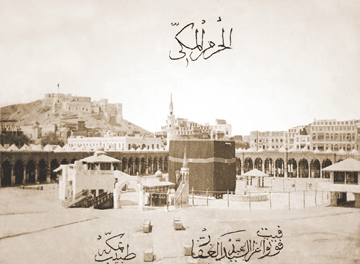
[Illustration: The ka‘ba in Mecca during the period of Ottoman Sultan Abdulhamit II.]

[Editor’s Note: As the holiest location in the Muslim World, the Arabian city of Mecca is prohibited territory for any non-Muslim. Over the years a number of travelers disguised themselves and visited the sacred enclosure of the ka’ba, most notably Johann Ludwig Burckhardt (1784-1817), who made his overture in 1812, and Richard Burton in 1853. In 1877 an Englishman named John Keane entered Mecca. His travel account is available online. Here is the story of that surreptitious visit, as told by Robin Bidwell.]

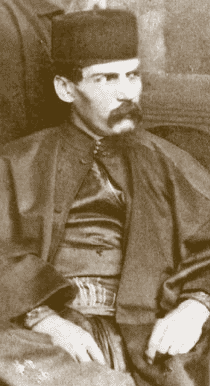
John Fryer Keane was the son of a clergyman and had run away to sea at the age of twelve. He spent most of the next nine years among Muslims, mainly as an officer on ships with Indian crews. He arrived at Jedda, attached himself to the suite of an Indian prince and after six weeks in Mecca felt as completely at home as if he had been there all his life. No one commented upon his fair skin for, as he said, the visitors were so varied that it looked like Madame Tussaud’s out for a walk and the spectacle of the Archbishop of Canterbury in a mitre would really have caused no comment. He wandered around happily, peering in through a school window to see the boys having the soles of their feet beaten in batches of five and chattering with a Muslim lady who, as Miss McIntosh, had been taken prisoner during the Indian Mutiny.

He was deeply impressed by the religious sincerity of the pilgrims and the deep spirituality that it engendered, but he cared much less for the resident population. Continue reading Keane on Mecca