Category Archives: Islamic Rituals

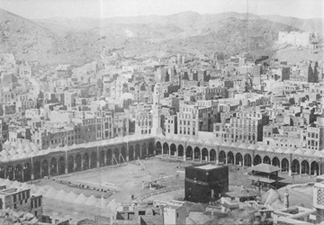
Wavell in Mecca: On Javan Muslims


[Note: Arthur John Byng Wavell (1882-1916) was a British soldier and adventurer who traveled in disguise to Mecca in 1908 and went on to Yemen in 1911 to witness fighting between the Zaydi imam’s troops and the Ottoman Turks. This account was originally published in 1912.]

Among all the pilgrims of different races daily pouring in [to Mecca on the hajj], I was most struck by the Javanese. In appearance and manners they seem not unlike the Japanese. They have the same acquisitive and imitative temperament, are intensely curious regarding everything new to them, and quick to adopt any fresh idea that may seem to them an improvement on what has gone before. In this they stand in strong contrast to the Arabs, and in fact to most Eastern peoples, whose extreme conservatism is what really hinders their progress. But while the Japanese have seemingly agreed to take England as their model, the Javanese endeavor to turn themselves into Arabs. The first thing they do on arriving is to attire themselves in the local costume – which, by the way, does not suit them at all. I am told that there are so many people wearing Arab dress in Java that a stranger might fancy himself in the Hedjaz. Continue reading Wavell in Mecca: On Javan Muslims
A Dialogue With Allah


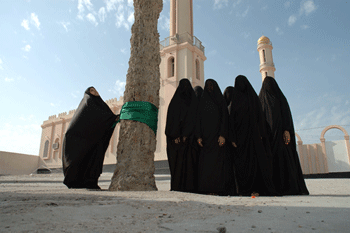
Figure 1: Mosque, women and palm tree.

By el-Sayed el-Aswad

Folk culture provides members of the society with living models in the form of iconic images, key symbols, and root metaphors that enable them to express themselves, and the other as well. Sanctity or religious meaning is bestowed on an object or place for the reason that a religiously significant event (a miracle, wonder or blessing) is associated with it.

At an art exhibition at the College of Art, Bahrain University last year, 2006, I was surprised to see very beautiful and stunning pictures in which a group of women were climbing palm trees (figure 2-5). Recognizing the cultural significance of the palm tree in Arab societies, I decided to interview Waheeda Malullah (figure 6), the artist whose photos show that the climbing of palm trees is not just aimed at the collection of dates commonly consumed in the Arab Gulf countries, but rather at the engagement in spiritual communication with invisible spheres of the cosmos and the achievement of blessing or grace (baraka), among other objectives. Continue reading A Dialogue With Allah

As the Year Ends

In a matter of hours the year 2005 will be fodder for the historians. It was a typical year in many respects, full of violence, murder, poverty, hatred and natural disasters. There were also glimmers of hope or at least rumors of hope, but these were overshadowed by the continued human tragedies and political stalemating. What else is new? For those who follow events in the Middle East and regarding the world’s one billion plus Muslim population, there is little to be thankful for apart from hope-tinged rumors. The impacts of tsunami, earthquakes, suicide bombs, airplane strikes, political rhetoric and cultural insensitivity seem to have had free reign last year. Does anyone really expect much of a change this coming year? Continue reading As the Year Ends

In Iraq, Mourning Has Broken on a Bridge to the Past

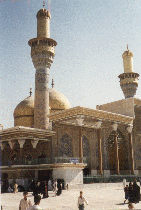
On Wednesday, Aug. 31, upwards of a thousand Muslim pilgrims died in a panic on a bridge in Baghdad. In a matter of minutes there were at least half as many fatalities as American forces have suffered so far in the entire Iraq War. This time there was no suicide bomber, but fear of an attack proved just as deadly.

The pilgrimage that left so many women and children dead was itself an act of mourning for the execution 1200 years ago of the seventh Imam in Shi’a tradition, Imam Musa ibn Ja’far al-Sadiq. Partisans believe the imam was poisoned by the fabled “Arabian Nights” Abbasid caliph Harun al-Rashid while he was in the custody of the chief of police in Baghdad. Musa ibn Ja’far lingered on for three days until achieving martyrdom in the eyes of his countless followers over the centuries. Continue reading In Iraq, Mourning Has Broken on a Bridge to the Past