Category Archives: Orientalist Images

New Orientalism at a German University?

By Andreas Neumann, Erlangen Center for Islam & Law in Europe (EZIRE)

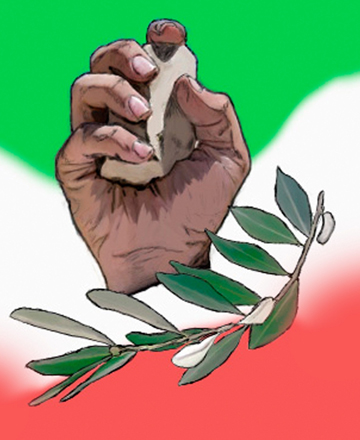
Recently, at one of the many German universities of excellence (names do not matter), students and other citizens were invited to a lecture with the title: “Stoning: a Non-Islamic tradition.” The hosts were the Seminar for Arab and Islamic Studies and the Institute of Criminal Sciences. The picture represented here is taken from the poster hanging all over the campus and also in the city. At its center, you see a huge hand on the point of casting a crude edged stone in the direction of the observer. In the foreground, there is an olive branch. The colors in the background evoke the national flag of Iran flying in wind. A short analysis might be fruitful. The picture is an example of contemporaneous stereotyped thinking and also transports a message contrary to the requirements of reason.

The hand, disambiguated by the context, symbolizes the gruesome act. It is combined with the enlarged olive branch. The olive branch was a symbol of peace in Greek and Roman antiquity, when it also was worn as an adornment by brides. Retrospectively, it was associated with Noah who sent out a dove which returned with an olive leaf in its beak (which became a branch in the Vulgate). This sign indicated that the water was receding. There might exist an older model of this image, since the association of the dove, the olive branch or even the rainbow with peace does not follow conclusively from the text. The Quran has not taken it over in its frequent references to the Genesis version of the story of the Flood (also see the account by Heinrich Speyer, Die biblischen Erzählungen im Qoran, Gräfenhainichen 1931, pp. 89-115). Nevertheless, the olive tree (by the way, in German more often called “Ölbaum”, oil tree) is cited several times in the Quran, especially in the beautiful verse of the light, Q 24:35, where the blessed olive tree in question is characterized as neither Eastern nor Western (cf. Zechariah 4:3-11). The olive branch has become an international symbol of peace and is represented on the emblem of the United Nations, where two of them symmetrically embrace a map of the world. Continue reading New Orientalism at a German University?
Orientalist Images #2


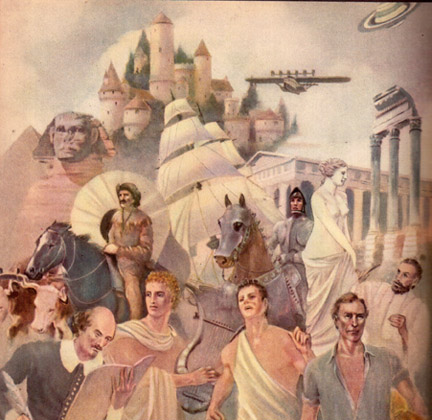
Half of the painting for the inside cover of Richards Cyclopedia, by Edwin Winfield Hall


[With this post I continue a series dedicated to photographs in an “Orientalist” mode. In addition to
Reading Orientalism, the title of my last book, the creation of an imagined Orient is very much a pictorial voyeuristic voyage. In this series I focus on Western images of the Middle East and North Africa, both those that perpetuate stereotypes and those that chip away at the bias. Readers of the blog are welcome to send in images they have found and want to share.]

I continue with an image from a 1933 edition of Richards Cyclopedia, with 24 volumes published in New York by J. A. Richards, Inc and edited by Ernest Hunter Wright and Mary Heritage Wright. This is an unusual encyclopedia, arranged by topics in a more or less arbitrary order but replete with images. The inside cover, half of which is shown above, is a collage of cultural references. Across the top one finds the beginnings of civilization (at least in the thinking of the time) in the ancient Egyptian pyramid and sphinx, with a towering medieval castle above and both a modern airplane and image of Saturn looking down on ancient Greece, where a beautiful half-naked Grecian standing odalisque butts up against a knight in shining armor. There are ships and covered wagons in this pictorial representation of manifest destiny. The part not shown is distinctively American progress, though with a Maharajah inexplicably riding an elephant in front of a giant oceanliner. Continue reading Orientalist Images #2

Orientalist Images #1: Berbers of Algeria


[With this post I start a new series dedicated to photographs in an “Orientalist” mode. In addition to Reading Orientalism (which is also the title of my last book), the creation of an imagined Orient is very much a pictorial voyeuristic voyage. In this series I focus on Western images of the Middle East and North Africa, both those that perpetuate stereotypes and those that chip away at the bias. Readers of the blog are welcome to send in images they have found and want to share.]

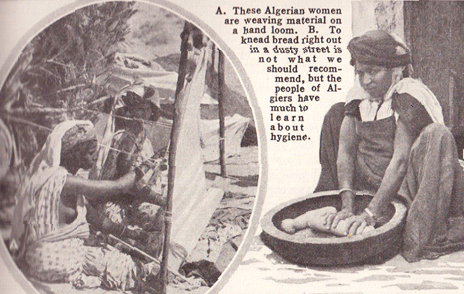
I start with images from a 1933 edition of Richards Cyclopedia, with 24 volumes published in New York by J. A. Richards, Inc and edited by Ernest Hunter Wright and Mary Heritage Wright. This is an unusual encyclopedia, arranged by topics in a more or less arbitrary order but replete with images. One of the articles is called “The Green Girdle of the Sahara” (vol 18, pp. 4631-4636). The subtitle is: “What Men Live Now along the Northern Strip of Africa, Where the Egyptians Started the Clock of History and Where Grim Carthage Used to Frown across the Sea at Rome?”

The article starts out by describing the Barbary coast and then adds this comment:

Although the Barbary Coast is not an Eastern, or oriental, country, lying as it does due south from Europe, it seems to visitors from Europe and America like a corner of the Orient. It has a religion out of the East, Mohammedanism (mô-hâm’êd-ân-îz’m). Among the farming peoples who make their living from its soil are many restless Jews and fierce Arabs, whose Eastern ways have been taken up by the native peoples. Thus the Berber of this small fertile strip treats his women folk as an oriental might treat them, and he has an oriental’s indifference to dirt. Yet the Berbers are cousins of the northern races, many of them having blue eyes and fair hair.

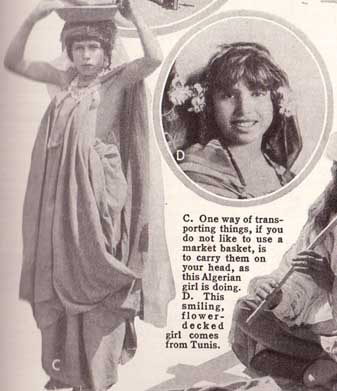
To be an Oriental outside the literal Orient, to have an indifference to dirt and to be a Mohammedan: such is the fate for the Berber in 1930’s stereotyping. The image above illustrates the sentiment of an Algerian woman who has “much to learn about hygiene.” Given the Islamic duty of ablutions before prayer and the long history of anti-bathing practice in Europe, this is a very narrow put-down indeed.


The picture immediately above shows both the hardship of being female (carrying market items on one’s head) and the beauty of the maid with flowers in her hair. Exotica über alles.

to be continued

Daniel Martin Varisco

Mocha Musings #3: Turkey and Persia


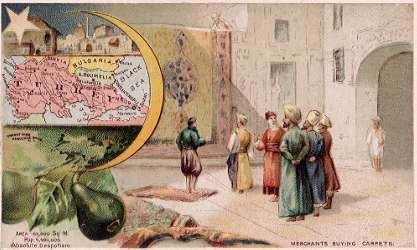
Area: 63,800 sq. mi
Population: 4,490,000
Government: Absolute Despotism
Scenes: Merchants Buying Carpets

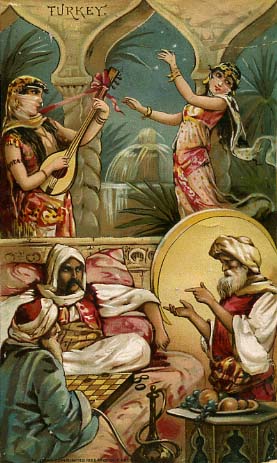
previous post I began a series on coffee advertising cards with Middle Eastern themes. One of the most colorful collections is that provided by the Arbuckle Coffee Company. In my great, great aunt’s album there were several Middle Eastern and North African nations represented, but from a different series than in the Arbuckle’s 1889 series. The 1889 version of Turkey is shown above, but my aunt’s version of Turkey is decidedly more imaginative:

Continue reading Mocha Musings #3: Turkey and Persia