Category Archives: “Arab Spring”

What the Arab papers say

The Economist has a roundup of views from the Arab press on the unfolding events in Egypt (in English translation):

THE Arab press has been following the unrest in Egypt closely since the country’s first “day of rage”, over a week ago.

In Al Shorouk, an independent Egyptian daily newspaper, Emad El Din Hussein describes the sudden disappearance of religious and political barriers that have divided Egyptians in the past decades:

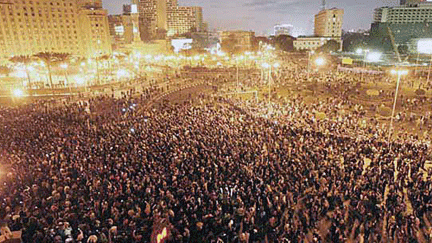
I swear by Almighty God that I cried with joy to see Egypt reborn in Tahrir Square on Tuesday night…Members of Muslim Brotherhood, Nasserists and Marxists were all present; you could recognize them from their physical appearance and the way they spoke or dressed. But they were few and far between…The majority of those present were ordinary citizens…thousands of people mingled together shouting different slogans and singing together…other demonstrators sat talking about poverty, unemployment and violation of human dignity.

Continue reading What the Arab papers say

Dawn

by Sherifa Zuhur, Sociology of Islam and Muslim Societies, February 1, 2011

I find it very difficult to assemble emotions, memories and impressions to respond to the events in Tunisia and Egypt. I have been responding sharply to others who seized the moment to offer their analysis. Certain characterizations of Egyptians did not sit well with me. I also fear that specific arguments are easily manipulated — that the centers of power who have so deftly dominated the media, huge sums of money and many segments of national elites will thwart the resurgence of popular resistance and demonstration of public will. But since those consulted by Barry and Joe and their “teams” are hard at work, spreading fear of a future Egypt non-compliant with the terms of Camp David, conjuring up the Islamist bogeyman, and (one fears) holding Hosni’s hand, we too should speak.

A group of Tunisian friends joined my Facebook page and share their jubilation and updates with me. Their example has inspired Egypt, however, to attribute events in Egypt to Tunisia, or social media and the impact of al-Jazeera would be wrong. Underlying events are Egyptians’ own lengthy struggles and perceptions that transformation is possible. To some degree, fear of counter-revolution is what froze civil expression in Egypt when the communists, the workers and the Muslim Brotherhood were each treated as intolerable threats to the Nasser government. Student activism became possible again in Sadat’s era, but firm rules were established about the “forbidden topics” (the infitah, peace with Israel, corruption, Saudi Arabia etc.) People complied, or they suffered professional defeat, exile, or worse. Then, for many years, violent attacks – against government officials, against judges, policemen, continued up to the crescendo of the firebombing of buses in Tahrir square and the massacre of tourists at Luxor. When the truce with the Gama’at Islamiyya and then Gihad Islami (Islamic Jihad) were achieved, the detentions, torture, and suspension of civilian liberties could have been lifted, but they were not. This year, I spent some time studying instances of extrajudicial actions versus what is acknowledged as state terror. Perhaps they differ in volume, but not in effect. We are speaking of drowning in cold water, the use of dogs, hanging, beatings, electrocution, and threats to family members. These were the weapons of government and are responsible, at least to some degree for the emergence of figures like Ayman al-Zawahiri. In the 2000’s as new “terror” threats emerged, the Minister of the Interior and his employees arrested thousands in the Sinai and elsewhere, and these tactics continued as well as public beatings and confrontations with demonstrators. The emergency laws were extended again, and again. Continue reading Dawn

Yemen is Not Tunisia, not Egypt

Yesterday I published a commentary on CNN Opinion about the recent protests in Yemen. I attach the start of this here, but the full account can be read at CNN.com.

(CNN) — “Yemen is not Tunisia.” These were the words that President Ali Abdullah Saleh spoke to his people on television last Sunday.

As street protests erupt in Yemen’s capital, it is not surprising that an Arab leader who has held power since a bloodless coup in 1978 would dismiss calls for his ouster.

But he was correct.

Although his regime has been accused of corruption, Saleh is no Zine El Abidine Ben Ali of Tunisia, nor even Hosni Mubarak of Egypt. Instead of using an iron fist, he has maintained power by cleverly playing off rivalries among tribal, religious and political divisions.

When he became president of North Yemen, he allied himself with Sheikh Abdullah al-Ahmar, who headed the most powerful tribal alliance in the North. After negotiating the unification of Yemen’s North with the socialist South in 1990, Saleh fostered a climate of grass-roots democratization before outmaneuvering the socialists for total control of the country.

Power is shared in Yemen largely because of the continuing local importance of tribal affiliation. This is not always understood. A major conflict near Yemen’s border with Saudi Arabia, for example, has been wrongly characterized as an Islamist rebellion. Like most political conflict in the region, the battle has religious overtones, but it is mainly over tribal autonomy…

I was interviewed this morning for the program Worldview of WBEZ in
Chicago and this interview aired today but is archived on the website.

Daniel Martin Varisco

Other despots should quail


We’ve Waited For This Revolution For Years. Other Despots Should Quail
By Mona Eltahawy, The Observer, January 29, 2011,

My birth at the end of July 1967 makes me a child of the naksa, or setback, as the Arab defeat during the June 1967 war with Israel is euphemistically known in Arabic. My parents’ generation grew up high on the Arab nationalism that Egyptian president Gamal Abdel Nasser brandished in the 1950s. But we “Children of the Naksa”, hemmed in by humiliation, have spent so much of our lives uncomfortably stepping into pride’s large, empty shoes.

But here now finally are our children – Generation Facebook – kicking aside the burden of history, determined to show us just how easy it is to tell the dictator it’s time to go.

To understand the importance of what’s going in Egypt, take the barricades of 1968 (for a good youthful zing), throw them into a mixer with 1989 and blend to produce the potent brew that the popular uprising in Egypt is preparing to offer the entire region. It’s the most exciting time of my life. Continue reading Other despots should quail

Ozymandias Redux


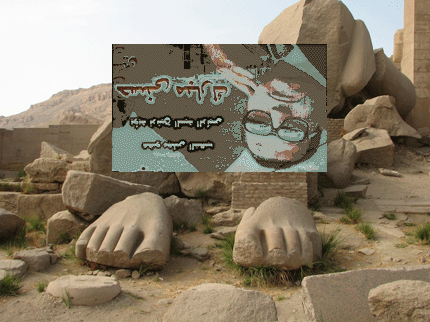
One of the great Victorian Orientalist poems, Ozymandias, was penned by Percy Bysshe Shelley almost two centuries ago in 1818. Substitute the name “Hosni Mubarakias” and experience the déjà vu that is Egypt, and indeed the entire world.

I met a traveler from an antique land
Who said: “Two vast and trunkless legs of stone
Stand in the desert… Near them, on the sand,
Half sunk a shattered visage lies, whose frown,
And wrinkled lip, and sneer of cold command,
Tell that its sculptor well those passions read
Which yet survive, stamped on these lifeless things,
The hand that mocked them and the heart that fed;
And on the pedestal these words appear:
My name is Ozymandius, King of Kings,
Look on my works, ye Mighty, and despair!
Nothing beside remains. Round the decay
Of that colossal wreck, boundless and bare
The lone and level sands stretch far away.”

The memories of past kings and pharaohs are not sacred, as looters were able to enter the Cairo Museum and damage some of the objects there. Looting is as old as the pyramids. Such was the fate with most of the pharaohs’ well concealed (and conceited) wealth for the afterlife. Now the objects preserved in the museum are also in danger.

Egypt will survive the fall of its latest pharaoh, but right now the sneer of cold command is once again sinking in the sand.

All Eyes on Egypt


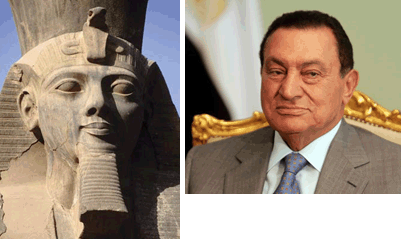
Ramses II, left; Mubarak I, right

About a month ago I visited the King Tut exhibit in New York. Here was the splendor of one of the minor pharaohs of Egypt, one that died at a very young age. Other pharaohs reigned for a lifetime, such as Ramses II who was in power over three millennia ago and ruled the mighty Egyptian empire for more than half a century. Hosni Mubarak on the Nile is no pharaoh any more than Saddam Hussein was Nebuchadnezzar on the Euphrates. Still, he has been in power almost three decades with a son said to be waiting in the wings for succession. But it is unlikely that he will match Ramses, and not simply because he would be over a century old if he did. The words of the Prophet Daniel, for a different time and place, are apt: mene mene tekel upharsin.

A Greek historian noted about the same time as Daniel that Egypt was a gift of the Nile. Not much has changed, since the vast majority of Egypt’s population lives along this river, including its delta at the Mediterranean. One of the major changes is the population density. With over 80 million Egyptians on the narrow strip along the Nile and southern Mediterranean coast, there is hardly an Egyptian more than a stone’s throw from water. When I worked on a sanitation project in 1981 for USAID, I visited a number of “villages” in the governorates of Asyut and Minufiyya. I say “villages” because of the lack of services, since some had more than 10,000 residents. At the time, as USAID was scrambling to spend development money promised to Egypt in the aftermath of Sadat signing a peace agreement with Israel, many people thought the problems in the country insurmountable. Continue reading All Eyes on Egypt

Youtubing the current wave of Egyptian protests


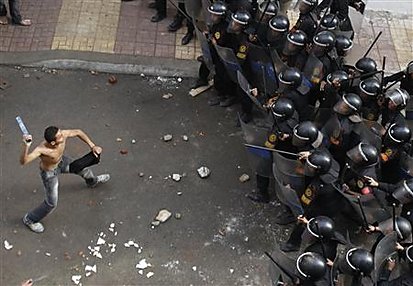
An Egyptian Christian clashes with Egyptian riot police in front of the the Coptic Orthodox church in Alexandria, 230 km (140 miles) north of Cairo January 1, 2011; Photo, Reuters

Tunisia lost a dictator and this has heartened critics of other regimes, especially with seemingly for-life leaders, to take to the streets and, nowadays, to youtube. New videos are posted around the clock. Here is one from a day ago, but you can easily follow a thread. The mainstream media always sanitize the news and views, but the amateur Youtube videos are almost always out of context and prone to exaggerate what is really going on. But there is indeed unrest in the streets and it is not yet played out. There is an account of what is going on in today’s New York Times.